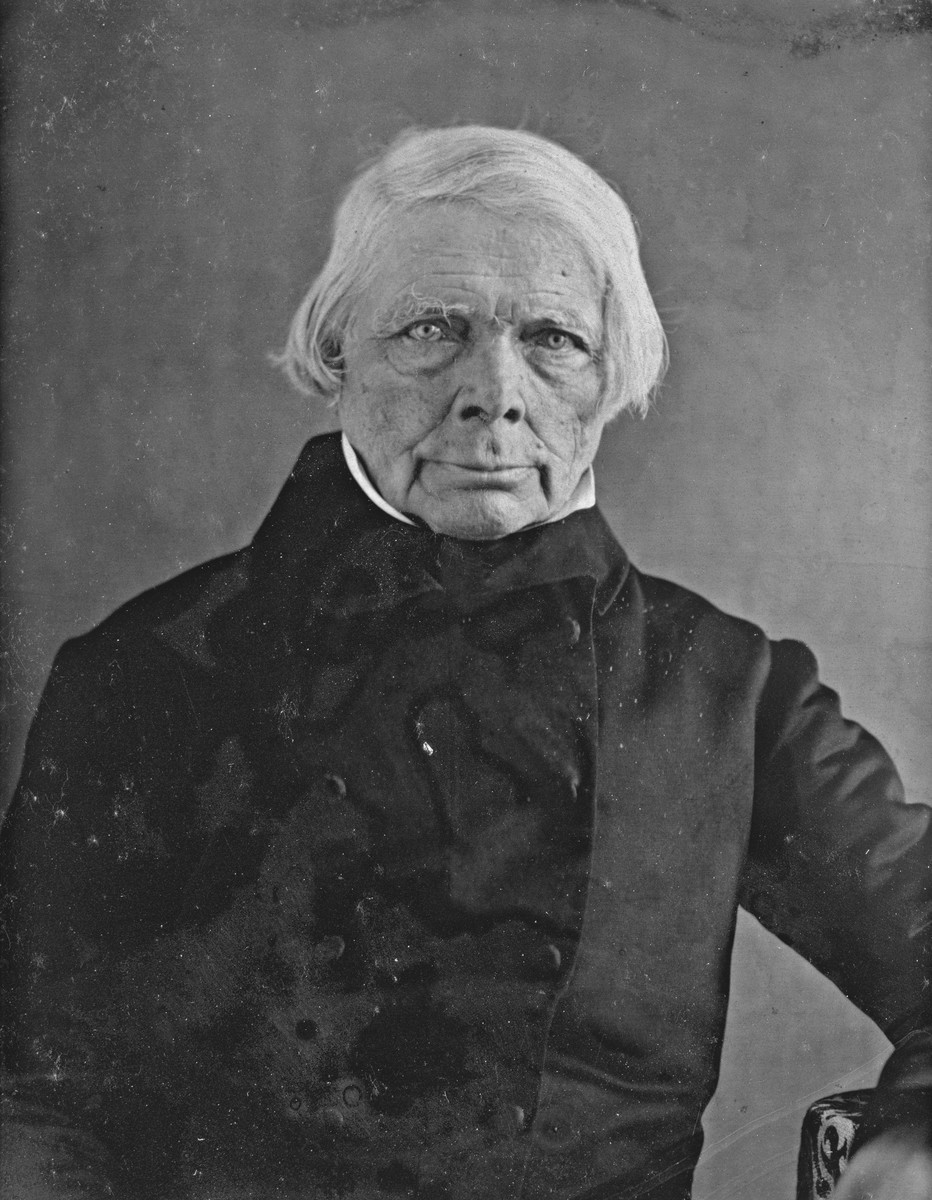
Friedrich Wilhelm Joseph Schelling
Dates: 1775–1854 Domain: Philosophy, Natural Philosophy, Theology
Biography
Friedrich Wilhelm Joseph Schelling was born in Leonberg, Württemberg, in 1775. A prodigy: he entered the Tübingen Stift at fifteen, where his fellow students included Hegel and Hölderlin; he published his first major philosophical work at eighteen; he was appointed professor at Jena at twenty-three. In the early period of his career he developed, in rapid succession, a philosophy of nature (Naturphilosophie) and a system of transcendental idealism that made him the leading philosopher in Germany — briefly the peer of, then overshadowed by, Hegel. Hegel's phenomenological dialectic proved more tractable for the institutional and political purposes of early nineteenth-century Germany than Schelling's speculative naturalism, and Schelling spent much of his middle and later life in relative obscurity.
His long life (he died in 1854, at seventy-nine) is divided into distinct philosophical periods that read almost as different thinkers. The early Naturphilosophie (roughly 1797–1800) is the immediate intellectual context: the claim that nature and spirit are not two different substances (as Descartes had argued) but two aspects of a single Absolute — nature as the unconscious production of the same productive activity that in consciousness becomes self-aware. Nature is visible spirit; spirit is invisible nature. The organic world — the fact that living beings are not merely machines but self-organizing, self-maintaining processes — is, for Schelling, the direct evidence of spirit's activity in the material world. The human being is the point where nature's productive activity becomes aware of itself.
His System of Transcendental Idealism (1800) ends with the philosophy of art: art is the highest human activity because it is the point where the conscious and unconscious activities of the absolute are reconciled — the artwork is the product of both deliberate craft and inspiration that exceeds the artist's intention, and this duality makes it a genuine expression of the Absolute in a way that no purely cognitive or purely practical activity can be. This makes Schelling the philosopher who grounds the Romantic claim about the artist as initiate: not as mystical exaggeration but as systematic philosophical argument.
His treatise Of Human Freedom (1809) is one of the most demanding texts in modern philosophy: a direct engagement with the problem of evil that refuses to dissolve it into privation (absence of good) or into logical necessity. Schelling argues that there is in God a ground, a dark will, a non-rational foundation, that is not identical with God's rational essence and that is the precondition for genuine human freedom. Without this dark ground, there could be no genuine evil (only logical error) and no genuine freedom (only the unfolding of predetermined essence). This introduces an element of genuine darkness, contingency, and tragedy into the Absolute that Hegel's dialectic systematically excluded.
The late philosophy — the Ages of the World (never completed), the Philosophy of Mythology and the Philosophy of Revelation (delivered as lectures in Munich and Berlin from the 1820s to the 1850s) — is an attempt to understand mythology not as primitive error awaiting philosophical correction but as a necessary stage in the development of human consciousness, and revelation not as irrational intrusion into rational history but as a positive content that reason requires but cannot generate from within itself. This is the project's philosophical partner for the historical argument about the Mysteries: myth is not pre-philosophy; it is a different mode of knowing with its own structure and its own necessity.
Key Works (in library)
| Work | Year | Relevance |
|---|---|---|
| System of Transcendental Idealism | 1800 | Art as the highest expression of the Absolute; the artist as the Mysteries' modern heir |
| Of Human Freedom | 1809 | The dark ground in God; genuine evil and genuine freedom as theological-philosophical problems |
| Philosophy of Mythology | 1842 (lectures) | Mythology as a necessary stage of consciousness, not primitive error |
| Philosophy of Revelation | 1854 (lectures, posthumous) | Positive philosophy; revelation as the content reason cannot generate from itself |
| The Ages of the World | 1811–1815 (uncompleted drafts) | The divine life as temporal process; the three ages of past, present, and future |
Role in the Project
Schelling is the philosopher who makes the central argument from within the mainstream of German idealism. Where Hegel dissolved mythology into philosophy (Geist recovering itself from its self-alienation in nature), Schelling preserved the irreducibility of mythological consciousness — its claim to know something that philosophical argument cannot reproduce. This is the project's position: the Mysteries are not proto-philosophy, not primitive religion waiting to be transcended by enlightened reason; they are a distinct and necessary mode of knowing that has been suppressed rather than superseded. Schelling's Philosophy of Mythology is the most systematic defense of this position in the Western philosophical tradition.
Key Ideas
- Nature as Visible Spirit: The natural world is not mere mechanism but the unconscious productive activity of the same Absolute that in human consciousness becomes self-aware; the material and spiritual are not two substances but two aspects of one.
- The Dark Ground: The irrational foundation in God that is the precondition for genuine freedom and genuine evil; the point where Schelling parts company with the purely rational Absolute of Hegel.
- Art as Highest Activity: The artwork as the product where conscious craft and unconscious inspiration converge — the point where the Absolute expresses itself most directly through human activity.
- Positive Philosophy: The claim that reason requires a positive content (revelation, myth, event) that it cannot generate from within itself; the limits of pure rationalism as a complete account of existence.
- Mythology as Necessary Stage: Mythological consciousness is not an error awaiting correction but a distinct mode of being-in-the-world with its own coherence and its own contribution to the development of consciousness.
Connections
- Influenced by: Fichte (early idealism), Kant (the critical limits of reason), FIG-0022 Goethe (Naturphilosophie and the living organism), Böhme (the dark ground), Plotinus (via the Absolute)
- Influenced: FIG-0002 Barfield (Schelling's philosophy of myth and consciousness development is a direct predecessor), FIG-0047 Novalis (mutual influence), Kierkegaard (attended Schelling's Berlin lectures in 1841), Heidegger (late Schelling is a major influence)
- In tension with: Hegel (the alternative systematic completion of German idealism; their rivalry structured the entire subsequent history of German philosophy), rationalist theology
Agent Research Notes
[AGENT: perplexity | DATE: 2026-03-22] Schelling's dates are confirmed 1775–1854. He outlived Hegel by twenty-three years but was philosophically eclipsed by him within Germany for most of that period. His lectures at Berlin (1841–1842) were attended by Kierkegaard, Engels, Bakunin, Burckhardt, and Ranke — an extraordinary gathering of the intellectual future of Europe. The standard modern edition of the collected works is the Historisch-kritische Ausgabe (Frommann-Holzboog, 1976–). The best English introduction is Andrew Bowie's Schelling and Modern European Philosophy (1993). The Philosophy of Mythology and Philosophy of Revelation are now available in English translation (SUNY Press).