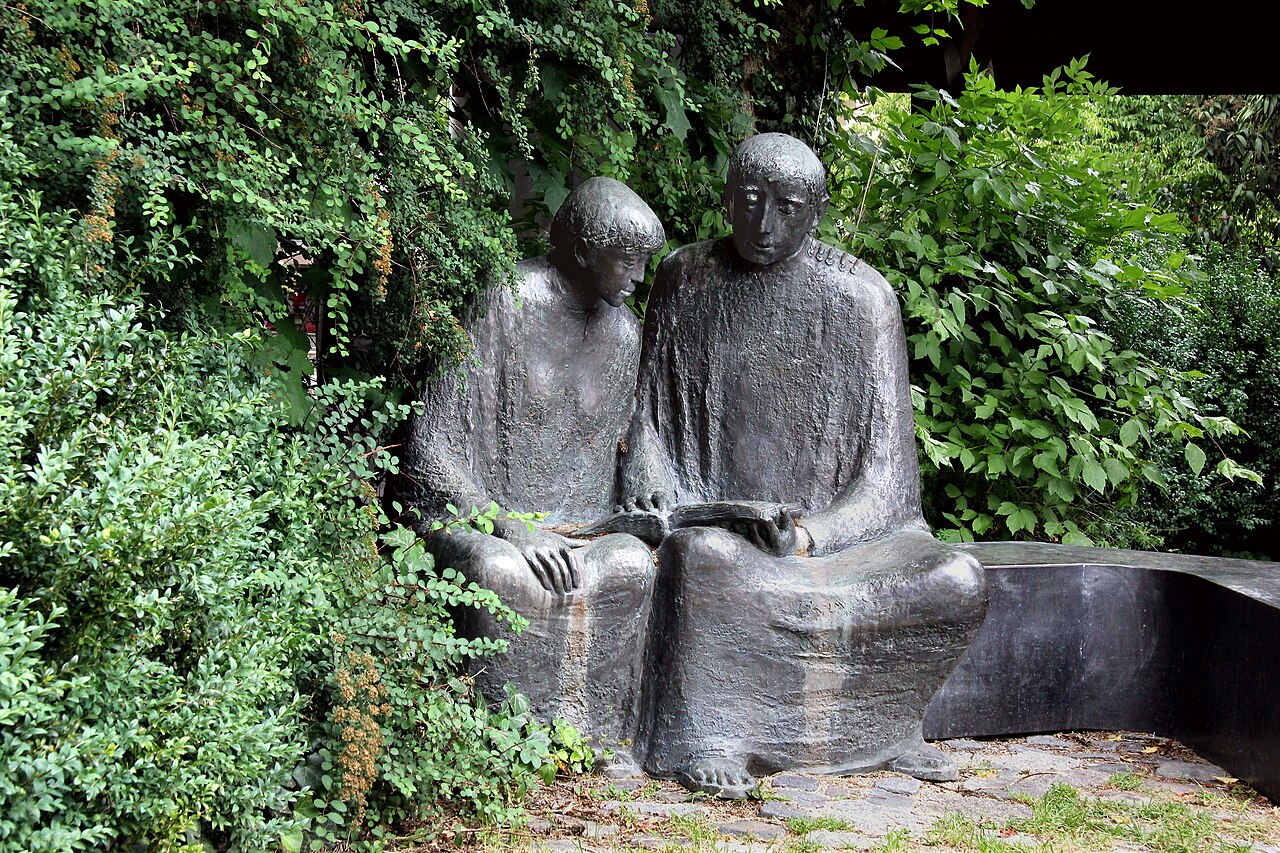
Meister Eckhart
Dates: c. 1260–c. 1328 Domain: Mystical Theology, Philosophy, Apophatic Tradition
Biography
Meister Eckhart von Hochheim was born around 1260 in Hochheim, Thuringia (central Germany). He entered the Dominican Order and rose to become one of its most distinguished theologians and administrators: he twice served as prior of the Saxon province, taught theology at Paris (twice, an unusual distinction), and served as Vicar General of the Bohemian province. In his later life he preached extensively in the vernacular to laypeople and communities of nuns in the Rhineland — and these vernacular sermons are where his most radical thinking is concentrated. Toward the end of his life, inquisitorial proceedings were initiated against him at Cologne and then at Avignon. He died around 1328, before the proceedings were complete. In 1329, Pope John XXII issued the bull In agro dominico, condemning twenty-eight propositions from Eckhart's work, seventeen as heretical, eleven as dangerous and suspect. Eckhart had submitted to the Church's authority before his death, but the posthumous condemnation meant that his work circulated underground for centuries.
His thought is notoriously difficult to summarize because it operates at multiple registers simultaneously: as scholastic theology (the Latin works), as vernacular mystical preaching (the German sermons), and as something between them that does not fit either category cleanly. The central claim — stated repeatedly in the German sermons with different metaphors but always the same underlying assertion — is that the ground of the human soul (Grunt in the German; Funklein or "spark" in other contexts) is identical with the ground of God (Gottheit: the Godhead, as distinct from the God who creates and governs). This is not a claim about a union that can be achieved through spiritual practice; it is a claim about an identity that is always already the case but normally hidden. The task of spiritual life is not to create this union but to recognize it — to allow the accidental features of the self (its attachments, its images, its willing) to fall away, leaving the groundless ground that was always there.
The concept of Gelassenheit (often translated as "detachment," "letting-be," or "releasement") is Eckhart's name for the disposition that allows this recognition. It is not the renunciation of the world in the monastic sense, though it includes that; it is the abandonment of all attachment to one's own spiritual achievement, all images of God, all concepts of the divine. This includes the most pious images: "I pray God to free me from God" (Ich bitte Gott, daß er mich quitt mache Gottes) — which is not blasphemy but the apophatic logic pressed to its conclusion. Every concept of God, no matter how elevated, is still a concept, a human production, and must be released if the Godhead (which is beyond all concepts, including the concept of "God") is to be encountered.
Heidegger's concept of Gelassenheit — which he explicitly borrowed from Eckhart — is the key connection for the project. In his 1955 memorial address "Gelassenheit" and in "The Question Concerning Technology," Heidegger uses the term to describe the disposition of openness toward Being that is neither passive resignation nor aggressive domination — the willingness to let things be what they are rather than forcing them into the framework of technological will. The continuity from Eckhart to Heidegger is not merely terminological; the same underlying problem is at stake: how to maintain genuine openness to reality in the face of the systematic closure that both Christian dogmatism (in Eckhart's time) and modern technological thinking (in Heidegger's) impose.
The Rhineland mystical tradition that Eckhart anchored — continuing through Johannes Tauler, Henry Suso, and the anonymous Theologia Germanica — is one of the central examples of a living initiatory stream flowing through an institutional religious context without being contained by it. The vernacular sermons were addressed to a literate but non-clerical audience, primarily communities of women religious (Beguines), who were themselves living in a semi-institutional, semi-charismatic space. The underground character of this transmission — the persecution, the pseudonymous texts, the circle of devoted readers — mirrors the structure of the Mysteries in a different key.
Key Works (in library)
| Work | Year | Relevance |
|---|---|---|
| German Sermons (Predigten) | c. 1290–1328 | The radical vernacular teaching; the ground of the soul and Gelassenheit |
| Talks of Instruction (Reden der Unterweisung) | c. 1294–1298 | Practical spiritual guidance; the accessible entry to Eckhart's thought |
| The Book of Divine Consolation | c. 1308–1313 | Written for a bereaved queen; the theology of suffering and the divine ground |
| Latin Works (Opus Tripartitum) | c. 1311–1326 | The scholastic philosophical framework underlying the vernacular sermons |
Role in the Project
Eckhart is the primary example of the apophatic tradition as a form of initiated knowledge — as a practice that systematically dismantles all concepts, images, and comfortable positions to arrive at something that cannot be articulated but can be enacted. His condemnation illustrates the fundamental tension between mystical experience and institutional religion: the experience of the identity of the human ground with the divine ground is, from an institutional perspective, dangerous — because it makes the institution's mediation superfluous. The one who has found the Godhead in the ground of the soul does not need the priest, the sacrament, or the bishop. This is why mystics who press far enough always encounter institutional resistance, and Eckhart's condemnation is the paradigm case.
Key Ideas
- The Godhead (Gottheit): The divine beyond God — the groundless ground beneath the personal God who creates and governs; accessible only through the total abandonment of all concepts, including all concepts of "God."
- The Ground of the Soul (Grunt): The deepest level of the human being, which is not personal but identical with the divine ground; always present, normally hidden by the accidental features of the self.
- Gelassenheit (Releasement): The radical disposition of letting-be — releasing all attachments, including attachment to spiritual progress and to one's own concepts of the divine.
- The Spark (Funklein): An alternative metaphor for the ground of the soul — the divine fire in the human being that cannot be extinguished by sin or ignorance, only obscured.
- Birth of the Word in the Soul: The dynamic model of the Trinity reinterpreted as the continuous event in which the divine Logos is born in the soul that has cleared itself of all obstacles — the initiatory birth as theology.
Connections
- Influenced by: FIG-0010 Pseudo-Dionysius (the apophatic tradition), Thomas Aquinas (Dominican scholasticism — which Eckhart both absorbed and exceeded), Albert the Great, Neoplatonism via Proclus
- Influenced: FIG-0013 Heidegger (Gelassenheit), Johannes Tauler, Henry Suso, the Theologia Germanica, Nicholas of Cusa (FIG-0020), the Rhineland mystical tradition generally
- In tension with: Pope John XXII (who condemned twenty-eight propositions), the institutional theology of the personal God, modern Protestantism (which inherited some of his themes in distorted form)
Agent Research Notes
[AGENT: perplexity | DATE: 2026-03-22] Eckhart's dates are uncertain; c. 1260–c. 1328 is the standard estimate. The bull In agro dominico was issued March 27, 1329, after Eckhart's death. The standard modern edition of Eckhart's works is the Deutsche Forschungsgemeinschaft edition (Kohlhammer, 1936–). The best English translation is by Maurice O'C. Walshe (revised by Bernard McGinn, 2009). Bernard McGinn's multi-volume The Presence of God (especially Vol. 4, The Harvest of Mysticism in Medieval Germany) is the essential scholarly context. Heidegger's use of Gelassenheit is in Gelassenheit (1959) and in several lectures from the 1940s–1950s.