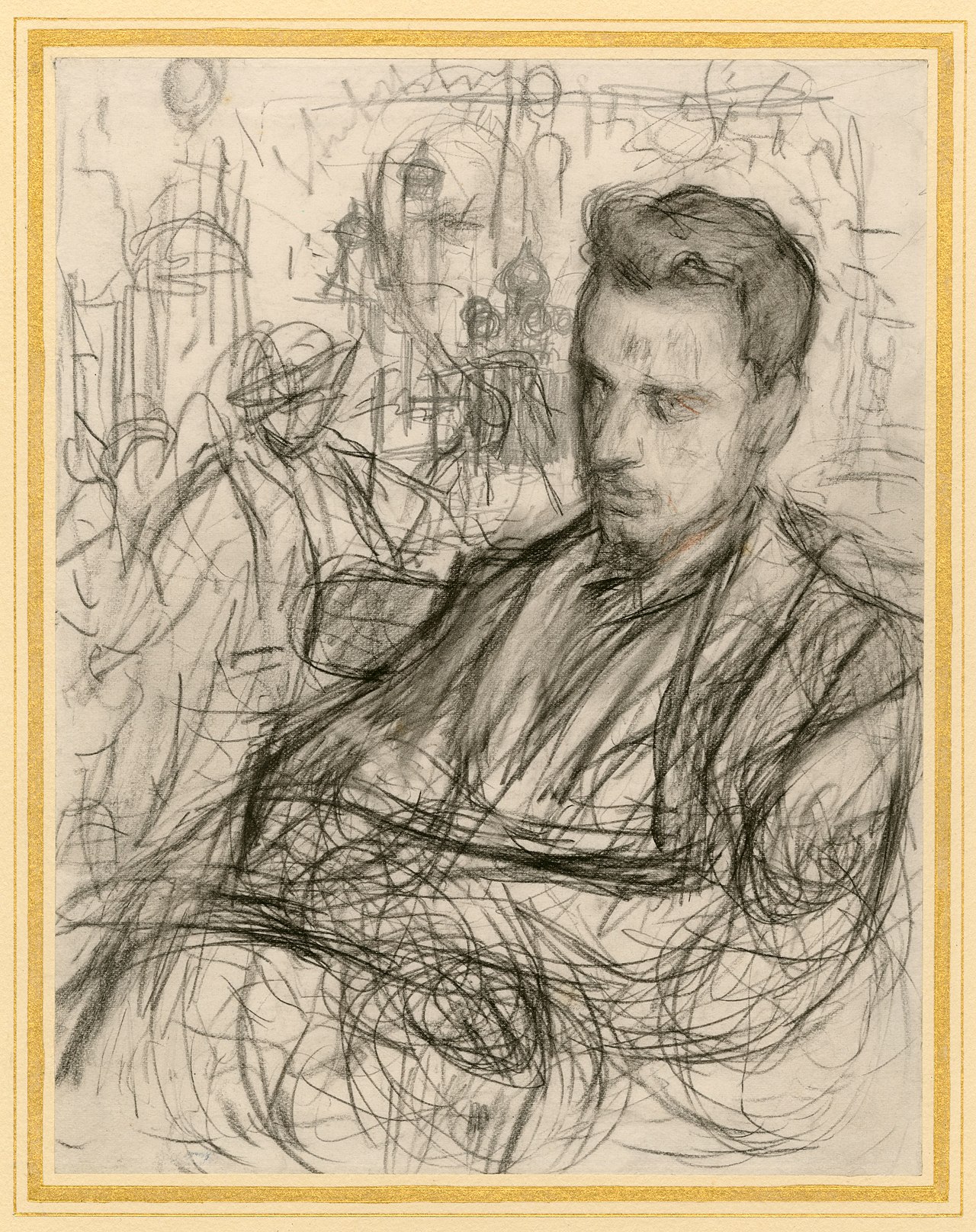
Rainer Maria Rilke
Dates: 1875–1926 Domain: Poetry, Aesthetic Philosophy, Mystical Anthropology
Biography
Rainer Maria Rilke was born in Prague in 1875, the son of a disappointed railway official who sent him to military school as a child — an experience of institutional coercion that left permanent marks on his understanding of what the human soul requires to develop. He escaped military life through illness, studied at Prague, Munich, and Berlin, traveled to Russia twice with Lou Andreas-Salomé (a brilliant, difficult woman who understood him perhaps better than anyone and declined to let him destroy himself in devotion to her), and spent much of his adult life in the peculiar arrangement of the artist as guest in aristocratic households — including the Castle of Duino, belonging to Princess Marie von Thurn und Taxis-Hohenlohe, where in February 1912 he heard, he said, a voice in the wind say: "Who, if I cried out, would hear me among the order of Angels?"
That line became the opening of the Duino Elegies, which he spent a decade completing — not because he was composing continuously but because the work required a transformation he could not force. The first two elegies came quickly at Duino; then years of struggle and partial completion; then the miraculous final completion in February 1922 at the Château de Muzot in Switzerland, when all ten elegies and the fifty-five Sonnets to Orpheus arrived within days. He described the completion as a dictation — the poems given rather than made. He died four years later from leukemia, his hands wounded by a rose thorn.
The Duino Elegies are ten long poems addressed to angels — but Rilke's angels are not comforting intermediaries. They are "almost deadly birds of the soul" — beings of pure intensity who inhabit a mode of existence from which the human is excluded. The first elegy's opening question — who would hear a human cry among the angels? — is answered by the elegies' sustained meditation: the angels cannot hear us because we are too tentative, too divided between our awareness and our avoidance of death. The tenth elegy's closing image — the young dead man asking the Lamentations to show him the origin of joy, and the Lamentation pointing to the spring that rises at the foot of the mountain of primal sorrow — gives the project its most precise modern image for the relationship between descent into grief and the recovery of what is most alive.
Key Works (in library)
| Work | Year | Relevance |
|---|---|---|
| Duino Elegies | 1923 (begun 1912) | The angelic order as initiatory demand; the human's particular task within the whole |
| Sonnets to Orpheus | 1923 | Orpheus as the model of the consciousness that transforms through singing |
| Letters to a Young Poet | 1929 (posthumous) | Practical philosophy of the artistic vocation; negative capability in German form |
| The Notebooks of Malte Laurids Brigge | 1910 | The modern consciousness in Paris; learning to see as initiatory discipline |
Role in the Project
Rilke's specific contribution to the Romantic Counter-Revolution series is the phenomenology of what it costs a consciousness to maintain itself at the threshold between the human and the angelic — neither avoiding the angel's demand nor being destroyed by it. His concept of the "Open" (das Offene) — the mode of awareness available to animals and perhaps to the newly dead, in which being is not divided against itself by the consciousness of its own end — is the negative definition of what the human consciousness, in its initiatory transformation, might move toward.
No other figure in the KB makes the incapacity of the human consciousness its explicit subject with this kind of philosophical precision. The Elegies are not lamentation about the human condition; they are an investigation of what the human condition, accepted without evasion, reveals about the role of consciousness in the whole. The angel does not need our praise; the human's particular task is to transform the visible into the invisible through love and attention — to say of a thing that it was here, that it was seen, that we held it and praised it before it disappeared.
Key Ideas
- The Angel: Not a religious figure but an ontological one — the order of being that has completed what the human is still attempting. Not consoling but demanding. The first line of the Elegies is not rhetorical; it is a genuine question about audibility.
- The Open: The mode of awareness in which being is not divided against itself — available to animals, to the unconscious, perhaps to the dying. The human's access to it comes through love and through the full acknowledgment of transience.
- Transformation of the Visible: The human's specific task in the Elegies: to take the visible world — the house, the bridge, the fountain, the gate — and transform it through love and attention into the invisible. To be the brief bearers of the world to its own depth.
- Orpheus as Model: In the Sonnets, Orpheus is not the figure who fails (looks back, loses Eurydice) but the figure who descends and returns as song — who survives dismemberment because the song is not in the body. He is the model of the consciousness that transforms through art.
Connections
- Orphic tradition: FIG-0037 Orpheus (the Sonnets to Orpheus directly address the mythological figure)
- Romantic lineage: FIG-0047 Novalis (German Romantic mystical poetry as direct precursor), FIG-0022 Goethe (Rilke read and was influenced by Faust)
- Modernist parallels: FIG-0081 Eliot (both produce their central works in the early 1920s as responses to the same cultural catastrophe, by different routes)
Agent Research Notes
[AGENT: perplexity | DATE: 2026-03-22] Rilke died December 29, 1926 at Val-Mont sanatorium. The leukemia was diagnosed only in October 1926; the cause of death was long obscured. The story of hearing the voice at Duino in February 1912 is documented in his letters and in Princess Marie's memoir. The final completion of the Elegies and the Sonnets at Muzot in February 1922 took approximately three weeks (February 2–20 for the Elegies, with the Sonnets arriving concurrently). Ralph Freedman's Life of a Poet (1996) is the standard English biography.