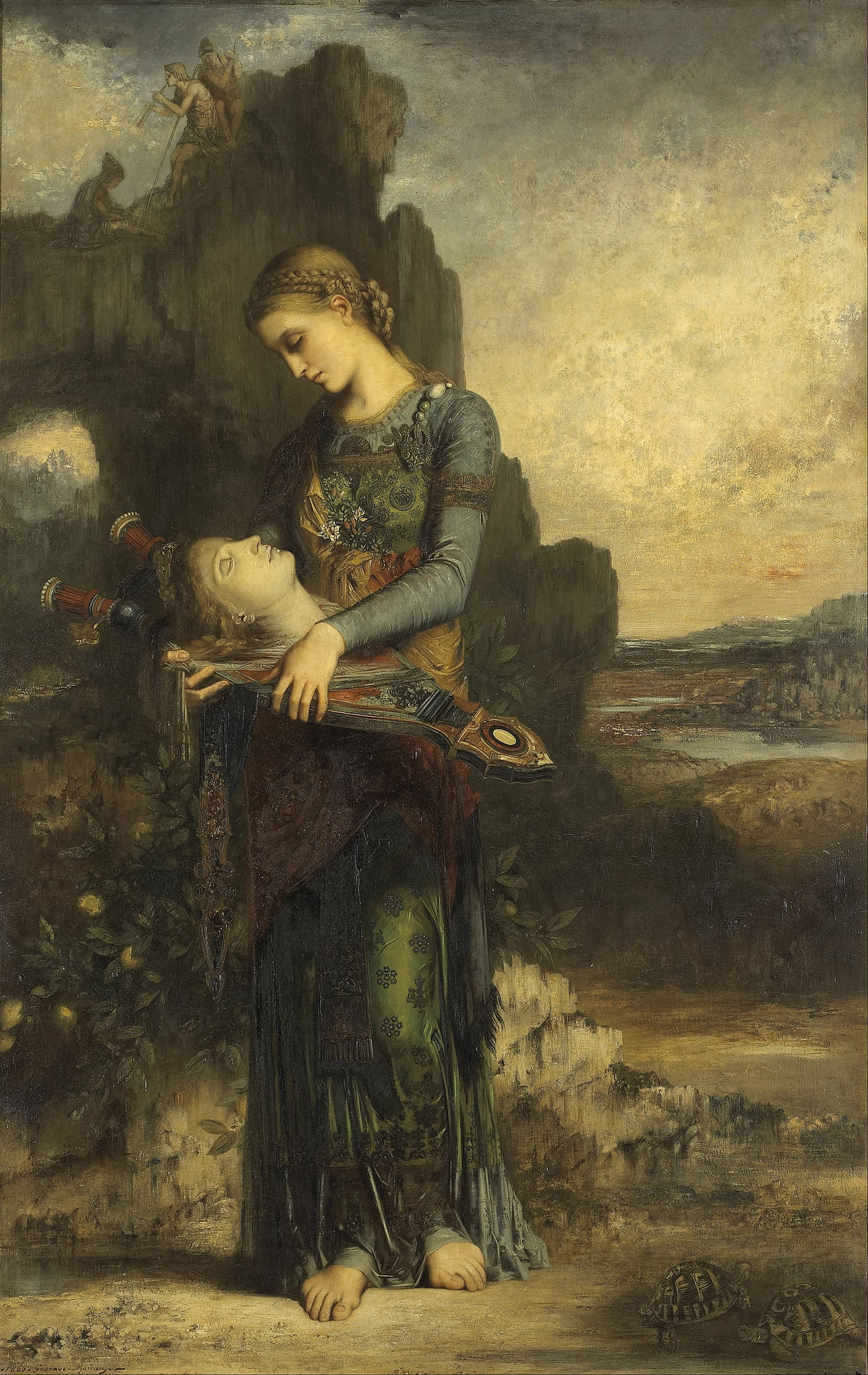
Orpheus
Dates: Mythic Domain: Mythology, Mystery Religion, Poetry, Music
Biography
Orpheus is not a historical figure but a mythological one — traditionally identified as a Thracian poet and musician, son of the Muse Calliope, whose music was so perfect that it moved stones, tamed wild animals, and altered the course of rivers. His biography is entirely mythological, and the project engages him on those terms: the myth tells us something true about the structure of experience that historical biography cannot capture. The Orpheus legend has two main strands, and both are essential.
The first strand is the katabasis — the descent to the underworld to recover Eurydice. Orpheus's wife Eurydice is killed by a snake on their wedding day. Orpheus descends into Hades — an act that was, in ancient Greek understanding, reserved for the dead and for extraordinary heroes — and plays his music before Persephone and Hades, who are moved to allow Eurydice to return to the living on the single condition that Orpheus not look back at her as they ascend. He cannot sustain this. At the last moment, at the threshold of the upper world, he turns. She is returned to death. He emerges alone. The myth does not give us a reason for the backward look — jealousy, doubt, love, the sheer unbearable proximity of what he might have had — and the indeterminacy is significant. The failure is not explained away. It stands as a permanent ambiguity at the center of the story, because it encodes a genuine problem about the limit of what the descending initiate can recover intact.
The second strand is the Orphic mysteries and the Orphic literature. Beginning at least in the sixth century BCE, a tradition of initiatic practice circulated under Orpheus's name, offering a path of purification and post-mortem transformation different from the mainstream of Greek religion. The gold tablets — small inscribed sheets of gold found in tombs across the Greek world from the fifth century BCE onward — give instructions to the soul of the deceased on how to navigate the underworld: which waters to avoid (the spring of Lethe, forgetfulness), which water to drink (the spring of Memory, Mnemosyne), what to say to the guardians, how to claim divine ancestry. "I am a child of Earth and starry Heaven; my race is of Heaven" — the dead person asserts divine origin against the assumption that death ends the story. These tablets presuppose both a belief in the soul's persistence and a specific initiatic instruction available in life that prepares the soul for what it will face.
The Orphic cosmogony — preserved in fragments and in later Neoplatonic accounts — describes a creation narrative in which the primordial god Phanes (or Protogonos) emerges from a cosmic egg, containing within himself the seeds of all subsequent beings. This is the oldest known egg cosmogony in the Greek tradition, and it has clear parallels to Egyptian, Persian, and Vedic creation accounts — evidence, the project notes, for the deep currents that run beneath national religious boundaries.
Orpheus's music is not incidental to his theological significance. That his music could move all of nature, stones, rivers, the dead themselves, encodes a claim about the ontological power of sound that runs through Pythagorean music theory, Hermetic practice, and into the Indian concept of nada brahman (the universe as sound). Music in the ancient world was not entertainment but cosmology in practice: the right proportions, performed correctly, put the performer and the listener in alignment with the proportions of the cosmos itself. This is why Plato wanted to regulate what modes musicians could play in the ideal city — not because he was a prude but because he took the claim about music's power seriously.
Key Works (in library)
| Work | Year | Relevance |
|---|---|---|
| Orphic Gold Tablets | 5th century BCE onward | Direct evidence for the Orphic initiatic path and post-mortem navigation |
| Orphic Hymns (attributed) | c. 2nd–3rd century CE (compiled) | The liturgical text of the Orphic tradition |
| Orphism and Greek Religion (Guthrie) | 1935 | The standard twentieth-century scholarly account |
Role in the Project
Orpheus is the project's figure of the founding katabasis — the moment at the origin of the Western esoteric tradition when a human being descends into the underworld not to accept death but to contest it, and returns changed by the failure of that contest. His story is the template for every katabasis the project traces, and his failure, the backward look, is the template for every limitation that the initiatory enterprise encounters. The project is not about success stories; it is about what happens when human beings attempt to bring back from the depths something that cannot survive the light of day in its original form. Orpheus brings back not Eurydice but the music of loss: he becomes the poet of grief, the one who can articulate the inarticulable, which may be more important than what he failed to retrieve. The project argues that this transformation of loss into art, or philosophy, or sacred practice, is itself a form of the Return.
Key Ideas
- Katabasis: The voluntary descent into the underworld — the willingness to face death, disintegration, and the loss of everything recognizable, as the condition for any genuine transformation.
- The Backward Look: The failure at the threshold — the moment of return at which something essential is lost; the irreversibility of certain thresholds in the initiatory journey.
- Gold Tablets as Initiatic Technology: Written instructions for the soul's post-mortem navigation, presupposing initiatic preparation in life; the initiation continues after death.
- Music as Cosmological Power: Sound structured in the right proportions acts on the cosmos because the cosmos is itself structured by the same proportions; music is not metaphor but operative practice.
- Orphic Cosmogony: The creation from the cosmic egg as the earliest Greek account of a universe produced by a single divine principle expressing itself in sequential manifestations.
Connections
- Influenced by: Egyptian and Phrygian religious traditions, pre-Socratic cosmology
- Influenced: FIG-0035 Pythagoras (the Orphic-Pythagorean connection is well-documented; the gold tablets use Pythagorean language), FIG-0034 Plato (the Orphic myths appear repeatedly in the dialogues), the Eleusinian Mysteries, the entire Western katabasis tradition
- In tension with: Mainstream Olympian religion (which accepted death's finality), Platonic rationalism (which inherited the Orphic content but sublimated it)
Agent Research Notes
[AGENT: perplexity | DATE: 2026-03-22] The gold tablets have been edited and translated by Alberto Bernabé and Ana Isabel Jiménez San Cristóbal (Instructions for the Netherworld, 2008) and by Fritz Graf and Sarah Iles Johnston (Ritual Texts for the Afterlife, 2007). The most important scholarly monograph is Walter Burkert's Ancient Mystery Cults (1987), which covers the relationship between Orphic and Eleusinian traditions. Virgil's Georgics IV (29 BCE) and Ovid's Metamorphoses X (8 CE) are the primary literary sources for the Eurydice myth. The Orphic gold tablets were found at sites across Greece, southern Italy, and North Africa — confirming that the Orphic tradition was genuinely pan-Mediterranean.