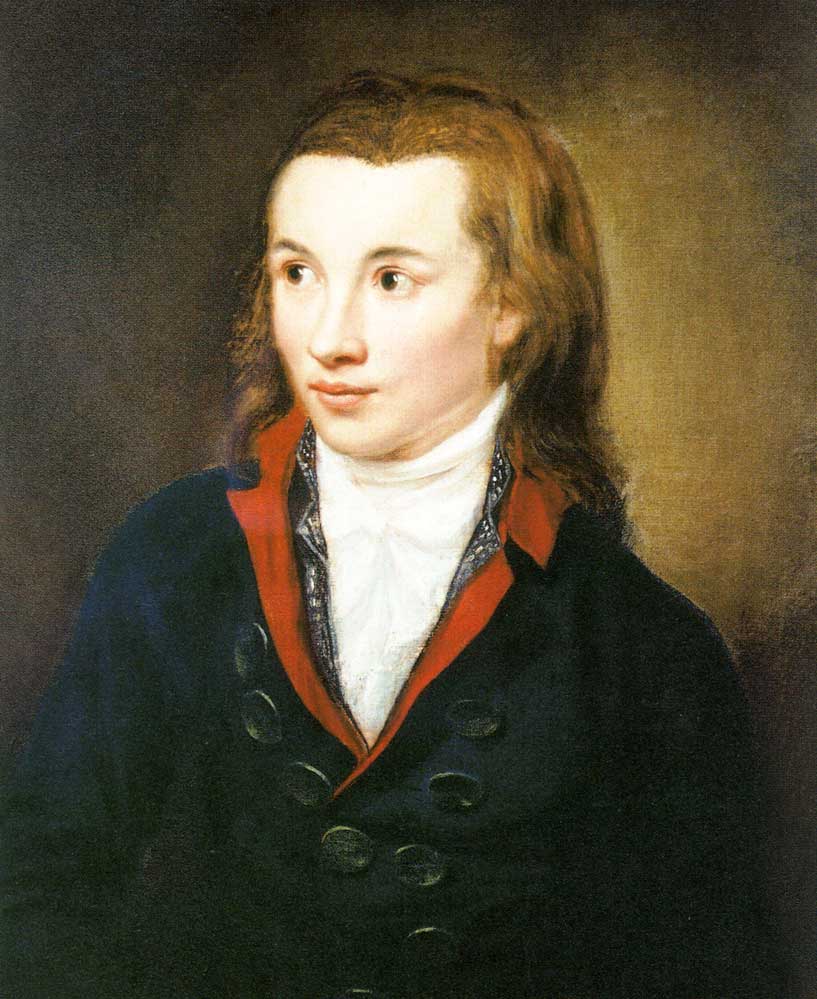
Novalis
Dates: 1772–1801 Domain: Poetry, Philosophy, Natural Science, Romanticism
Biography
Georg Philipp Friedrich von Hardenberg — who wrote under the pen name Novalis ("the one who works new ground") — was born in Oberwiederstedt, in Saxony, in 1772 into a Pietist family of minor Saxon nobility. His education was exceptional: he studied at Jena, where he attended Schiller's lectures, formed a close friendship with Friedrich Schlegel, and absorbed Fichte's philosophy of the self-positing ego with the intensity of someone who recognized in it the philosophical statement of something he already knew from within. He worked as a practical mining engineer and salt-mine administrator — not in spite of his philosophical and poetic ambitions but as an expression of them: the miner who descends into the earth to find the hidden ore is one of Novalis's central symbolic figures.
The decisive biographical event was the death of his fiancée Sophie von Kühn in 1797, at the age of fifteen, after a prolonged illness during which Novalis spent much of his time at her sickbed and then, after her death, at her grave. The experience produced a complete transformation of his consciousness — what he described as the decision to follow Sophie, to descend into death and return transformed — that is directly encoded in the Hymns to the Night (1800). The Hymns are the great Romantic poem of death, transfiguration, and the creative relationship to darkness: Night is not the mere absence of light but a positive presence, the ground of being from which light emerges, the principle of interiority and depth against the exteriority and surface of Day. The poem moves from grief to mystical transformation to a vision of death as passage rather than end.
Novalis's philosophical program, developed in fragments and notes (the Pollen collection of 1798 is the most accessible entry), is what he called magischer Idealismus — magical idealism. Against Fichte's purely theoretical idealism (in which the self posits the world through cognitive activity), Novalis argued that the imagination, properly cultivated and disciplined, is capable of actual effects on the world — not through psychological influence but through the ontological power of the image. This is the claim Barfield would later restate as "final participation": the disciplined imagination, in the person who has genuinely worked on the self, is an organ of ontological contact with reality.
His unfinished novel Heinrich von Ofterdingen (1802, published posthumously) is organized around the symbol of the Blue Flower — a flower that the protagonist, a young poet, dreams of and then spends his life seeking. The Blue Flower is not a specific thing; it is the symbol of the infinite longing that points beyond every finite satisfaction toward something that cannot be named but that gives all particular beauties their meaning. It became the central symbol of German Romanticism — but for Novalis it was specifically initiatic: the quest for the Blue Flower is a quest for the transformation of consciousness that the Mysteries had taught was the human calling.
His fragment The Novices at Saïs (unfinished, published posthumously) is a philosophical novella set in an Egyptian temple of knowledge, in which students are taught by a master who insists that the unity of human and nature can only be known by one who has overcome the separation between subject and object. The unveiled figure at Saïs (borrowed from Schiller) is the symbol of the natural truth that destroys the unprepared beholder and transforms the prepared one into the sage. This is an initiatic scenario in explicitly Eleusinian language, applied to the epistemology of natural science.
Key Works (in library)
| Work | Year | Relevance |
|---|---|---|
| Hymns to the Night | 1800 | The great Romantic poem of death-transformation and the positive nature of darkness |
| Pollen (Blüthenstaub) | 1798 | Philosophical fragments; the most concentrated statement of magical idealism |
| Heinrich von Ofterdingen | 1802 (posthumous) | The Blue Flower as the symbol of the initiatory quest |
| The Novices at Saïs | 1802 (posthumous) | The Egyptian mystery school as epistemological allegory |
Role in the Project
Novalis is the Romantic who most fully made the connection between the Mysteries and the question of how we know the natural world. His magical idealism is not mysticism dressed up as philosophy; it is a genuine epistemological claim: that the knowing self is implicated in what it knows, and that the quality of knowledge available depends on the quality of the knower. Novalis makes this claim in the context of natural science (the mine, the laboratory, the study of geology and chemistry) — anticipating Goethe's participatory science and Barfield's theory of final participation, and showing that the Romantic tradition is not anti-scientific but the carrier of a different concept of science.
Key Ideas
- Magical Idealism: The imagination as an ontological power — not merely a subjective faculty producing images, but an instrument of genuine reality-transformation in the person who has worked sufficiently on the self.
- The Blue Flower: The symbol of infinite longing and the initiatory quest — the irresolvable aspiration toward a depth of being that no finite object can satisfy but that all genuine beauty points toward.
- Night as Ground: Night (death, darkness, interiority) as the positive source from which light and life emerge — against the Enlightenment's equation of light with truth and darkness with ignorance.
- The Minerologist-Initiate: The miner who descends into the earth as a figure for the philosopher who descends into the depths of consciousness; practical natural science and mystical initiation as the same gesture.
- Romantic Encyclopaedism: The attempt to unify all sciences, arts, and religions into a single synthetic vision — the most recent form of the prisca theologia project, adapted to post-Kantian philosophy.
Connections
- Influenced by: Johann Gottlieb Fichte (the idealist philosophy), FIG-0022 Goethe (the example of the unified artist-scientist), Jacob Böhme (the mystical tradition), FIG-0048 Schelling (mutual influence)
- Influenced: FIG-0002 Barfield (final participation as the theoretical elaboration of Novalis's magical idealism), FIG-0048 Schelling (mutual; the age difference is small), the Romantic tradition generally
- In tension with: Kantian limits on knowledge (Novalis pushed against the thing-in-itself as an unnecessary barrier), the disenchanted science of mechanism
Agent Research Notes
[AGENT: perplexity | DATE: 2026-03-22] Novalis's dates are confirmed 1772–1801. He died of tuberculosis on March 25, 1801. The Hymns to the Night were first published in the journal Athenäum (1800). Heinrich von Ofterdingen and The Novices at Saïs were published posthumously by Ludwig Tieck and Friedrich Schlegel. The standard German edition is the Schriften (Stuttgart, 1960–). The best English translation of the Hymns is by Dick Higgins (McPherson and Co., 1984). Barfield's discussion of Novalis is in Romanticism Comes of Age (1944) and scattered through his later work. Novalis's mining work is documented in Alexander Košenina's biographical research.