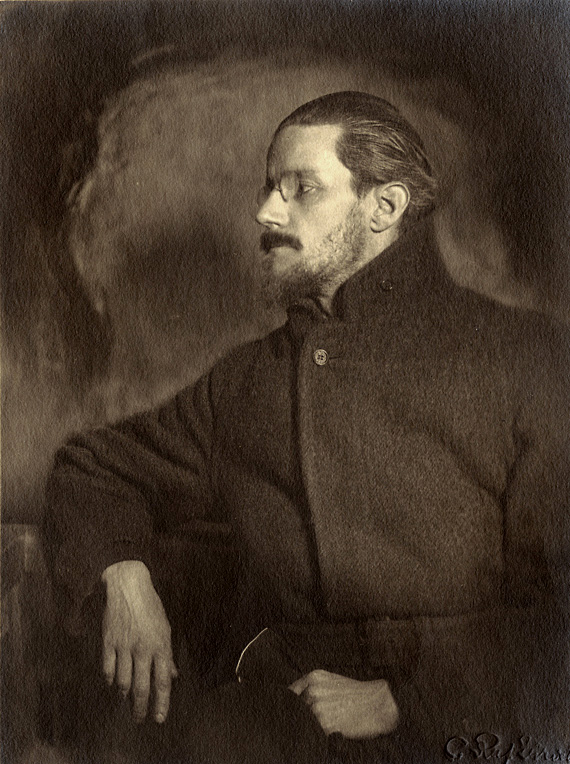
James Joyce
Dates: 1882–1941 Domain: Fiction, Literature, Epic Narrative
Biography
James Joyce was born in Dublin in 1882 and left it as definitively as possible — departing for Paris in 1904, spending the rest of his life in Trieste, Zurich, and Paris — while making Dublin the substance of everything he wrote. The paradox is the subject of his career: a man who rejected Irish Catholicism, Irish nationalism, and Irish literary life with systematic completeness, who structured his masterwork on an ancient Greek epic while setting it in the city he had abandoned, who believed that to write truly about Dublin he had to see it from far enough away that he could see all of it.
A Portrait of the Artist as a Young Man (1916) is the record of Stephen Dedalus's formation and departure: his passage through Catholic faith, crisis, aesthetic vocation, and the decision to "forge in the smithy of my soul the uncreated conscience of my race." The final section is Stephen's journal, fragmentary, preparing for departure. The novel's structure is initiatic: the hero is separated from his community by his vocation, passes through a liminal period of transformation, and departs toward the work that will incorporate what he has become. That he reappears in Ulysses as not yet having written anything is Joyce's ironic comment on the gap between initiation received and work accomplished.
Ulysses (1922) takes place on June 16, 1904 — the day Joyce first walked with Nora Barnacle, which is why Bloomsday is celebrated on that date. Leopold Bloom, a Jewish advertising canvasser, moves through Dublin over the course of eighteen hours; Stephen Dedalus, young, bereft, brilliant, moves through the same city on parallel tracks that occasionally intersect. The Homeric structure — each episode corresponding to an episode in the Odyssey — is not merely decorative. Bloom's visit to Dignam's funeral (the Hades episode) is a genuine katabasis; the Circe episode in Nighttown is the Circe encounter, a hallucinatory descent into unconscious material; and Bloom's return home to Molly in the final episodes is the Nostos, the homecoming. Molly Bloom's final unpunctuated monologue, "yes I said yes I will Yes", is the primary modern text for the feminine ground of being to which the initiatic descent ultimately returns.
Finnegans Wake (1939) is another matter: a work of such concentrated linguistic difficulty that it functions less as a novel than as a score for a consciousness that has synthesized all myth, all history, and all the cycles of sleep and waking into a single river of language. HCE (Here Comes Everybody) is the fallen man who is also every fallen man; ALP (Anna Livia Plurabelle) is the river that carries everything away and returns it. The Wake is beyond summary; it must be performed or read aloud to be accessed at all.
Key Works (in library)
| Work | Year | Relevance |
|---|---|---|
| Ulysses | 1922 | Homeric katabasis structure in secular modernism; Bloom's odyssey as initiatory day |
| A Portrait of the Artist as a Young Man | 1916 | The artist's initiatic formation; separation from community through vocation |
| Finnegans Wake | 1939 | Cyclical history, dream consciousness, mythological totality |
Role in the Project
Joyce's contribution to the Modern Labyrinth series is the demonstration that the Homeric initiatory structure survives in secular modernism when a writer of sufficient intelligence and knowledge deploys it consciously. Unlike Kafka — whose characters are denied the initiatic completion — Bloom completes his journey: he descends into Nighttown, confronts what he has suppressed, and returns home to Molly. The ending is not triumphant (Bloom enters the marital bed; Molly's monologue confirms his cuckolding; he sleeps) but it is real. The labyrinth is navigated. This is the Modern Labyrinth series' argument against pure Kafkaesque diagnosis: the structure is available even now, even in secular form, if the work is done.
Key Ideas
- Epiphany: Joyce's early concept — "a sudden spiritual manifestation, whether in the vulgarity of speech or of gesture or in a memorable phase of the mind itself" — of the moment when an ordinary object or event reveals its essential nature. This is the secular equivalent of hierophany: the eruption of the sacred into the ordinary.
- Stream of Consciousness: The technical innovation of following subjective experience in its actual moment-to-moment texture rather than in retrospective narrative order — an attempt to render the phenomenology of consciousness as it actually occurs.
- The Secular Nostos: Bloom's return home is unheroic (he finds evidence of Molly's infidelity), but it is a return. The initiatic closure is available even in a secular, ironic, modern form. This is Joyce's answer to modernism's pessimism.
- Molly's Yes: The closing monologue's affirmative, "yes I said yes I will Yes", is Joyce's feminine ground of being, the acceptance of existence that underlies all the masculine striving of the novel's daylight sections.
Connections
- Homeric foundation: FIG-0068 Homer (Odyssey as the structural template for Ulysses)
- Modern Labyrinth series: FIG-0074 Kafka (labyrinth with no exit vs. Joyce's labyrinth navigated), FIG-0087 Borges (the labyrinth as metaphysical condition)
- The stream and the consciousness: FIG-0021 Jung (Joyce and Jung were in Zurich simultaneously; Jung wrote the first analysis of Ulysses and treated Joyce's daughter Lucia)
Agent Research Notes
[AGENT: perplexity | DATE: 2026-03-22] Ulysses was serialized in The Little Review beginning 1918; published as a book by Sylvia Beach (Shakespeare and Company, Paris) February 2, 1922. Bloomsday (June 16) derives from Joyce and Nora's first walk on June 16, 1904. Jung's essay on Ulysses was published in Europäische Revue in 1932. Jung treated Lucia Joyce for schizophrenia; Joyce resisted the diagnosis throughout. Richard Ellmann's biography James Joyce (Oxford, 1959; revised 1982) is definitive.