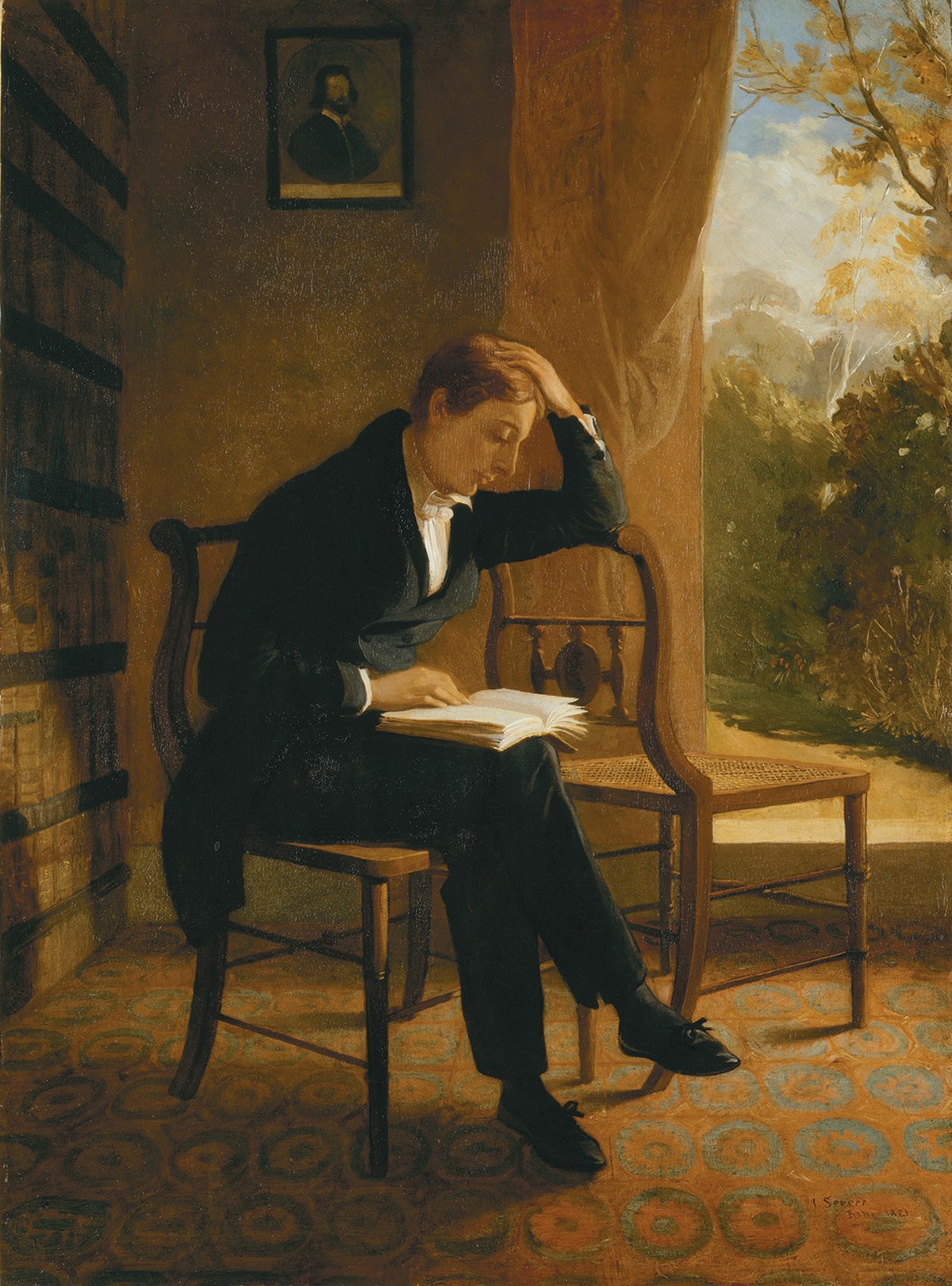
John Keats
Dates: 1795–1821 Domain: Poetry, Romantic Aesthetics, Consciousness Studies
Biography
John Keats was born in London in 1795, the son of a livery stable keeper. He was the shortest-lived of the major Romantics and, by one measure, the most purely gifted — a man who had approximately three years of full poetic productivity before tuberculosis killed him in Rome at twenty-five. The poetic maturation is compressed and extraordinary: in 1817 he published his first volume to ridicule; by 1819, twenty-four years old, he had written almost all the poems the world knows him by, including the great odes, The Eve of St. Agnes, and the two versions of Hyperion. The Letters he wrote during this same period are among the most philosophically acute documents of the Romantic movement.
The concept of negative capability appears in a letter of December 1817 to his brothers, written after seeing the Christmas pantomime with Coleridge. Keats noticed something in the experience of meeting a man of "Negative Capability" — "when a man is capable of being in uncertainties, Mysteries, doubts, without any irritable reaching after fact and reason." He identified Shakespeare as the supreme example: a consciousness that could inhabit experience fully without the need to resolve it into a system. The contrast is with Coleridge, who "would let go a fine isolated verisimilitude caught from the Penetralium of mystery, from being incapable of remaining content with half-knowledge." This is a precise formulation of what the project calls participatory epistemology: the capacity to remain in contact with what is real without the extractive gesture that pins it down and kills it.
The Odes of 1819 are his worked examples. Ode to a Nightingale holds the experience of a bird's song, which seems to come from outside time, against the poet's awareness of his own mortality and the cessation of beauty. It does not resolve the tension: the final question ("Was it a vision, or a waking dream? / Fled is that music: — Do I wake or sleep?") leaves the experience exactly as it was — unresolved, hovering, real. Ode on a Grecian Urn addresses the permanence of figures on the urn — a youth who will never stop pursuing, a girl who will never be kissed — and concludes with two lines that have generated more commentary than almost any other two lines in the language: "Beauty is truth, truth beauty, — that is all / Ye know on earth, and all ye need to know." Whether these lines are a philosophical claim or a dramatic statement assigned to the urn, and whether they are true or are the sublime overreach of a consciousness intoxicated by its own perception, is a question the project holds open rather than settling.
The Fall of Hyperion, the later and more explicitly initiatory version of the Hyperion project, stages the poet's ascent to the shrine of the goddess Moneta — a katabasis upward, a confrontation with the face of suffering that must be endured before the poet can write. Moneta lifts her veils and shows the poet a face that contains all human suffering — it is the initiatory encounter with what cannot be looked away from.
Key Works (in library)
| Work | Year | Relevance |
|---|---|---|
| Odes (Nightingale, Grecian Urn, Psyche, Melancholy, Autumn) | 1819 | Negative capability as poetic practice; beauty and transience held in productive tension |
| The Fall of Hyperion | 1819 (unfinished) | Katabasis and initiatory encounter; the poet's confrontation with Moneta |
| Letters | 1816–1820 | Philosophical commentary including the negative capability formulation |
Role in the Project
Keats is the Romantic Initiates track's philosopher of the threshold. Negative capability is not a pleasant concept about tolerating uncertainty; it is a disciplined cognitive posture that keeps the mind in genuine contact with experience rather than replacing experience with the mind's own categories. This is what Barfield calls final participation — not the naïve original participation of archaic consciousness but the achieved participation of a consciousness that has passed through the subject-object split and come out the other side, maintaining contact with the world without being dissolved by it.
The Letters are the primary source for Keats, alongside the poems, because they show the philosophy being worked out in real time rather than in retrospect. Keats was twenty-two when he formulated negative capability. He had three more years to live and write. What he produced in those years is what happens when the formulation is tested in practice.
Key Ideas
- Negative Capability: The capacity to remain in "uncertainties, Mysteries, doubts, without any irritable reaching after fact and reason." The epistemological posture that keeps the mind in genuine contact with experience rather than replacing it with conceptual certainties.
- Beauty is Truth: The Ode on a Grecian Urn's final claim — whether a philosophical thesis or the urn's own statement — that beauty and truth are identical. This is Keats's poetic version of what Plato's Symposium argues through dialectic.
- Moneta's Veil: In The Fall of Hyperion, the goddess whose veiled face the poet must earn the right to see — and when the veils are lifted, what is revealed is the accumulated suffering of all humanity. The initiatory encounter with what cannot be avoided.
- Vale of Soul-Making: From the letters: the world is not a vale of tears to be escaped but a vale of soul-making — the conditions in which souls are formed through what they suffer and what they perceive. This is Keats's version of the initiatory argument for the necessity of descent.
Connections
- Romantic Initiates track: FIG-0078 Shelley (Promethean fire vs. Keatsian negative capability), FIG-0090 Coleridge (Coleridge as the contrasting figure in the negative capability letter itself), FIG-0047 Novalis (parallel Romantic mystical poetics from the German tradition)
- Philosophical framework: CON-0024 Negative Capability (the concept entry to which this biography is foundational), FIG-0002 Barfield (final participation as the philosophical framework for what Keats practiced)
Agent Research Notes
[AGENT: perplexity | DATE: 2026-03-22] Keats died February 23, 1821 in Rome. The negative capability letter is dated December 21, 1817, addressed to George and Thomas Keats. The Odes were written between April and September 1819; all published in the 1820 volume Lamia, Isabella, The Eve of St. Agnes, and Other Poems. The Fall of Hyperion was abandoned unfinished. Robert Gittings' John Keats (1968) is the standard biography. Helen Vendler's The Odes of John Keats (Harvard, 1983) is the finest close-reading analysis.