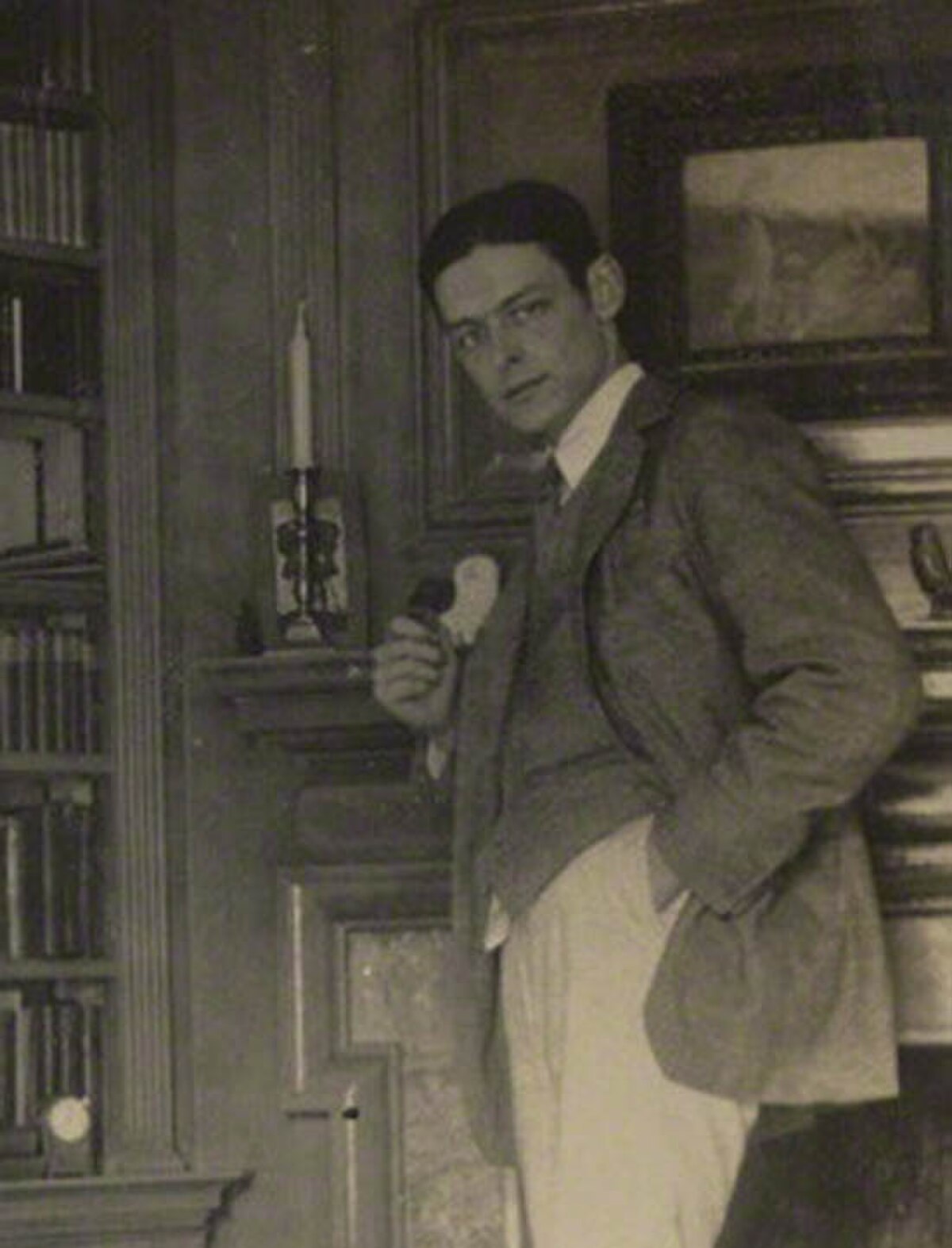
T.S. Eliot
Dates: 1888–1965 Domain: Poetry, Literary Criticism, Cultural Criticism
Biography
Thomas Stearns Eliot was born in St. Louis, Missouri, in 1888, and arrived at Harvard in 1906 as a philosophy student of exceptional gifts — he read Sanskrit, studied under George Santayana and Bertrand Russell, wrote a doctoral dissertation on F.H. Bradley's idealism, and became a British subject in 1927. His early career as a philosopher was abandoned for poetry after his encounter with Pound's work, and by 1922, when The Waste Land was published, he had produced the most influential single poem of the twentieth century.
The Waste Land (1922) is structured around the Fisher King mythology — the king whose wound makes the land barren, whose healing (in the Grail legends) restores fertility — and Jessie Weston's then-recent study From Ritual to Romance (1920), which argued that the Grail legend descended from ancient fertility cults. Eliot's poem does not tell the Grail quest; it inhabits the Waste Land itself, the condition in which the Grail has been removed and the question of how to find the water has been forgotten. Its five sections move through various waste-land environments — the dead city of London, the game of chess, the Thames, the fire sermon, the drowning, the dry thunder — to arrive at the fragmentary final section's commands: "Datta, dayadhvam, damyata" (give, sympathize, control) from the Brihadaranyaka Upanishad. These commands are not fulfilled in the poem; they are named.
The conversion to Anglo-Catholicism in 1927 initiated the second major phase: Ash Wednesday (1930), the sequence of poems marking the turn toward the religious life, and Four Quartets (1935–1942), the four poems that are the mature Eliot's extended meditation on time, memory, language, and the still point. Burnt Norton's central image — "At the still point of the turning world. Neither flesh nor fleshless; / Neither from nor towards; at the still point, there the dance is" — is the key Eliot formulation: the contemplative center that does not escape time but inhabits it differently. The Quartets are structured around the Aristotelian four elements and the Christian liturgical seasons, moving through earth, air, water, and fire toward the final section of Little Gidding's declaration: "the fire and the rose are one."
He won the Nobel Prize in Literature in 1948. He remarried happily in 1957, having spent decades in an extraordinarily unhappy first marriage to Vivienne Haigh-Wood.
Key Works (in library)
| Work | Year | Relevance |
|---|---|---|
| The Waste Land | 1922 | The condition of the barren land; diagnosis of the modern consciousness without the Grail |
| Four Quartets | 1935–1942 | The turn toward contemplative practice; the still point and its demands |
| Ash Wednesday | 1930 | The threshold poem; between the Waste Land and the Quartets |
Role in the Project
Eliot's two long poems map the initiatory journey the Modern Labyrinth series traces. The Waste Land is the separation — the diagnosis of the condition from which something must be recovered — and Four Quartets is the liminal exploration, the sustained engagement with what Eliot calls "the intersection of the timeless moment" with the temporal. The incorporation is not represented in the poems; it is pointed toward.
His synthesis of sources — Upanishads, Augustine, Dante, Julian of Norwich, the pre-Socratics, the Grail mythology — mirrors the project's own method. Eliot did not choose one tradition; he held them simultaneously and attended to what became visible through the superposition. This is imaginative synthesis in the specific sense the project describes, and Four Quartets is its most sustained modern demonstration in a literary form.
Key Ideas
- The Waste Land as Diagnosis: The Fisher King's wound is the wound of modern consciousness — the severance from the vital tradition that would make meaningful action possible. The poem's fragments are the cultural detritus of a consciousness that has lost its center.
- The Still Point: In Four Quartets, the still point of the turning world is the contemplative center available within time — not outside it, not by escaping the turning, but as the axis around which the turning occurs. It cannot be held but can be inhabited.
- Time and the Timeless Moment: Eliot's central theme in Four Quartets — "the intersection of the timeless moment" with historical time. The rose-garden moment, the moment in the chapel, the moment of the kingfisher: these are not escapes from time but penetrations to its depth.
- The Objective Correlative: Eliot's critical concept — the set of objects, situation, or chain of events that will evoke the intended emotion. A critical formulation that describes how great poetry works, and that is structurally related to the project's analysis of ritual symbolism.
Connections
- Modern Labyrinth: FIG-0080 Joyce (parallel modernist response to the loss of the initiatic framework), FIG-0082 Rilke (parallel engagement with the threshold between human and angel), FIG-0088 Hesse (the synthesis project in prose form)
- Dante's legacy: FIG-0033 Dante (The Waste Land and Four Quartets are both structured by Dante; Eliot's critical essays include a major essay on Dante)
- The Grail tradition: CON-0002 Katabasis (the Fisher King wound as the katabasis that the entire civilization has been unable to complete)
Agent Research Notes
[AGENT: perplexity | DATE: 2026-03-22] The Waste Land was dedicated to Ezra Pound ("il miglior fabbro") and was significantly cut by Pound before publication; the original drafts were discovered in 1968. Jessie Weston's From Ritual to Romance (1920) is cited by Eliot in his notes. Eliot's conversion to Anglo-Catholicism, his British naturalization, and his attachment to royalism were announced simultaneously in 1927. Four Quartets was completed during the Second World War: Burnt Norton (1935), East Coker (1940), The Dry Salvages (1941), Little Gidding (1942).