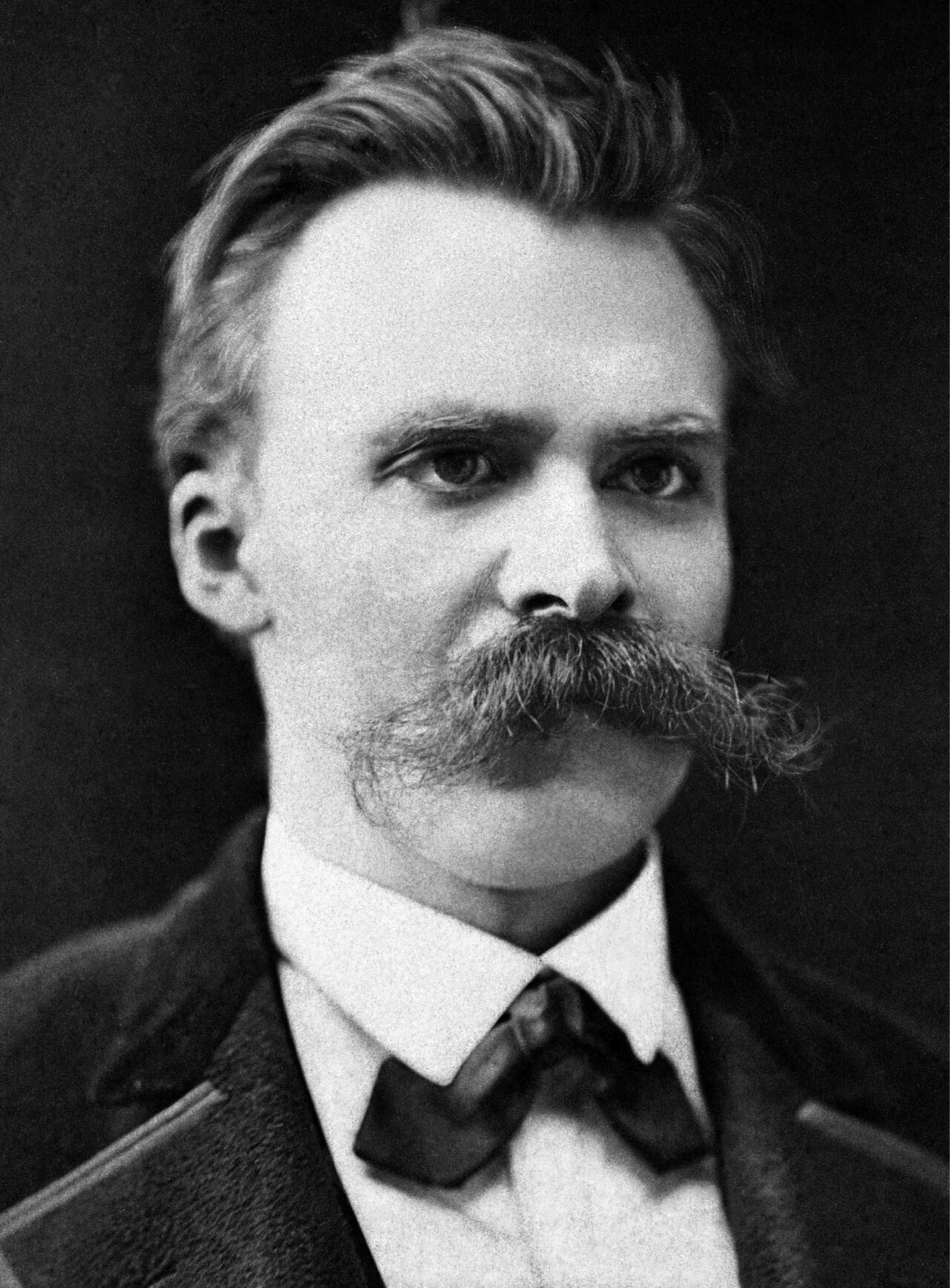
Friedrich Nietzsche
Dates: 1844–1900 Domain: Philosophy, Cultural Criticism, Classical Philology
Biography
Friedrich Nietzsche was born in Röcken, Prussia, in 1844, the son of a Lutheran minister who died of a brain ailment when Nietzsche was four — a biographical shadow that follows the philosopher's lifelong diagnosis of Christianity as the religion of the sick and resentful. He was educated at the famous Schulpforta boarding school and arrived at the University of Leipzig as a classicist of exceptional gifts. His appointment at Basel in 1869 — before he had even completed his doctorate — was a recognition of his philological abilities, and his early essays show the rigorous classical training that would later be turned against classics' own assumptions. His friendship with Richard Wagner, begun in 1868 and central to his early intellectual formation, ended definitively in 1878 when Nietzsche recognized in Wagner's late religious aesthetics the bad faith his philosophy would diagnose in Christianity.
The Birth of Tragedy (1872) is Nietzsche's first major work and, his most important. Written under the double influence of Schopenhauer's philosophy and Wagner's musical ambitions, it proposes that Greek culture at its height maintained a productive tension between two drives: the Apollinian (form, individuation, the beauty of the bounded appearance) and the Dionysian (dissolution, chaos, the ecstatic return to the primordial unity beneath individual forms). Greek tragedy was the art form that held this tension together — the Apollinian clarity of dramatic form containing the Dionysian frenzy of the choral music. The death of tragedy — which Nietzsche attributes to Socrates and the victory of rational optimism — was simultaneously the death of the Dionysian and the birth of the culture of mere knowledge, which the project's entire argument is about.
The collapse of 1878–1882 — his break with Wagner, with Schopenhauer, with German nationalism, with Christianity, with the university — issued in the sequence of aphoristic works (Human, All Too Human, Daybreak, The Gay Science) that culminate in the proclamation of the death of God in The Gay Science section 125. Nietzsche's madman in the marketplace crying that we have killed God is not a celebration: it is a diagnosis of nihilism's arrival, a recognition that the values that had structured Western culture for two millennia have collapsed, and a demand that philosophy confront the consequences rather than retreating into academic prudence.
Thus Spoke Zarathustra (1883–1885) is Nietzsche's attempt to construct a philosophical mythology adequate to the post-Christian condition — and it is the book that most directly concerns the project, because Zarathustra is engaged in the problem of initiatic transmission in a world without initiatic tradition. He descends from his mountain, offers his teaching, is rejected and misunderstood, and must work out what it means to teach wisdom that no existing institutional framework can receive. The eternal return — the thought that every moment of existence must be willed as though it will recur infinitely — is Nietzsche's secular analogue to the Mysteries' transformation of the relationship to time.
Key Works (in library)
| Work | Year | Relevance |
|---|---|---|
| The Birth of Tragedy | 1872 | Apollinian-Dionysian polarity; diagnosis of the death of Greek tragic consciousness |
| Thus Spoke Zarathustra | 1883–1885 | Philosophical mythology of the post-Christian condition; eternal return and its demands |
| Beyond Good and Evil | 1886 | Philosophy as the practice of questioning every settled value |
| The Genealogy of Morality | 1887 | Historical psychology of ascetic ideals; the will-to-power in its inverted form |
Role in the Project
Nietzsche provides the After Eleusis series with its primary philosophical framework for understanding what is lost when the Dionysian is suppressed — and what would be required to recover it. The Birth of Tragedy's analysis is one the project follows carefully while noting its limitations: Nietzsche's Dionysus is a concept reconstructed from classical sources by a nineteenth-century German philologist, not a direct witness account. But the structural observation — that the Western tradition has been progressively Apollinian, progressively rationalist, progressively hostile to the dissolving and transforming power of the Dionysian — maps onto Gebser's consciousness structure analysis, Barfield's loss of original participation, and McGilchrist's left-hemisphere dominance with striking precision.
His concept of eternal return is the project's philosophical counterweight to linear eschatology — the time-structure in which every moment is an eternal recurrence rather than a step toward a future that will justify it. This is structurally related to Eliade's illud tempus, the sacred time that ritual restores, though Nietzsche reaches it through extreme philosophical rigor rather than through the comparative phenomenology of religion.
Key Ideas
- Apollinian-Dionysian: The productive tension between the principle of beautiful form, individuation, and clarity (Apollo) and the principle of ecstatic dissolution, chaos, and primordial unity (Dionysus). Greek tragedy held them together; modern culture has killed the Dionysian.
- Death of God: Not a metaphysical thesis but a cultural diagnosis. The values that gave Western civilization its form have lost their grounding. The consequences, nihilism, the revaluation of all values, have not yet been fully absorbed.
- Eternal Return: The thought experiment that every moment of existence must be willed as though it will recur infinitely. Not a cosmological claim but a test of whether one's life is being affirmed completely enough to be willable without reservation.
- Will to Power: Not the drive for domination but the drive toward self-overcoming, toward becoming more fully what one is. In its inverted form (ressentiment, the ascetic ideal), it is the psychology of everything the project is organized against.
Connections
- Direct predecessors: FIG-0076 Schopenhauer (Nietzsche absorbed and then explicitly rejected the will-as-suffering framework), FIG-0089 Hegel (Nietzsche's dialectic is a reaction against Hegelian optimism about history)
- Parallel diagnosticians: FIG-0003 Gebser (consciousness structures as parallel to Nietzsche's cultural analysis), FIG-0013 Heidegger (Being and technology as Heidegger's reframing of Nietzsche's diagnosis)
- Romantic precursors: FIG-0022 Goethe (Faust as Dionysian figure), FIG-0023 Blake (Nietzsche and Blake converge on the necessity of creative destruction)
Agent Research Notes
[AGENT: perplexity | DATE: 2026-03-22] Nietzsche's mental collapse in Turin, January 3, 1889 (he was found embracing a horse's neck in the Piazza Carlo Alberto), is well documented; the remaining eleven years of his life were spent in mental incapacity, first in an asylum, then cared for by his mother and then his sister Elisabeth Förster-Nietzsche, who managed his posthumous reputation with significant distortion. The Will to Power is Elisabeth's compilation from notebooks, not Nietzsche's own text. Walter Kaufmann's translations and interpretive essays remain the most reliable English-language guide to distinguishing Nietzsche's actual positions from their misappropriations.