I. The Scene Before the Battle
The Bhagavad Gita begins on a battlefield. Two armies face each other on the plain of Kurukshetra. Arjuna, the greatest warrior of the Pandava clan, asks his charioteer Krishna to drive him between the lines so he can see who he will fight. He sees cousins, uncles, teachers, friends. He drops his bow. His hands shake. He tells Krishna he would rather die than kill the people he loves.
Krishna's response takes eighteen chapters and constitutes the most concentrated instruction in the spiritual life that the Indian tradition has produced. The Gita is embedded in the Mahabharata, the vast epic of the Bharata dynasty's civil war, but it operates as an independent text, a dialogue between a human being paralyzed by moral crisis and the divine being who is simultaneously his friend and the Lord of the universe. The setting is not incidental. The Gita's instruction arises from a specific crisis (a warrior's refusal to fight) and addresses that crisis on its own terms before transforming it into a universal teaching about action, knowledge, and devotion.
Easwaran's translation, first published in 1985, prioritizes accessibility and contemplative depth over philological precision. His extensive introduction and chapter commentaries situate the Gita within the practice of meditation. This is a practitioner's translation, shaped by decades of teaching and personal practice, and it serves the project's purposes for that reason: it presents the Gita as a living instruction, not a historical artifact.
II. The Three Yogas
The Gita's structure organizes itself around three paths to liberation, each suited to a different temperament. Karma yoga (the yoga of action) teaches that the fruit of action belongs to God, not to the actor. Act without attachment to outcomes. Do what is required by your dharma (your role, your duty, your position in the order of things) and release the result. Jnana yoga (the yoga of knowledge) teaches discrimination between the real and the unreal, the Self and the not-Self, the eternal and the transient. Bhakti yoga (the yoga of devotion) teaches surrender to the divine person, Krishna himself, as the most direct path to liberation.
These are not competing paths. Krishna presents them as complementary dimensions of a single discipline. The warrior acts (karma), the philosopher discriminates (jnana), the lover surrenders (bhakti). Each path, pursued fully, arrives at the same recognition: the individual self (atman) is not separate from the divine ground (Brahman), and the sense of separation that produces suffering is an illusion that practice dissolves.
For the project, the three yogas represent the Indian tradition's most systematic account of how initiatory transformation works through different modes of engagement. The Western mystery traditions tend to integrate these modes without naming them separately: the Eleusinian initiate undergoes ordeal (action), receives a vision (knowledge), and surrenders to the goddess (devotion). The Gita makes explicit what the Mysteries performed implicitly.
III. The Cosmic Vision
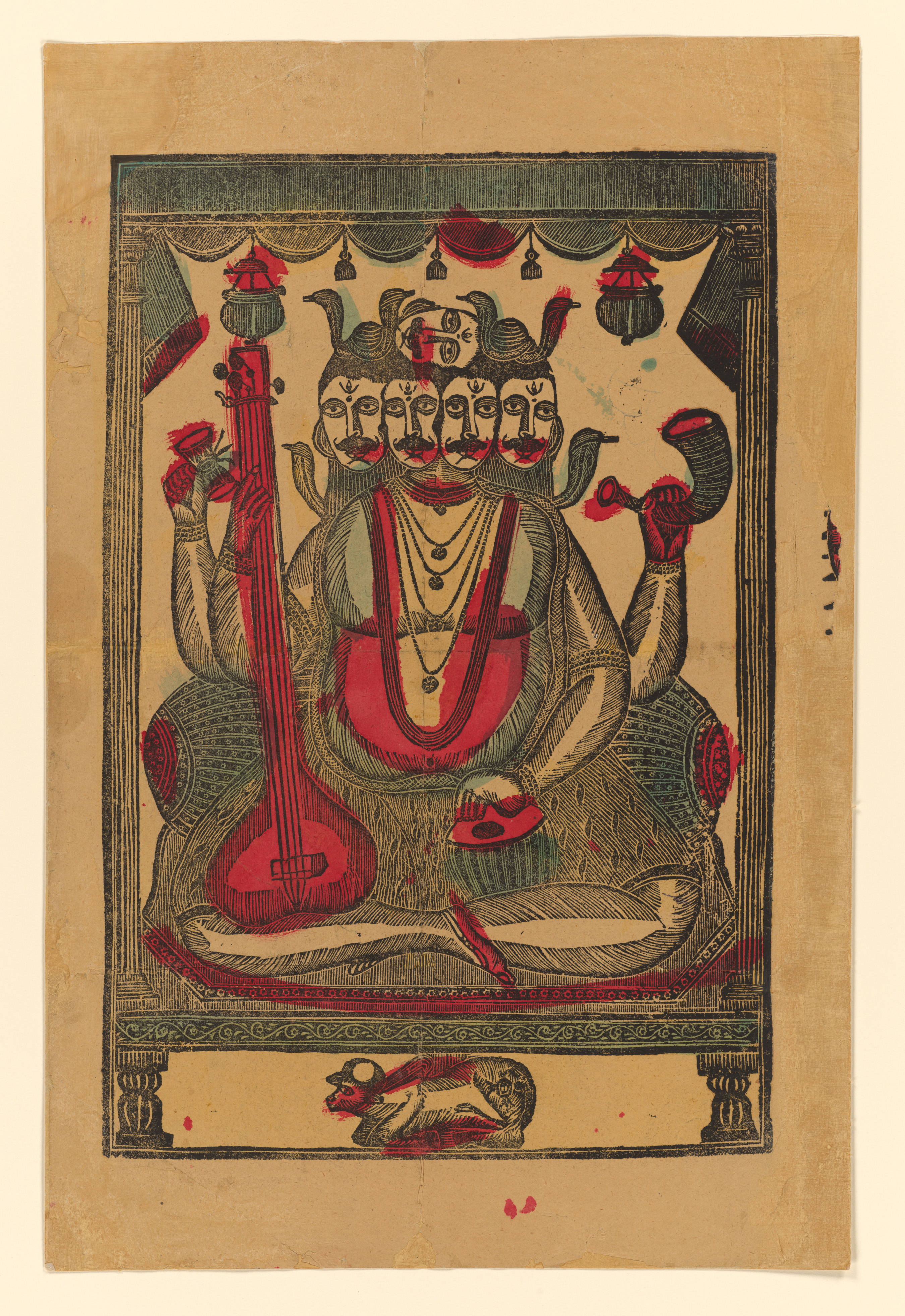
Chapter 11 is the Gita's climax. Arjuna asks to see Krishna's true form. Krishna grants him divine sight. What Arjuna sees is terrifying. The entire universe is contained in a single divine body. All beings enter the mouths of the god like rivers pouring into the ocean, creation and destruction happening simultaneously. The vision is so overwhelming that Arjuna begs Krishna to resume his familiar human form.
This is the Indian epopteia. Arjuna sees the totality of reality in a single perception, and the vision is not consoling. It is annihilating. The divine is everything: destruction, death, the battlefield on which Arjuna stands. "I am time," Krishna says, "the destroyer of all; I have come to consume the world." The vision does not resolve Arjuna's moral crisis. It dissolves the frame in which the crisis exists. From the perspective of the cosmic vision, the distinction between killing and not killing, between victory and defeat, between life and death, belongs to the realm of appearances. The Self that Arjuna fears to destroy in his enemies cannot be destroyed.
The parallel to the Eleusinian experience is structural: the initiate at Eleusis also saw something that dissolved the boundary between life and death, that revealed reality as more than the ordinary mind can hold (CON-0001). The difference is in the setting. The Eleusinian revelation happened inside a temple, within a ritual container, mediated by the Hierophant. The Gita's revelation happens on a battlefield, mediated by the god himself in the form of a friend. The container is the relationship between teacher and student, between the divine and the human, between Krishna and Arjuna.
IV. Dharma and the Problem of Action
The Gita's answer to Arjuna's crisis is not "fight" or "don't fight." It is: "act from the Self, not from the ego." Arjuna's paralysis comes from identification with the personal self, the self that loves its cousins and fears their death. Krishna's instruction is to act from the impersonal Self, the atman that is identical with Brahman, that neither kills nor is killed, that acts because action is its nature and releases the result because the result belongs to the divine order.
Critics have read the teaching as quietism (accept your caste role) or as moral abdication (kill your cousins because God says so). Each reading misses the Gita's actual claim (CON-0004). The instruction is not to act without feeling or without moral awareness. It is to act from a consciousness that has been transformed by the practice of yoga, a consciousness that participates in the divine order rather than standing outside it as a separate agent making individual moral calculations. The Gita's ethics are participatory ethics: the right action arises from the right consciousness, and the right consciousness is one that has dissolved the boundary between the individual will and the divine will.
This is the hardest teaching in the text and the one most relevant to the project. Every initiatory tradition the project examines makes a version of this claim: that the transformed consciousness acts differently from the untransformed one, and that the difference is not a matter of better moral reasoning but of a changed relationship to the source of action itself.
V. The Charioteer
The Gita's framing image is the chariot. Krishna drives; Arjuna fights. The Platonic parallel is impossible to miss: in the Phaedrus, the soul is a chariot driven by reason, pulled by two horses (noble and appetitive). In the Katha Upanishad (which predates the Gita), the body is the chariot, the intellect the driver, the mind the reins, the senses the horses, and the Self the passenger. The Gita takes this image and incarnates it: the divine drives the chariot. The Self does not merely ride. It steers.
For the listener, the Gita opens one of the most direct lines of comparison between Eastern and Western traditions. The chariot image, the cosmic vision, the teaching on action without attachment, the insistence that liberation comes through practice rather than belief: all of these have precise structural parallels in the Greek and Hermetic traditions the project has already explored. The Gita makes the parallels visible without collapsing the differences. Krishna is not Demeter. The battlefield is not the Telesterion. But the territory they address, the transformation they demand, and the consciousness they cultivate speak to each other across the traditions with a clarity that the project exists to register.