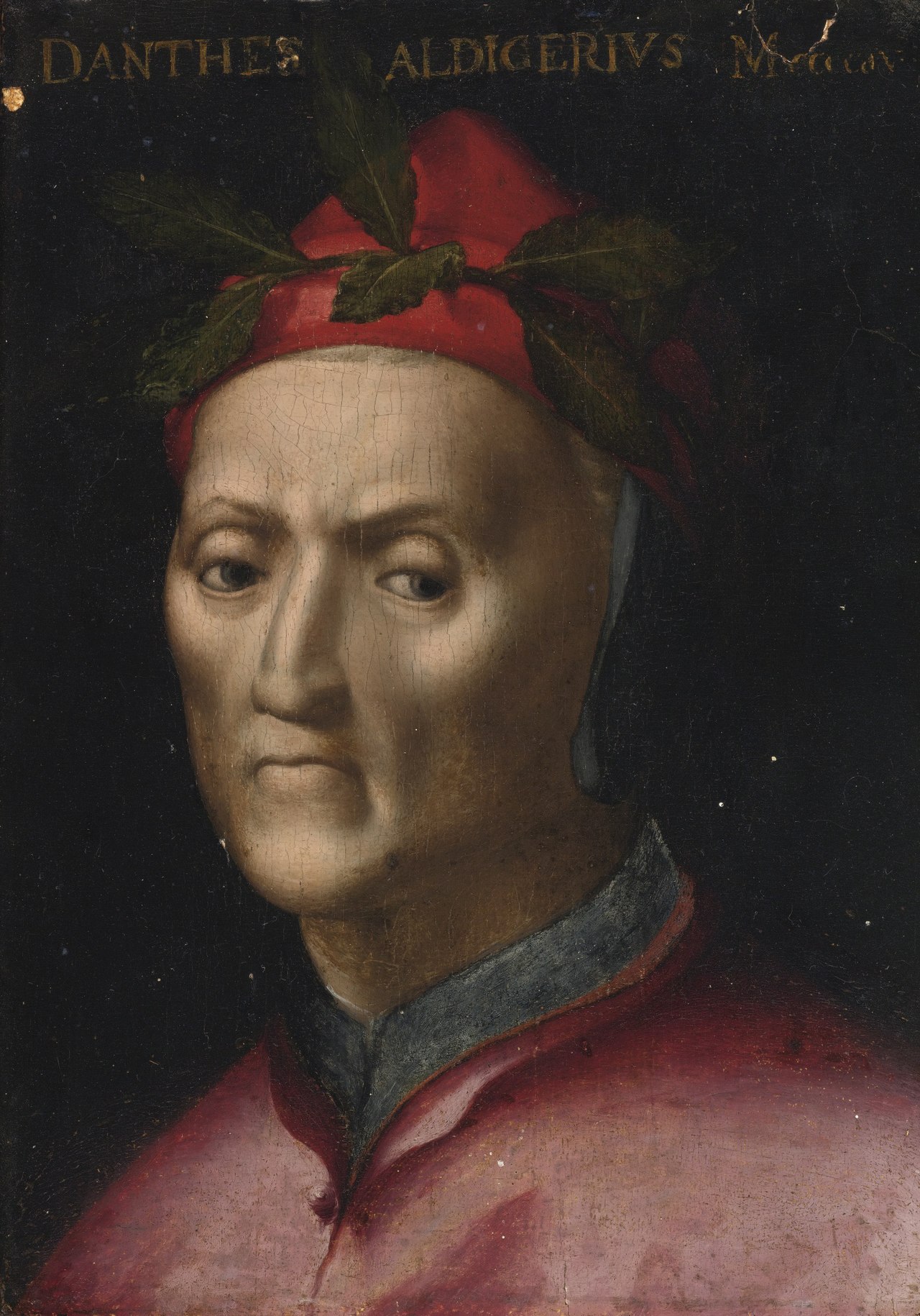
Dante Alighieri
Dates: 1265–1321 Domain: Literature, Poetry, Theology, Esoteric Philosophy
Biography
Dante Alighieri was born in Florence in 1265 into a family of minor nobility. His education was thorough in both the scholastic philosophical tradition and the poetry of the dolce stil novo ("sweet new style"), a lyric mode that treated erotic love as a vehicle for spiritual ascent. His love for Beatrice Portinari — whom he may have met when both were children and who died in 1290 — became the organizing figure of his poetic and spiritual imagination. He participated in the political life of Florence as a member of the White Guelphs, served as a prior of the city, and was exiled in 1302 when the Black Guelphs took power, condemned in absentia to burning at the stake if captured. He never returned to Florence and died in Ravenna in 1321, having completed the Commedia shortly before his death.
The Commedia, which later ages would call Divine, is the poem written in exile: it is therefore also a poem of homecoming, of the return from the underworld, of the recovery of what has been taken away. Its narrative frame — Dante the pilgrim, guided first by Virgil (reason-philosophy) and then by Beatrice (theology-love), descending through Hell, ascending through Purgatory, and rising through the celestial spheres to the final vision — enacts in literary form the tripartite structure of ancient initiation: descent into the underworld (katabasis), the ordeal and purification of the middle world, and the final vision of divine light (epopteia). This structure is not incidental to the poem; it is the poem.
René Guénon's The Esotericism of Dante (1925) is the most ambitious argument that the Commedia encodes specific initiatory material from the Templar and Fedeli d'Amore traditions. Guénon identifies structural parallels between the poem's geography and the symbolic architecture of initiatic rites, and argues that the poem was deliberately constructed to transmit esoteric content under a surface narrative accessible to uninitiated readers. This argument is contested by Dante scholars, who note that Guénon's claimed evidence for Templar transmission is thin and that much of what he identifies as esoteric could equally be explained by the rich symbolic tradition of medieval Christian theology. There is no need to adjudicate this debate. What matters is that the Commedia exhibits the initiatory structure whether or not it was consciously encoded there — either because Dante was working from an esoteric tradition that shaped his imagination, or because the initiatory pattern is so embedded in Western symbolic life that a sufficiently serious poet could not avoid it.
Dante's theological architecture in the Commedia is scholastic in its framework but visionary in its execution. The poem is structured according to Thomistic cosmology — nine concentric heavens, the fixed stars, the Primum Mobile, and beyond them the Empyrean — but the encounters within that structure are genuinely experiential: Dante does not merely describe the intellectual understanding of divine order; he records its emotional and sensory impact on a human being moving through it. The meeting with Beatrice in the Earthly Paradise, in which she strips away Dante's self-deceptions with a precision that would not be out of place in a psychoanalytic session; the encounter with the three lights of the Trinity in the final canto; the moment in which the poem finally fails language entirely ("A questo punto possa più il poema") — these are not scholastic argument but something closer to mystical report.
The Vita Nuova (1295), Dante's earlier prose-and-verse account of his love for Beatrice, is itself a minor initiatic document: the narrative of how an overwhelming love-experience transformed the poet's consciousness and inaugurated a new mode of being. The title means "new life" — the rebirth vocabulary of initiation in secular form.
Key Works (in library)
| Work | Year | Relevance |
|---|---|---|
| The Divine Comedy (Commedia) | c. 1308–1321 | The supreme initiatory narrative in Western literature |
| La Vita Nuova | c. 1295 | The initiatory love narrative; the death-and-rebirth of the self through eros |
| Il Convivio | c. 1304–1307 | Unfinished philosophical commentary; the allegorical levels of meaning |
| De Monarchia | c. 1312–1313 | The political philosophy underlying the cosmic order of the Commedia |
Role in the Project
The Commedia anchors the project's argument that the initiatory tradition was not extinguished by Christianity but was absorbed and transformed by it. Dante represents the moment when medieval Christianity produced its greatest literary artifact precisely by encoding an initiatory journey within an orthodox theological framework — a feat of synthesis that required both genuine theological sophistication and genuine spiritual experience. The poem is also the project's evidence that the threefold structure (descent, purgation, vision) is not merely a pattern imposed by comparative analysis but a structural necessity that emerges from the interior logic of spiritual transformation. Dante arrived at it through medieval theology, Virgil, and his own experience of exile and longing; the ancient initiates arrived at it through very different means; that they arrived at the same structure suggests the structure is real.
Key Ideas
- Katabasis: The descent into Hell as the necessary first movement — one cannot rise without first descending, without confronting the full weight of what has gone wrong.
- Purgation (Catharsis): The active work of purification in Purgatory — not passive suffering but deliberate engagement with the consequences of one's choices; the longest and in some ways most interesting canticle.
- Epopteia: The final vision of divine light in the Empyrean — what the ancient Mysteries called the vision of the sacred, here articulated as the beatific vision.
- Beatrice as Guide: The beloved as the figure of transformative wisdom — not merely a human woman but an image of the Sophianic dimension of the divine, the one who sees clearly what the pilgrim cannot yet see.
- Allegorical Levels: Dante's four levels of scriptural interpretation (literal, allegorical, moral, anagogical) applied to the poem itself; the poem is simultaneously autobiography, theology, moral philosophy, and mystical document.
Connections
- Influenced by: Virgil (Aeneid: the katabasis model), Aristotle and Thomas Aquinas (the philosophical-theological framework), the troubadour tradition, Guido Cavalcanti (dolce stil novo)
- Influenced: FIG-0039 Boethius (predecessor text — Lady Philosophy anticipates Beatrice), the entire Western literary tradition, FIG-0033's own Commedia as influence on FIG-0007 Guénon's esoteric reading
- In tension with: Historical-critical readings that reject any esoteric content, purely allegorical readings that deny the experiential dimension
Agent Research Notes
[AGENT: perplexity | DATE: 2026-03-22] Dante's dates are confirmed 1265–1321. The Commedia was written in exile (c. 1308–1321); Dante completed Paradiso shortly before his death. Guénon's L'Ésotérisme de Dante was first published in 1925. Charles Williams's The Figure of Beatrice (1943) is the best English-language account of Beatrice as theological-initiatic figure. Dorothy Sayers's translation and commentary (Penguin, 1949–1962) is the most accessible English introduction to the theological architecture. Maria Rosa Menocal's Shards of Love (1994) situates the Commedia in the context of Arabic-Andalusian influence on medieval Italian poetry.