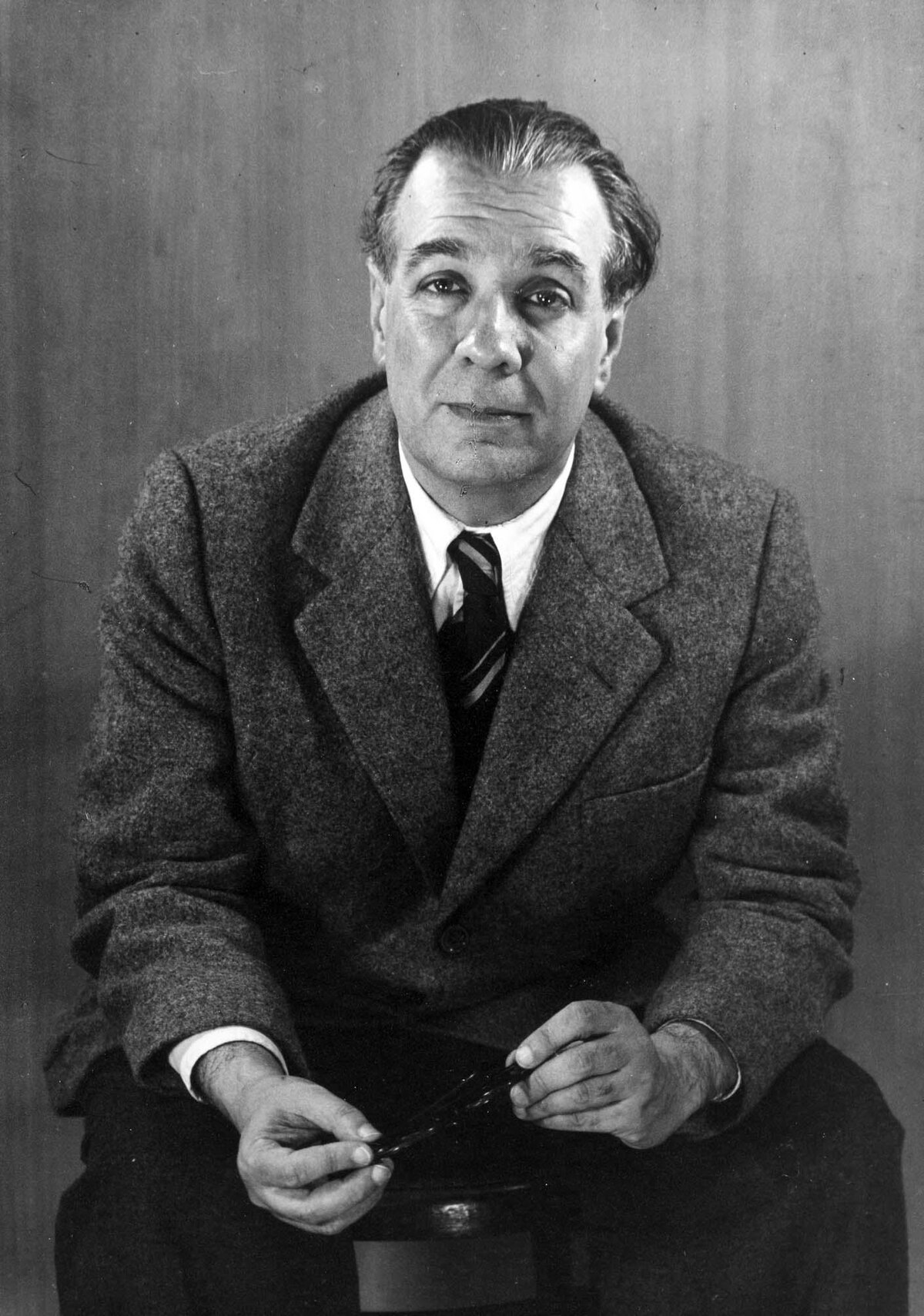
Jorge Luis Borges
Dates: 1899–1986 Domain: Fiction, Literature, Essay, Kabbalah, Philosophy of Infinity
Biography
Jorge Luis Borges was born in Buenos Aires in 1899, the son of a bilingual household — his father was a lawyer who wrote a novel; his grandmother was English — and grew up between two languages and two cultures in a way that gave him permanent productive distance from both. He was educated partly in Geneva during World War I and spent the early 1920s in Spain with the Ultraístas before returning to Argentina. He went blind progressively from the 1950s (a hereditary condition) and was director of the National Library of Argentina from 1955 — a position whose irony he did not miss: the man appointed to run the national library in the same year he lost his sight to read.
The body of fiction that secured his international reputation consists largely of stories written between 1939 and 1952 and collected in Ficciones (1944) and El Aleph (1949). These are not short stories in the conventional sense. They are thought experiments rendered in precise, classical prose: hypothetical entities (a man who can remember everything, a library containing all possible books, a map the size of the territory it represents) explored with the rigor of philosophy and the texture of fiction. They operate at the intersection of Kabbalah, Idealist philosophy, and the aesthetic traditions of Chesterton and De Quincey.
"The Library of Babel" (1941) is the central Borges text: the Library is infinite, containing every possible combination of the alphabet in books of standard format, which means it contains all the books that have ever been written or could be written, alongside an overwhelming majority of books consisting of meaningless character sequences. The Library's inhabitants have organized their lives around the search for the Book — the master catalog that would identify which books are meaningful. They have never found it. They are looking for it still. The story is a philosophical argument about the structure of any universe in which the meaningful cannot be distinguished from the meaningless by any formal procedure.
"The Aleph" (1945) is the complementary piece: a small point in a Buenos Aires basement that contains, simultaneously, all points of the universe — the whole of space seen from every direction at once. This is the Kabbalistic Ein Sof experienced as a literary phenomenon; it is also what Swedenborg claimed to perceive in his visions, and what Plotinus described as the One's mode of being. Borges reaches these concepts through literary imagination rather than mystical practice, which raises the project's question: is the literary approach to these limits a genuine form of contact, or a particularly sophisticated form of the map mistaken for the territory?
Key Works (in library)
| Work | Year | Relevance |
|---|---|---|
| Ficciones | 1944 | The Library of Babel, the Garden of Forking Paths; the labyrinth as ontological condition |
| El Aleph | 1949 | The Aleph, the Zahir; infinite totality as literary-mystical experience |
| Seven Nights | 1980 | Lecture series including treatments of the Thousand and One Nights, the Divine Comedy, Kabbalah |
Role in the Project
Borges is in the Modern Labyrinth series because his fiction is the most precise modern map of what it feels like to be inside an infinite library with no orienting tradition. The Library of Babel is the project's image of modernity's relationship to knowledge: there is more information than any consciousness can process, no formal procedure for distinguishing the meaningful from the meaningless, and the scholars who have dedicated their lives to finding the master key have not found it.
His connection to Kabbalistic thought — well documented in his essays and acknowledged in his fiction — makes him a bridge figure between the ancient textual tradition of infinite divine meaning and the modern literary tradition's secular version of the same problem. He also connects to the ars memoriae tradition (FIG-0017 Yates, FIG-0059 Llull, FIG-0026 Bruno) through his meditation on the total book, the total library, the compendium that would contain everything.
Key Ideas
- The Library of Babel: An infinite library containing every possible book — and therefore containing all meaningful texts alongside an overwhelming preponderance of noise. The structure of any information environment that lacks an orienting tradition.
- The Garden of Forking Paths: Time as a labyrinth in which every choice produces a branching universe — the story that anticipated the many-worlds interpretation of quantum mechanics by decades, and that gives the project its image of non-linear sacred time.
- The Aleph: The point that contains all points simultaneously — the infinite seen whole. Borges approaches through fiction what Plotinus and Swedenborg approached through metaphysics and vision.
- Circular Ruins: The dreamer who discovers that he himself is someone else's dream. The question of the subject's ontological status when the subject is itself a product of a dreaming consciousness.
Connections
- Modern Labyrinth: FIG-0074 Kafka (labyrinth with no exit; Borges's labyrinths have exit conditions — you can find the center, even if finding it raises new questions), FIG-0080 Joyce (Finnegans Wake as the circular library Borges theorizes)
- Kabbalistic tradition: FIG-0043 Luria (tzimtzum and the infinite text), FIG-0044 Couliano (the Renaissance imagination science and its relationship to Borges's combinatorial imagination)
- The total book: FIG-0059 Llull (the Ars Magna as the finite combinatorial system that anticipates Borges's infinite Library)
Agent Research Notes
[AGENT: perplexity | DATE: 2026-03-22] Borges was appointed director of the National Library of Argentina by the Aramburu government in 1955, shortly after losing his remaining functional vision. "The Library of Babel" first appeared in El jardín de senderos que se bifurcan (1941), then collected in Ficciones. His blindness was hereditary — his father and grandmother both went blind — which accounts for his composing everything in his head before dictation in his final decades. Edwin Williamson's biography (2004) is the standard English-language life.