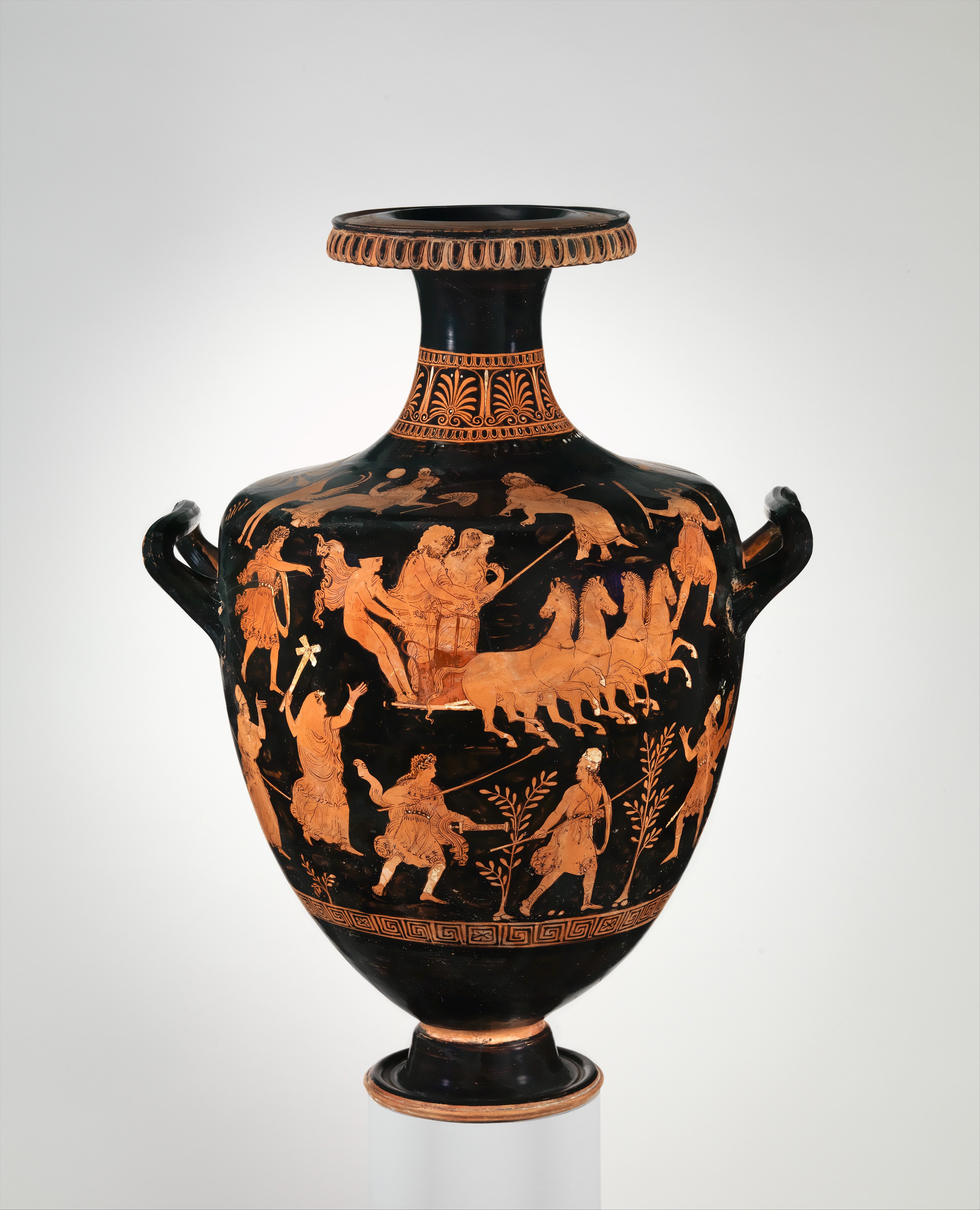
Hierophant
Definition
Hierophant (Greek: ἱεροφάντης, hierophantēs) is a compound of hieros ("sacred," "holy") and phainein ("to show," "to bring to light," "to reveal"). The hierophant is literally "one who shows or reveals holy things." In the specific context of the Eleusinian Mysteries, the Hierophant was the chief priest: the highest religious authority at Eleusis, drawn from the Eumolpid clan (descendants of Eumolpus, the mythological founder of the Mysteries), who held the position for life and whose name was never publicly disclosed during his tenure. He was simply called "the Hierophant."
The Hierophant's function was precise and climactic: it was he who performed the final revelation (epopteia) within the anaktoron, the innermost sanctuary of the Telesterion. He displayed the sacred objects (ta hiera), whose nature remains unknown, and it was this act of revelation, performed in the midst of the assembled initiates, that constituted the heart of the Eleusinian experience. Hesychius's lexicon defines the Hierophant as a "mystagōgos priest who displays the mysteries" (ho ta mystēria endeiknymenos hiereus). His is the performative act: he shows; the initiates see.
The Hierophant's role involved more than the single act of revelation. He was also responsible for conducting the prorrhesis (proclamation at the opening of the Mysteries), performing the sacrifices, guiding the procession from Athens to Eleusis, and presiding over the entire nine-day festival sequence. He was assisted by other priestly functionaries: the Dadouchos (torch-bearer), the Hieroceryx (sacred herald), and the Epibōmios (the one at the altar). But the Hierophant was supreme, and only he could reveal the final sacred things.
The term Hierophant subsequently entered broader usage as a generic title for a revealer of sacred knowledge, not tied to Eleusis but applicable to any teacher or spiritual guide who mediates access to sacred reality. In this generalized sense, the Hierophant is the person who stands between the profane world and the sacred, who knows the sacred and has the authority and responsibility to reveal it to those prepared to receive it.
Tradition by Tradition
Ancient Greek / Eleusinian
At Eleusis, the Hierophant occupied the most prestigious religious office in the Greek world after the Oracle at Delphi. Epigraphical evidence (inscriptions naming past Hierophants) and literary testimony (Plutarch, Pausanias, Clement of Alexandria) give us a relatively rich picture of the office. The Eumolpid Hierophant presided over the Mysteries for more than a millennium: from their first attestation in the 7th century BCE until the sack of Eleusis by Alaric in 396 CE, which effectively ended the institution.
The Hierophant struck a large gong (mykēs) at the culminating moment of the rites, a sound that Pausanias describes as extraordinarily resonant and uncanny. He announced a divine birth; the exact nature of this announcement is debated, but it seems to have involved the display of a freshly cut ear of grain (stagus amphiblastou sitou — "an ear of grain reaped in silence") as a symbol of the death-and-rebirth mystery at the heart of the Eleusinian revelation. Whatever was shown and said in those final moments, its effect on the thousands gathered in the Telesterion was, by all ancient accounts, overwhelming.
Orphic / Pythagorean
The mystagōgos (guide of the initiates) in Orphic contexts performs a function analogous to the Hierophant: leading the candidate through the initiatory process and revealing the sacred knowledge: in the Orphic case, primarily eschatological knowledge about the soul's fate and the means of its liberation. Plato's portrayal of Socrates in the Meno and Phaedo as a kind of philosophical mystagōgos, leading his interlocutors through the philosophical process as a preparation for death, is a transposition of the hierophantic function into the philosophical key.
Hermetic
The opening scene of the Poimandres (Corpus Hermeticum I) is a hierophantic encounter: the divine Intellect (Nous) appears to Hermes/the narrator and reveals the nature of reality. Hermes, having received this revelation, is then charged to transmit it to humanity: "Go now, and become for them a guide (hēgemōn), so that through you the human race may be saved by God." Hermes becomes the archetypal hierophant: the revealer of sacred things, the bridge between divine reality and human understanding.
Neoplatonic
Proclus (Commentary on Plato's Republic) describes philosophy itself as a hierophantic function: the philosopher reveals the sacred realities concealed within the Homeric poems and Platonic dialogues. Neoplatonic commentary was understood not as scholarly analysis but as a form of sacred revelation, making visible the divine logoi encoded in the texts. The Neoplatonic teacher is a hierophant of the philosophical tradition.
Project Role
The Hierophant concept occupies a unique position in the Mystery Schools project: it is both the object of scholarly study and a self-description of the project's own mode and aspiration. By invoking the Hierophant as a core concept, the project acknowledges what kind of endeavor it is.
The podcast host does not simply analyze historical materials about mystery traditions; the aspiration is to enact something like the hierophantic function in a contemporary medium: to bring ancient sacred knowledge into encounter with a modern audience in such a way that something of its transformative charge is transmitted. This is an ambitious and self-aware claim, and the project holds it humbly: the hierophant reveals only what has been given to them, only to those prepared to receive it, and always in service of the sacred rather than personal ego.
The concept also implies an ethical dimension: the Hierophant's authority is not personal but traditional: he reveals what the tradition has entrusted to him. The podcast operates under an analogous obligation: to the integrity of the sources, to scholarly accuracy, and to the genuine content of the traditions rather than to entertainment, sensationalism, or the amplification of the host's personality.
Distinctions
Hierophant vs. Mystagōgos: The mystagōgos (guide of the initiates) was the Athenian citizen who introduced a candidate to the Mysteries and sponsored them at Eleusis. The Hierophant was the supreme priestly officiant who performed the final revelation. The mystagōgos guides the candidate to the threshold; the Hierophant performs the act of revelation at the threshold.
Hierophant vs. Prophet: A prophet (Greek prophētēs, "one who speaks before/for") speaks on behalf of the divine in a context of immediate divine inspiration; prophetic speech is understood as given, spontaneous, from the divine. The Hierophant's revelation is scripted and traditional: he shows what has always been shown, in the prescribed way. The Hierophant transmits tradition; the prophet interrupts it.
Hierophant vs. Teacher (Didaskālos): A teacher transmits information and argument that the student can then evaluate independently. The Hierophant transmits an experience that changes the student's mode of being. The distinction mirrors that between education and initiation (CON-0001).
Revealing vs. Explaining: The Hierophant does not explain the sacred objects; he reveals them. The distinction is crucial: explanation translates the sacred into concepts the ordinary mind can handle; revelation presents the sacred in a form that must be encountered on its own terms. The project aspires to the latter mode.
Primary Sources
- Walter Burkert, Ancient Mystery Cults: The foundational modern scholarly treatment of the Hierophant's role and the Eleusinian priestly structure; rigorous historical analysis.
- Homeric Hymn to Demeter: Contains the mythological account of Demeter's institution of the Mysteries and the first Hierophant's charge.
- Mircea Eliade, Rites and Symbols of Initiation: On the sacred specialist as mediator between profane and sacred worlds.
- Mircea Eliade, A History of Religious Ideas, Vol. 1: Historical and comparative treatment of the Eleusinian cult and its priestly offices.
Eliade: The Initiatory Master Across Traditions
Eliade's Rites and Symbols of Initiation (LIB-0293) broadens the Hierophant concept beyond its Eleusinian specificity. Across tribal, shamanic, and mystery-cult initiation, the "master of initiation" — the elder, the shaman, the Hierophant — serves a consistent structural function: mediating between the sacred and the profane, guiding the initiand through the ordeal of symbolic death, and authorizing the revelation that follows. The initiatory master is not merely a teacher but a ritual presence whose authority derives from having undergone the same transformation. Eliade notes that in many traditions, the master "kills" the initiand symbolically (through circumcision, ritual wounding, naming the initiand as dead) and then presides over the "rebirth." The Hierophant at Eleusis, who revealed the sacred objects in the Telesterion, is the Greek institutionalization of this archaic function — the one who has seen and can therefore show.
Agent Research Notes
[AGENT: perplexity | DATE: 2026-03-20] The specific ancient sources for the Hierophant's role include: Pausanias (Description of Greece 1.14.3, 1.37.4); Plutarch (On the Control of Anger); Clement of Alexandria (Protrepticus); Dio Chrysostom (Olympic Discourse); and epigraphical evidence from Eleusis. The Eumolpid family's monopoly on the Hierophancy is attested and sociologically significant: it shows that initiatic transmission, in the ancient world, was understood to require unbroken genealogical or traditional lineage, echoing Guénon's emphasis on the "initiatic chain." The relationship between the podcast host as self-described "hierophant" and Guénon's strict requirement of genuine initiation is a tension worth acknowledging in the podcast's own self-reflection.