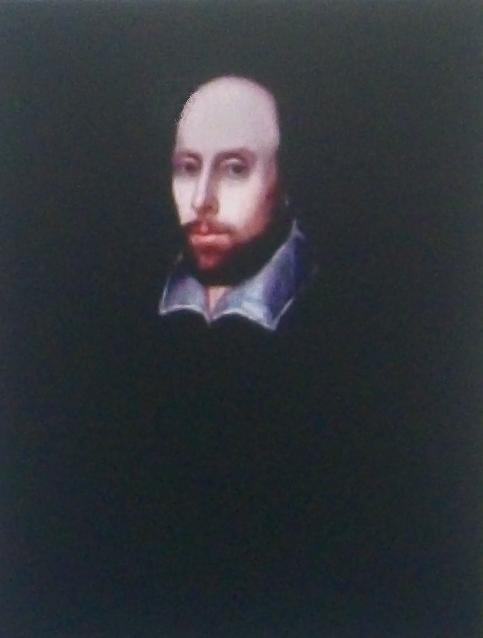
William Shakespeare
Dates: 1564–1616 Domain: Drama, Poetry, Initiatory Narrative
Biography
William Shakespeare was born in Stratford-upon-Avon in 1564, the son of a glover, and died there in 1616. Between these conventional biographical endpoints lies almost nothing documented — the so-called "lost years" between his youth in Stratford and his appearance as an established playwright in London in the early 1590s are genuinely lost, which has fed two centuries of speculation about Catholic recusancy, travel, alternative authorship, and initiatic membership that the project explicitly does not traffic in. What the plays are is documented; what Shakespeare did to produce them is not, and the biographical mystery is less interesting than the texts.
He worked as an actor-playwright within the commercial theatre culture of Elizabethan London — a culture that was simultaneously highly commercial (plays were performed for paying crowds including the illiterate groundlings), artistically ambitious, politically constrained (the censorship of the Master of the Revels was constant), and intellectually saturated with the Hermetic and Neoplatonic ideas that Frances Yates documented in Giordano Bruno and the Hermetic Tradition (1964). Whether Shakespeare was personally initiated into any esoteric tradition, knew the Hermetic texts directly, or absorbed these ideas through the general intellectual culture of the period, the plays show their marks. The imagery of A Midsummer Night's Dream is Ficinian: Bottom's transformation and restoration is structured as a low-comedy mystery initiation. The Tempest's Prospero is a Renaissance magus in the tradition of Dee — a scholar who has retired to an island with his books and his art and who stages, over the course of a single day, a sequence of separations, trials, and reincorporations that brings every other character to their proper condition.
Hamlet is the project's most demanding Shakespearean text. The prince has received a visitation from the dead — his father's ghost, which in Renaissance theology had highly ambiguous status: was it a genuine soul from purgatory? A demon in disguise? A projection of Hamlet's own disturbed mind? — and has been given knowledge that requires action in a world entirely organized to prevent the action. His situation is the initiand's situation without the initiadic closure: the liminal phase with no re-aggregation available. His famous delay is not indecisiveness but the paralysis of someone who has received a revelation that the existing social order has no slot for. The play ends in bodies. The consciousness it describes — absolute knowledge, inability to act, progressive alienation from everyone around him — is the project's diagnosis of modernity's relationship to what the Mysteries revealed.
King Lear is the katabasis stripped of all mythological apparatus: an old man loses everything, title, authority, daughters, sanity, and in the process becomes capable of the perception that the full possession of these things had prevented. "Unaccommodated man is no more but such a poor, bare, forked animal" — this is initiation by stripping, by the systematic removal of every identity-marker until what remains is purely human.
Key Works (in library)
| Work | Year | Relevance |
|---|---|---|
| Hamlet | c. 1600–1601 | Initiatic insight without initiadic context; the paralysis of revealed consciousness |
| The Tempest | c. 1610–1611 | Prospero as Renaissance magus; the complete initiatic drama in miniature |
| King Lear | c. 1605–1606 | Katabasis through dispossession; the unaccommodated man as initiatory endpoint |
| A Midsummer Night's Dream | c. 1595–1596 | The Faery world as liminal space; Bottom's transformation as mystery parody |
Role in the Project
The Western Canon track's argument is that the literary tradition is a primary source for the history of consciousness — not illustration for ideas but evidence of what consciousness was doing at specific historical moments. Shakespeare is the track's central Renaissance exhibit. The plays show what happened to initiatic structure when it entered commercial theatre: it survived, transformed, with the mythological content secularized and the ritual conditions replaced by aesthetic ones. This is not a diminishment but a translation, and a translation as significant as the one the Neoplatonists performed when they moved the Mysteries from ritual practice into philosophical theory.
What Shakespeare provides that Ficino or Bruno cannot is the evidence in narrative — the full experience of characters moving through the initiatic structure rather than the theoretical account of what that structure is. Close reading of The Tempest shows the three-phase pattern (separation on the enchanted island, liminal trials under Prospero's direction, incorporation into a transformed Milanese court) operating with architectural precision. This is not reading the structure into the text; it is attending to what the text does.
Key Ideas
- Theatrical Initiation: The argument that Renaissance drama — public performance, ritual setting, mythological content — performed a social function analogous to mystery initiation: a controlled collective experience of dissolution and transformation.
- Hamlet's Paralysis: The diagnostic portrait of a consciousness that has received initiatic insight (knowledge of death and its demands) without the ritual architecture that would have provided the path from that knowledge to a transformed life. The tragedy is structural, not merely personal.
- Prospero's Art: In The Tempest, magic is the art of staging encounters that transform the people who undergo them. Prospero does not change Caliban or Antonio directly; he arranges the conditions under which they are confronted with their own natures. This is the function of the Hierophant.
- The Late Romances: The Winter's Tale, Pericles, Cymbeline, and The Tempest all share a structure: a catastrophic loss (separation), years of wandering and suffering (liminal), and a recognition scene (incorporation) that is typically staged as resurrection or miraculous restoration. These plays embody the Eleusinian structure most directly.
Connections
- Renaissance context: FIG-0017 Yates (Hermetic tradition in Elizabethan culture), FIG-0024 Ficino (Neoplatonic magic that informs Dream and Tempest), FIG-0027 Dee (Dee as the model for Prospero is a scholarly debate the project can note without resolving)
- Literary katabasis sequence: FIG-0033 Dante (Shakespeare inherits the Christian katabasis tradition), FIG-0084 Milton (Paradise Lost as the next major English initiatic poem), FIG-0085 Virgil (the Aeneid katabasis that Dante and Shakespeare both inherit)
Agent Research Notes
[AGENT: perplexity | DATE: 2026-03-22] Frances Yates's case for Shakespeare's Hermetic context is in Shakespeare's Last Plays: A New Approach (1975). The argument that Dee is a model for Prospero is associated with Peter Greenaway's film Prospero's Books and various scholars; it is a persuasive reading but not established fact. The "lost years" of Shakespeare's biography remain genuinely undocumented. The date of Hamlet as c. 1600–1601 is the scholarly consensus; first quarto published 1603. Harold Bloom's Shakespeare: The Invention of the Human (1998) provides the secular literary case for Shakespeare's centrality to Western consciousness.