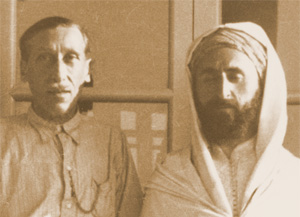
René Guénon
Dates: 1886–1951 Domain: Traditionalist Philosophy, Metaphysics, Comparative Religion
Biography
René Guénon was born on November 15, 1886, in Blois, France, and died on January 7, 1951, in Cairo. His intellectual biography falls into two sharply distinct halves, separated by his emigration to Egypt in 1930. In France, Guénon was a prolific writer and polemicist who moved through the fringes of French occultism and Freemasonry before rejecting both as degraded and inauthentic, subsequently producing a series of major philosophical works that established the foundations of what he called "the Tradition." In Cairo, having converted to Sufi Islam, he married, took an Egyptian name (Abdalwahid Yahia), lived quietly, and continued writing until shortly before his death.
Guénon's central contribution was the construction of a comprehensive anti-modern metaphysics grounded in what he called the sophia perennis or primordial Tradition: the claim that all genuine religious and esoteric traditions are partial expressions of a single, supra-human metaphysical truth that was fully known at the origin of the present cosmic cycle and has been progressively forgotten as humanity descends further into the Kali Yuga (the last and darkest age of the Hindu cosmic cycle). This is not merely a philosophical position but a metaphysical diagnosis of civilization: modernity is not progress but catastrophic decline, the triumph of quantity over quality, of the individual ego over universal intellect, of profane science over sacred knowledge.
The two books most relevant to the project are Perspectives on Initiation (1946) and The Crisis of the Modern World (1927). The former provides his most systematic account of authentic initiation, which for Guénon requires, above all, an unbroken initiatic chain (silsilah in Sufism) linking the initiate to the primordial source. A merely "virtual" initiation through reading books or solitary practice is, for Guénon, no initiation at all; it has no metaphysical efficacy without the transmission of spiritual influence through a legitimate chain. The Crisis of the Modern World is his most accessible diagnosis of modernity's spiritual failure and a compelling if sweeping indictment of Western civilization's loss of metaphysical orientation. The Reign of Quantity and the Signs of the Times (1945) deepens this analysis into a cosmological framework.
Guénon's intellectual influence has been enormous, extending through Julius Evola (who took Traditionalism in a more politically dangerous direction), Frithjof Schuon (who became the leader of the Traditionalist school after Guénon's death), Seyyed Hossein Nasr (who applied it to Islamic philosophy and environmental ethics), and Martin Lings. His influence on contemporary esotericism and on scholars of religion (who must reckon with him even when rejecting his claims) is pervasive.
Key Works (in library)
| Work | Year | Relevance |
|---|---|---|
| Initiation and Spiritual Realization | 1952 | Key texts on authentic vs. pseudo-initiation (LIB-0037) |
| Perspectives on Initiation | 1946 | Most systematic account of initiatic chain and the metaphysics of transmission (LIB-0040) |
| The Reign of Quantity and the Signs of the Times | 1945 | Cosmological framework for the critique of modernity (LIB-0043) |
| Introduction to the Study of the Hindu Doctrines | 1921 | Foundational statement of Traditionalist metaphysics (LIB-0038) |
| Man and His Becoming according to the Vedanta | 1925 | Metaphysical anthropology (LIB-0039) |
| The King of the World | 1927 | Doctrine of the spiritual center and the sacred geography of initiation (LIB-0042) |
| The Esoterism of Dante | 1925 | Application of Traditionalist hermeneutics to Western literature (LIB-0041) |
| Traditional Forms and Cosmic Cycles | 1953 | Collected essays on cosmological framework (LIB-0044) |
| The Crisis of the Modern World | 1927 | Accessible polemical statement of the Traditionalist critique of modernity (LIB-0344) |
Note: The Symbolism of the Cross does not appear in the current library index and should be considered for addition.
Role in the Project
Guénon is engaged critically rather than adopted wholesale. His diagnostic power (the account of modernity as metaphysically bankrupt, the insistence that authentic initiation requires transmission and not merely technique, the critique of neo-spiritual movements that confuse sentiment with gnosis) is taken seriously as a corrective to spiritual superficiality. However, the project departs from Guénon on key points: (1) his anti-historical stance (the Tradition stands outside history, unchanging, while history and consciousness evolution are themselves spiritually significant); (2) his exclusivism (only traditions with valid initiatic chains count, which functionally means Sufism and some forms of Hinduism and Catholicism); (3) his relationship to progress, which he rejects entirely, while the project follows Barfield and Gebser in reading the history of consciousness as genuinely developmental rather than merely degenerative.
Key Ideas
- Initiatic chain: Authentic initiation requires an unbroken transmission of spiritual influence from an accredited source; without this chain, practice may be psychologically interesting but metaphysically inefficacious.
- Virtual vs. effective initiation: A distinction within Guénon's framework between receiving the initiatic link (virtual) and actualizing it through practice (effective); most initiates remain at the virtual level.
- Primordial Tradition: The single, unified metaphysical truth of which all genuine religions and esoteric paths are local expressions adapted to the needs of particular peoples and historical periods.
- Kali Yuga / Reign of Quantity: The modern age as the terminal phase of a cosmic cycle characterized by the triumph of multiplicity over unity, quantity over quality, matter over spirit.
- Sacred science vs. profane science: Modern science as the reduction of knowledge to the measurable and calculable, producing technological mastery while destroying the capacity for metaphysical orientation.
The Crisis of the Modern World (1927)
Among Guénon's works, The Crisis of the Modern World is the most direct and the most widely read. It states the Traditionalist diagnosis without the technical apparatus of the metaphysical treatises, and it is the natural entry point for the project's engagement with him.
The book's organizing claim is that modernity represents not progress but inversion. The traditional civilizations, as Guénon describes them, ranked knowledge in a fixed order, with metaphysical knowledge of principles at the summit and quantitative, empirical knowledge at the base. The modern West, he argues, has overturned this order, treating the measurable and material as the standard of the real and dismissing the contemplative and metaphysical as illusory. This is the inversion that his later Reign of Quantity would develop into a full cosmology.
Crisis locates the root of the inversion in what Guénon calls individualism: the elevation of the individual viewpoint over universal principle. For Guénon, individualism is not a moral failing but a metaphysical error with social consequences. It produces the proliferation of competing philosophical systems, the substitution of sentiment and opinion for intellectual certainty, and the modern preference for action over contemplation. The chaos Guénon sees in modern intellectual life follows, in his account, directly from the loss of a shared supra-individual principle of order.
The book is also notable for what it proposes. Guénon does not call for political reform, which he regards as operating within the very framework that is the problem. He calls instead for the formation of an intellectual elite in the West capable of re-establishing contact with metaphysical principles, whether by recovering the genuine elements of the Western tradition or by drawing on the still-living traditional civilizations of the East. The project engages this proposal critically: Guénon's diagnosis of modern fragmentation has real force, but his remedy depends on the anti-historical and exclusivist assumptions that the project, following Barfield and Gebser, does not share.
Connections
- Influenced by: Neoplatonism (indirect), Sufism (Shadhili order), Hindu Advaita Vedanta, medieval Christian theology (Aquinas, Eckhart)
- Influenced: Julius Evola, Frithjof Schuon, Martin Lings, Seyyed Hossein Nasr, Ananda Coomaraswamy, James Cutsinger, FIG-0009 (Corbin, close but distinct trajectory)
- In tension with: FIG-0002 (Barfield; developmental vs. degenerative account of history), FIG-0003 (Gebser; five-structure evolution vs. single primordial tradition), FIG-0006 (Tarnas; participatory evolution vs. Traditionalist anti-modernism)
Agent Research Notes
[AGENT: perplexity | DATE: 2026-03-20] Guénon is exceptionally well-represented in the library with eight entries (LIB-0037 through LIB-0044). The most directly relevant to the project are LIB-0040 (Perspectives on Initiation) and LIB-0043 (Reign of Quantity). The Crisis of the Modern World is not in the index and should be flagged for acquisition. The project should be explicit about its critical engagement with Guénon's political valences: the Traditionalist school has been adopted in various forms by political thinkers including Steve Bannon and Alexander Dugin, though Guénon himself was not politically active in this way. This context is relevant for positioning the project's relationship to his thought.
[AGENT: claude-code | DATE: 2026-04-03] Deepened with material from LIB-0344 (The Crisis of the Modern World). Added a dedicated section on the 1927 book: the inversion of the hierarchy of knowledge, individualism as the metaphysical root of modern fragmentation, and Guénon's proposed remedy of a Western intellectual elite. Added Crisis (LIB-0344) to the Key Works table and corrected the prior note, which stated the book was absent from the library index before LIB-0344 was added. Existing content was not rewritten.