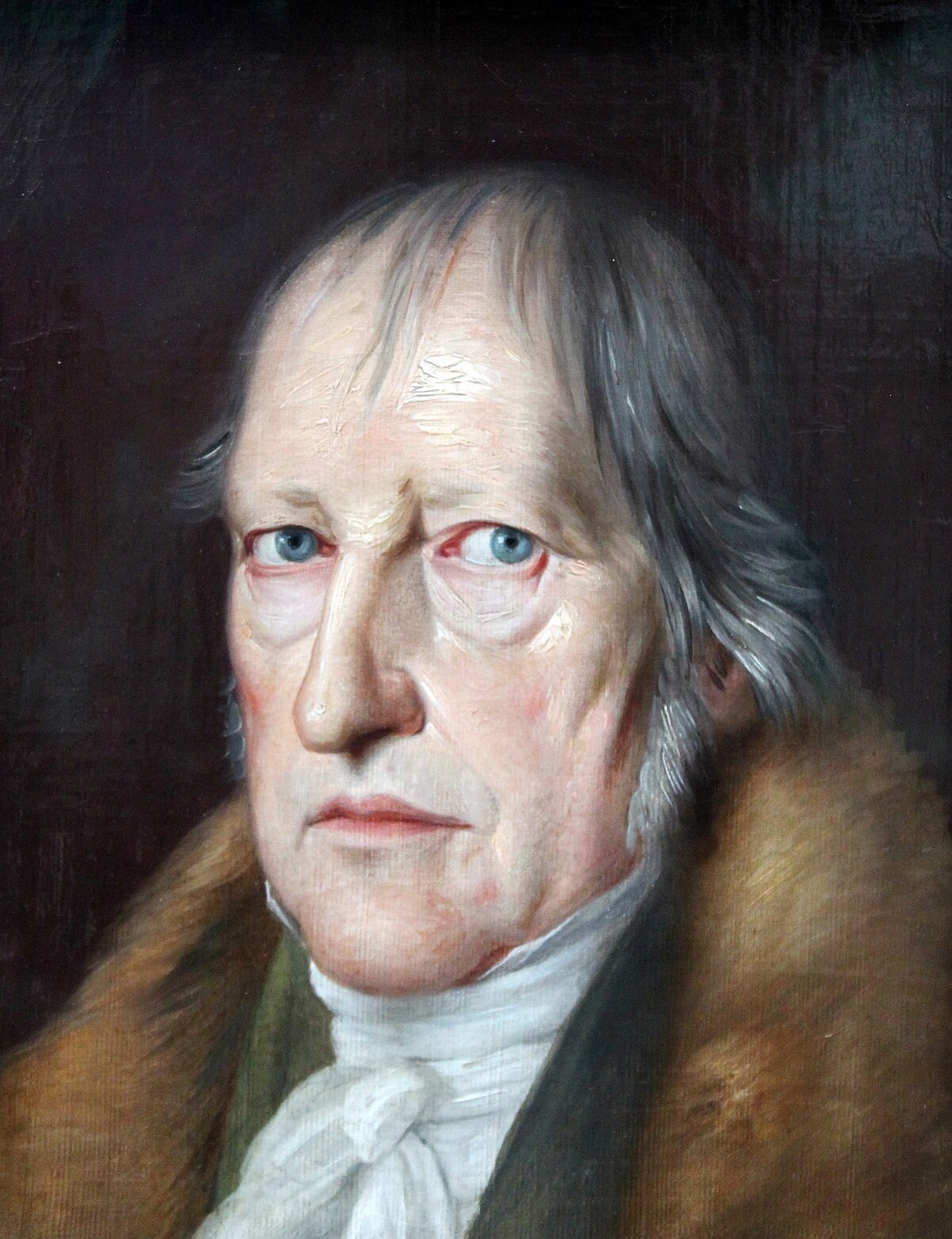
G.W.F. Hegel
Dates: 1770–1831 Domain: Philosophy, Dialectical Logic, Philosophy of History
Biography
Georg Wilhelm Friedrich Hegel was born in Stuttgart in 1770 and died in Berlin in 1831, reportedly of cholera, though some accounts suggest he had been failing for months. He was born the same year as Beethoven and Hölderlin; all three attended the Tübingen seminary together, where they planted a liberty tree in celebration of the French Revolution and read Rousseau, Kant, and each other. The young Hegel who walked in the snow to meet Napoleon — calling him "the World-Soul on horseback" — is a figure as far from the Berlin professor of the 1820s as can be imagined, and the distance between them is itself a Hegelian movement.
The Phenomenology of Spirit (1807) was written at extraordinary speed — Hegel reportedly finishing the final pages as Napoleon's cannon shook the windows at Jena. It is the most ambitious philosophical text of the modern period: an account of consciousness's journey through all its forms — from sense-certainty through perception, force and understanding, self-consciousness, reason, spirit, religion, and finally to Absolute Knowing — in which each form is shown to be internally inconsistent and driven by that inconsistency to a higher form. The Aufhebung: the dialectical movement of cancellation-and-preservation — is Hegel's technical term for this: each stage is negated, but what is true in it is preserved in the negation.
The Phenomenology's movement is structurally katabatic: consciousness descends through alienation — the master-slave dialectic, the unhappy consciousness, the terror of the French Revolution — and emerges through these encounters into the Absolute Knowing that is not a return to the original naïveté but an informed identity that has absorbed its own negation. This is Hegel's secular version of the initiatory structure: the consciousness that has risked itself in alienation and returned from it enriched rather than destroyed.
His Berlin lectures — on aesthetics, on philosophy of history, on the philosophy of religion — show the system applied to cultural history. The Lectures on Aesthetics propose that art has served its purpose and that philosophy now does what art once did: make the Absolute explicit to itself. This is the point at which the project most directly engages and departs from Hegel — because the claim that art has passed its peak into the domain of philosophical prose is exactly what the Romantic poets, and the project's own method, argue against.
Key Works (in library)
| Work | Year | Relevance |
|---|---|---|
| Phenomenology of Spirit | 1807 | The katabasis of consciousness through alienation to Absolute Knowing |
| Science of Logic | 1812–1816 | The dialectical logic that underlies the Phenomenology |
| Lectures on Aesthetics | 1835 (posthumous) | Art as the sensuous appearance of the Idea; the claim that art's moment has passed |
| Lectures on the Philosophy of Religion | 1832 (posthumous) | Religious consciousness as a stage in Spirit's self-knowledge |
Role in the Project
Hegel occupies a specific position in the Western Canon track: he is the thinker who attempts to re-open, by means of dialectical logic, the territory that Kant closed, and he does so by arguing that the thing-in-itself is not inaccessible but is the process of Spirit knowing itself through its own self-alienation. This is philosophically impressive, but the engagement with Hegel follows Kierkegaard's objection: the system dissolves the individual into the process of Spirit, replacing the living person with a logical moment in an already-concluded argument.
The Phenomenology's most important section is the "Unhappy Consciousness" — the moment in which self-consciousness, having established its freedom from nature and from the other (the master-slave dialectic), finds itself divided against itself, unable to inhabit either the changeable world of finite existence or the unchangeable world of eternal truth. This is the condition of the religious consciousness as Hegel analyzes it — and it is the condition that the initiatic traditions were designed to address. Whether Hegel's dialectical resolution of this condition is genuine or merely conceptual is the question the project holds open.
Key Ideas
- The Dialectic: The movement of thought through thesis, negation (Antithesis), and Aufhebung: the cancellation that preserves. Each form of consciousness contains its own negation and is driven by that internal contradiction to a higher form.
- Master-Slave: The analysis of self-consciousness as requiring recognition from another — and the discovery that the Master, by requiring the Slave's recognition, has made himself dependent on the recognition of one he regards as less than himself. Consciousness knows itself only through the mediation of what it negates.
- Unhappy Consciousness: The moment when self-consciousness cannot reconcile itself with either its finite or its infinite dimension — when the religious consciousness seeks the Absolute and finds itself divided from it. This is the initiatory condition without the initiatic resolution.
- The End of Art: Hegel's claim in the Aesthetics that art has served its historical function and that philosophy now does what art once did. This claim — which the Romantics and the project dispute — is the most consequential philosophical position on the status of aesthetic experience in modernity.
Connections
- German Idealism: FIG-0048 Schelling (contemporary and rival; Schelling's Philosophy of Nature represents the road not taken by Hegel's more rigorous logic), FIG-0075 Kant (Hegel responds to Kant throughout), FIG-0072 Nietzsche (Nietzsche's hammer is aimed partly at the Hegelian teleology of history)
- Consciousness structure parallels: FIG-0003 Gebser (consciousness structures as an alternative to Hegelian dialectical history), FIG-0002 Barfield (the evolution of participation as Barfield's non-dialectical response to the same historical problem)
Agent Research Notes
[AGENT: perplexity | DATE: 2026-03-22] Hegel died November 14, 1831; the cholera diagnosis was disputed by his physician, who thought it was gastroenteritis. The Phenomenology was completed in extreme haste in Jena in 1806–1807 as Hegel watched Napoleon's army defeat the Prussians. The liberty tree planting at Tübingen with Hölderlin and Schelling is reported but not definitively confirmed. Robert Pippin's Hegel's Idealism (1989) and Charles Taylor's Hegel (1975) are the best contemporary scholarly treatments in English.