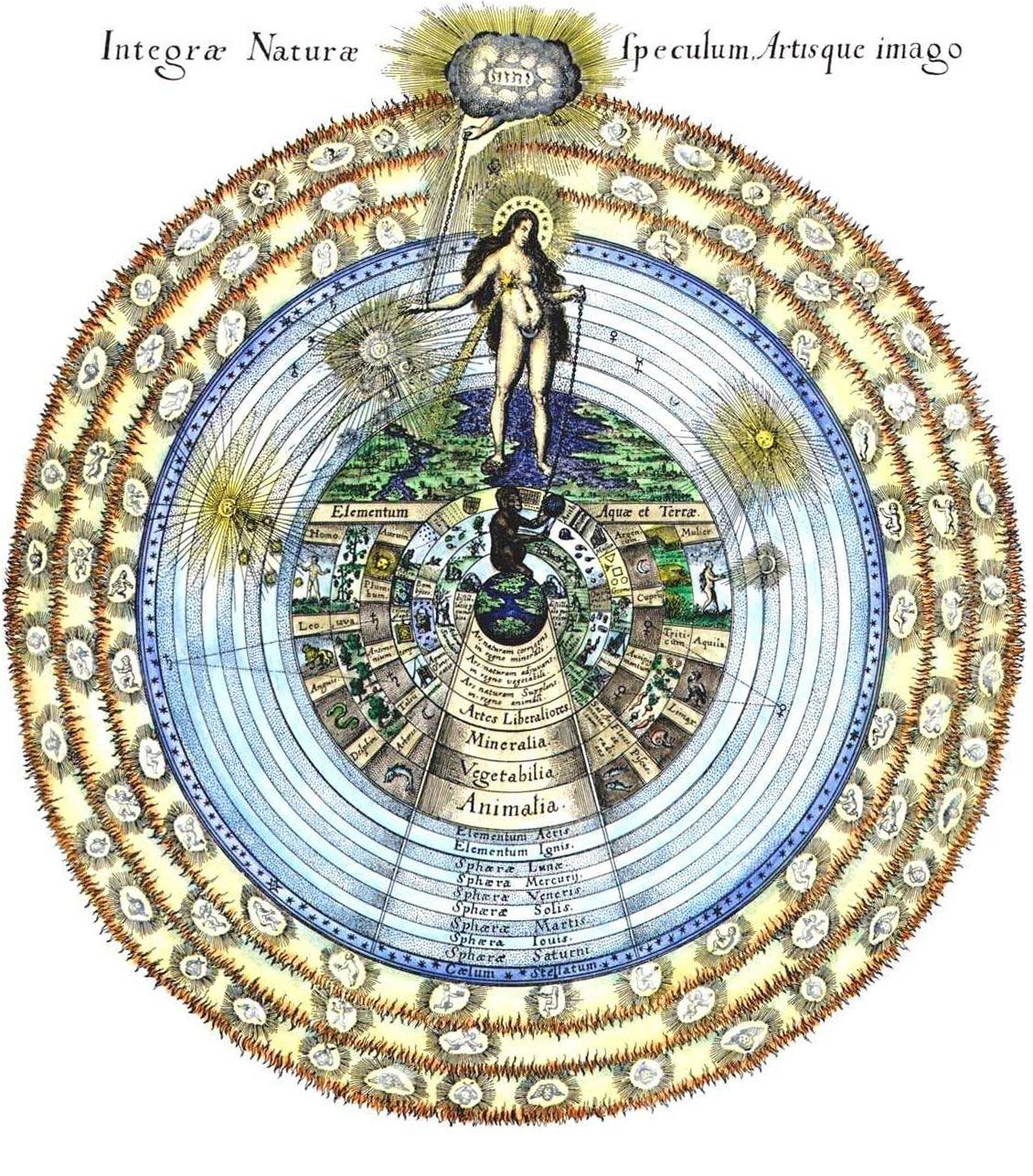
Anima Mundi
Definition
Anima mundi, World Soul, is the doctrine that the cosmos is not a collection of inert matter governed by external forces but a living, ensouled being organized from within by a principle of life and intelligence. The doctrine appears in Plato's Timaeus (c. 360 BCE), where the Demiurge fashions the World Soul as an intermediate principle between the intelligible forms and the material world, giving the cosmos its rotational motion, its capacity for sensation, and its participation in the eternal Forms. The World Soul is woven through the cosmos as a living field, and individual souls are portions of this field that have descended into mortal bodies.
The Neoplatonic tradition, particularly Plotinus (Enneads IV, 3-4), developed this doctrine into its most sophisticated form. For Plotinus, the World Soul is the third hypostasis of his triadic metaphysics (the One, Intellect, Soul), the principle that mediates between the pure intelligibility of Intellect and the sensible world it generates. The World Soul is simultaneously the life of the cosmos and the principle of individual souls; what appears as the multiplicity of living things is the World Soul's self-expression in matter. Essentially, for Plotinus, individual souls are not isolated within individual bodies but remain continuous with the World Soul even in their embodied state — the ordinary sense of individual isolation is a contraction of awareness, not a metaphysical fact.
The Stoic tradition ran a parallel current: their concept of the pneuma: a divine, intelligent fire that permeates all things — served the same philosophical function as the World Soul, making the cosmos a unified living organism whose parts are connected by a continuous medium. Stoic physics grounds Stoic ethics: because all human beings share in the same divine pneuma, they form a single world-community; and because the logos structures all things, rational acceptance of what is, amor fati, is the proper philosophical stance.
What unites these formulations is their practical consequence: a living cosmos is a cosmos that responds, that carries signatures, that participates in the activities performed within it. Correspondences, divination, magic, theurgy, and the efficacy of sacred ritual all depend on the World Soul as their metaphysical guarantee. When Ficino aligns a planetary hour, chooses the right image, plays the appropriate music, and opens himself to the influence of the solar principle through contemplation, he is working on the premise that the sun is not merely a gravitational body but a soul, a living intelligence whose influence can be drawn down into a prepared human vessel through the medium of the World Soul.
Tradition by Tradition
Platonic (Timaeus)
Plato's account in the Timaeus is mathematically elaborate: the World Soul is constructed by the Demiurge from a mixture of the Same, the Different, and Being, and woven into two intersecting circles corresponding to the celestial equator and the ecliptic. The mathematical precision is not ornamental: it shows that the World Soul is not an arbitrary vital principle but a structured intelligence whose order is the cosmic order. The harmony of the spheres — the Pythagorean doctrine that the planets' motions produce inaudible music — depends on the World Soul as the principle that makes the cosmos a musical whole.
Neoplatonic (Plotinus)
Plotinus extends and complicates the Platonic doctrine in the Enneads. For Plotinus, the World Soul has two aspects: an upper soul that remains in uninterrupted contemplation of the Intellect, and a lower nature that generates and sustains the material cosmos. Individual souls correspond to this structure: there is a part of the human soul that has never descended, that remains in permanent contact with the Intellect, even while another part is entangled in bodily life. The project of philosophy and contemplation, for Plotinus, is to awaken to the undescended part — to discover that one's deepest self never left the divine source. This is not self-help optimism but a precise metaphysical claim: the soul's connection to the World Soul guarantees that its return to the One is always already possible.
Hermetic and Renaissance
The Hermetic texts (the Corpus Hermeticum) presuppose the World Soul throughout but theorize it most explicitly in tractates like the Asclepius, where the cosmos is described as a "great god" whose body is the material world and whose soul is the divine pneuma. Marsilio Ficino's synthesis draws on both the Platonic and Hermetic versions of anima mundi for his theory of natural magic (De Vita, 1489). Ficino's magic is not demonic but solar: by understanding which earthly things are sympathetically connected to which heavenly principles through the medium of the World Soul, the philosopher-magician can attract and concentrate beneficial spiritual influences. The World Soul is the medium through which these sympathetic connections operate.
Stoic
Marcus Aurelius's Meditations give the most accessible expression of the Stoic World Soul: "All things are woven together and the common bond is sacred, and scarcely anything is alien to another. For all things are arranged together and together they make up the one order of the world. There is one world made up of all things, one god who pervades all things, one substance, one law." This is the World Soul as the ground of ethics: because all things share in one life, human action participates in the life of the whole.
Romantic Naturphilosophie (Schelling)
The German Romantic Naturphilosophie — especially F.W.J. Schelling's Ideas for a Philosophy of Nature (1797) and World Soul (Von der Weltseele, 1798) — represents the most serious post-Cartesian attempt to recover anima mundi within an empirically informed framework. Schelling argues that nature is not dead mechanism but unconscious spirit, and that natural science's own discoveries (electricity, magnetism, chemical affinity) point to a dynamic, organic, self-organizing principle in nature that the mechanistic framework cannot account for. His approach was eventually displaced by 19th-century mechanism, but it anticipated aspects of 20th-century systems theory and process philosophy.
Project Role
Anima mundi is the metaphysical backdrop against which the Mystery Schools project's central argument is set. The project's claim is not merely historical, "these traditions existed", but diagnostic: the loss of genuine initiatory traditions in the West is connected to the loss of the living cosmos as a working metaphysical premise. The specific causal claim matters: when the world ceased to be ensouled, the practices that depended on a living, responsive world lost their context. Divination, theurgy, sacred geography, and ritual efficacy all presuppose anima mundi; they cannot be transplanted into a mechanistic cosmos without fundamental distortion.
The project does not simply advocate returning to anima mundi as literal cosmology — this would be naive. It examines the doctrine as a hypothesis about what kind of cosmos makes mystery-tradition practices coherent, and asks what would have to be true about the world for these practices to have been what practitioners claimed they were.
Distinctions
Anima mundi vs. panpsychism: Contemporary panpsychism (the view that consciousness or experience is a fundamental feature of all matter) is not the same as anima mundi. Panpsychism ascribes a form of experience to individual physical entities; anima mundi describes a single World Soul that permeates and organizes the cosmos as a whole. Anima mundi is a stronger, more integrated claim.
Anima mundi vs. the Gaia hypothesis: James Lovelock's Gaia hypothesis argues that Earth's biosphere operates as a self-regulating system — a homeostatic organism in a cybernetic sense. This is a scientific claim, not a metaphysical one; Gaia does not require a World Soul, only a systems dynamic. The convergence with anima mundi is suggestive but the concepts should not be conflated.
Anima mundi vs. animism: Animism (the attribution of spirit to individual natural objects) is distributed; anima mundi is unified. For the animist, the tree has a spirit; for the Neoplatonist, the tree participates in the World Soul. The difference is significant: anima mundi provides a unified metaphysical field, not a collection of discrete spiritual entities.
Primary Sources
- Plato, Timaeus (c. 360 BCE): The founding statement of the World Soul doctrine in the Western tradition, with its mathematical account of the Soul's construction by the Demiurge.
- Plotinus, Enneads IV, 3-4 (c. 250 CE): The most sophisticated Neoplatonic analysis of the World Soul and its relationship to individual souls and to the sensible cosmos.
- Marsilio Ficino, Three Books on Life (De Vita, 1489): The Renaissance application of anima mundi to medical and magical practice, arguing for a spiritus mundi that connects celestial and earthly principles.
- F.W.J. Schelling, Von der Weltseele (1798): The most serious post-Cartesian philosophical attempt to recover the World Soul concept within a framework informed by empirical natural science.
- David Abram, The Spell of the Sensuous (1996): A contemporary phenomenological argument for the animacy of the perceptual world, drawing on Merleau-Ponty and indigenous oral traditions as convergent evidence that the world is alive in ways that Western modernity has systematically suppressed.
Agent Research Notes
[AGENT: perplexity | DATE: 2026-03-22] The most pressing question for the project is whether anima mundi can be taken seriously as more than a historical curiosity. Three options: (1) literal metaphysical commitment — the World Soul is real; (2) regulative ideal — we should act as if the world were ensouled, because this posture produces better attention; (3) phenomenological description — the experience of a living, responsive world is real even if the ontological claim is underdetermined. The project's approach is likely closest to (3): taking the experience of a living world seriously without requiring a commitment to Neoplatonic metaphysics as a precondition. This connects directly to the Hardening concept: the elimination of anima mundi was not a scientific achievement but a metaphysical decision, and that decision had consequences.