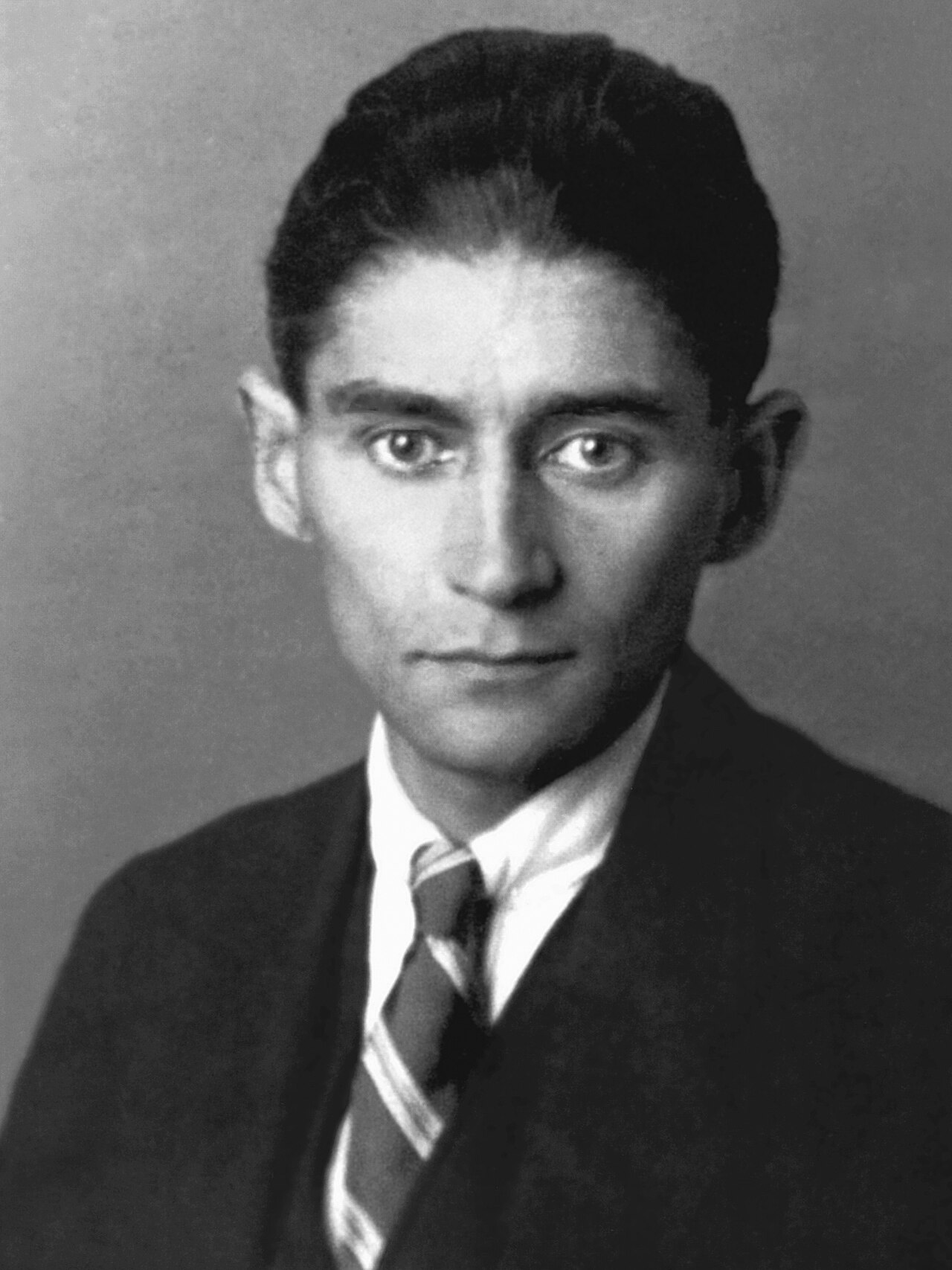
Franz Kafka
Dates: 1883–1924 Domain: Fiction, Literature, Parable
Biography
Franz Kafka was born in Prague in 1883, the son of a self-made Jewish merchant — Hermann Kafka, whose vigorous, contemptuous practical authority loomed over his son's entire life and occupies the center of the famous Letter to His Father (1919), which was never delivered. He trained as a lawyer and worked for the Workers' Accident Insurance Institute of the Kingdom of Bohemia from 1908 until tuberculosis forced his retirement in 1922 — a bureaucratic job, involving the assessment of workplace accident claims, that was not background to his writing. It is structurally continuous with it. He watched, from the inside, how institutional systems process human suffering: classifying it, routing it through procedures, arriving at decisions whose logic the claimants cannot follow, for reasons they cannot access.
He was, by all accounts, a genuinely funny man — his friends recalled him reading his work aloud, laughing until he had to stop. The grimness of the received image of Kafka is partly the projection of later interpreters and partly the filtering effect of the work's subject matter when removed from the performative context of its original reading. He wrote in German in a city where his social position was threefold marginal: Jewish in a predominantly Catholic Czech society, German-speaking in an increasingly Czech nationalist environment, and an intellectual in a commercial family that regarded his writing as an expensive hobby. He never resolved the engagement with Felice Bauer; he never resolved the engagement with Julie Wohryzek; he did not marry Dora Diamant, with whom he spent his last year in Berlin. He died in a sanatorium in Kierling, Austria, on June 3, 1924.
The Trial (1914–1915, published posthumously 1925) begins with Josef K. Waking on the morning of his thirtieth birthday to find himself arrested. He is not told the charge. He is not told who has accused him. He is routed through a series of proceedings — the initial interrogation in a Sunday suburb, the encounter with the court painter Titorelli whose knowledge of the law comes from his father's connection to judges he has never met — that progressively reveal an institution of unfathomable extent whose logic is inscrutable and whose outcomes are predetermined. The priest in the cathedral tells Josef K. The parable of the doorkeeper and the man from the country who waits his entire life at a door that was meant for him alone and never enters. Josef K. Is executed "like a dog" in a quarry. He never learns what his crime was.
The Castle (written 1921–1922) is structurally parallel: the Land Surveyor K. Arrives in a village, having been summoned by the Castle to perform his work, and spends the entire novel attempting to reach the Castle or make contact with its officials. Every approach brings another deflection. Every official encountered reveals only that the system has levels above and below them. K. Never reaches the Castle. The novel is unfinished. Kafka died before completing it, and the unfinishedness is not a flaw but structurally appropriate.
Key Works (in library)
| Work | Year | Relevance |
|---|---|---|
| The Trial | 1925 (written 1914–1915) | Initiation refused; the threshold without a door |
| The Castle | 1926 (written 1921–1922) | The authority that cannot be reached; the summons without arrival |
| The Metamorphosis | 1915 | The initiatory transformation imposed without consent or meaning |
| In the Penal Colony | 1919 | Law inscribed on the body; the judgment that precedes the reading |
Role in the Project
Kafka's position in the Modern Labyrinth series is as the diagnostic inverse of initiatic structure. The Mysteries provided a guide, a path, a known sequence from separation through liminality to incorporation. Kafka's fictions are organized around the systematic absence of every one of these elements: the charge is unknown, the guide is unreachable, the procedure is inaccessible, and incorporation never occurs. What remains — the summons, the anxiety, the sense of guilt whose object cannot be identified — is the religious experience of the threshold without the tradition that would make it navigable.
Walter Benjamin's reading of Kafka as a man "without a teacher" — someone who has lost the living oral tradition that once transmitted wisdom and finds himself in possession of parables whose interpretation has been lost — is the key secondary text for this entry. Kafka's parables are correct in form and empty of content in the specific sense that their content requires a living tradition to be received. The man from the country waits at the door all his life because he does not know that you just walk in. He never knew, because no one told him. This is the project's most precise image of the modern condition's relationship to initiatic knowledge.
Key Ideas
- Initiation Denied: Kafka's fictions systematically enact the initiatic structure — summons, threshold, trial, potential transformation — while withholding every element that would make the structure navigable. The form is recognizable; the content has been removed.
- The Judgment That Precedes Guilt: In both The Trial and In the Penal Colony, the legal machinery operates independently of any crime the accused has actually committed. The sentence is prior to the verdict; the verdict is prior to the trial. This is the bureaucratic inversion of grace.
- The Parable of the Doorkeeper: The parable in The Trial's penultimate chapter is Kafka's most direct statement of the threshold problem. The door was always open; it was always meant for the man from the country; he never entered. The law's protection of its own threshold from the person it addresses is the structure of all Kafka's work.
- Benjamin's Kafka: Walter Benjamin's reading — that Kafka inhabits a world where the wisdom has been preserved in gestural form but its content has been lost — is the primary interpretive framework for this figure.
Connections
- Modern Labyrinth series: FIG-0080 Joyce (the labyrinth navigated, however painfully), FIG-0087 Borges (the labyrinth as metaphysical condition), FIG-0081 Eliot (the Waste Land as the territory Kafka maps)
- Diagnostic parallels: FIG-0013 Heidegger (Gestell as the structure within which Kafka's characters move), FIG-0046 Dick (the Black Iron Prison as Gnostic version of Kafka's system)
- Conceptual: CON-0001 Initiation (Kafka as the systematic inversion of the initiatic structure)
Agent Research Notes
[AGENT: perplexity | DATE: 2026-03-22] Kafka's instruction to Max Brod to burn all unpublished manuscripts after his death is documented in their correspondence; Brod published everything instead. The Trial was dictated in German (Der Proceß) in the autumn of 1914 during a period of intense productivity. Benjamin's essay on Kafka (1934) is in Illuminations (translated by Hannah Arendt, Schocken Books, 1969). Milan Kundera's essays on Kafka in The Art of the Novel (1986) are valuable secondary material. The connection between Kafka's insurance work and his fiction is analyzed in Benno Wagner's essay in Kafka's Selected Stories (Norton Critical Edition, 2007).