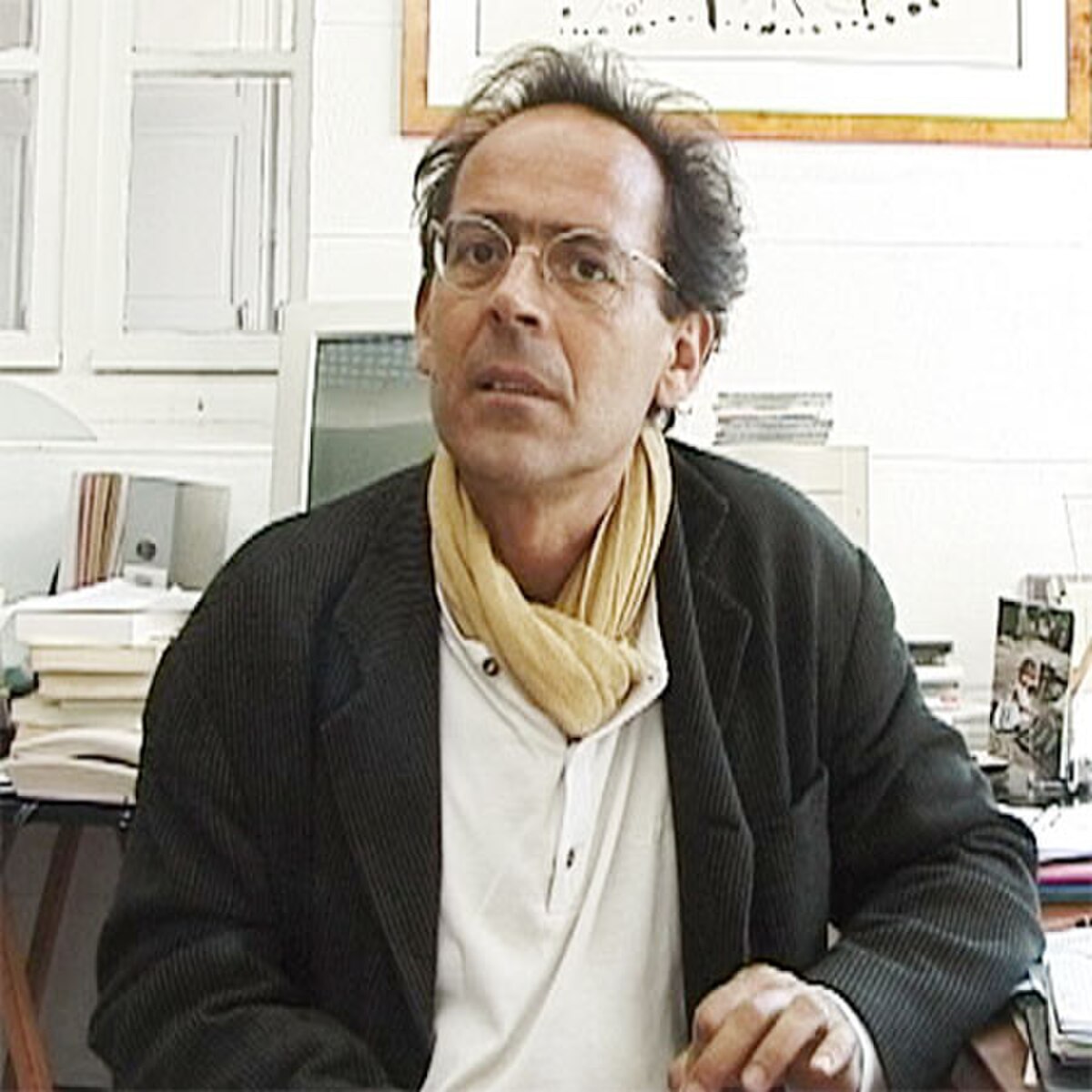
Bernard Stiegler
Dates: 1952–2020 Domain: Philosophy of Technology, Phenomenology, Political Philosophy
Biography
Bernard Stiegler was born in Villebon-sur-Yvette, France, in 1952. His intellectual biography has an unusual feature: he read Plato, Kant, and Heidegger for the first time in prison, where he was serving a five-year sentence for armed robbery (he was involved in a series of bank robberies in the late 1970s). He earned his doctorate under Jacques Derrida, and his prison years became a central motif of his thinking: the encounter with philosophy under conditions of radical constraint gave him a direct experience of what he would theorize as the care of the self against the proletarianization of existence. He died by suicide on August 5, 2020. He had written extensively about finitude, about what makes life worth living; the manner of his death does not resolve but intensifies those questions.
The central concept of Stiegler's philosophy is the pharmakon — borrowed from Derrida's reading of Plato's Phaedrus, where Socrates calls writing a drug that is simultaneously cure and poison. Stiegler radicalized this: every technology is a pharmakon, including fire, language, money, and digital computation. Technology does not merely extend human capacities; it transforms them, and the transformation can be either liberating or enslaving depending on how the technology is used, who controls it, and whether the users are capable of a pharmacology: a practice of discernment about the drug they are consuming.
His Technics and Time series — of which three volumes appeared (1994, 1996, 2001) and additional volumes were in preparation at his death — is his most sustained philosophical project. Building on Heidegger's analysis of technics and Derrida's analysis of différance, Stiegler developed an account of the co-constitution of the human and the technical: the human being is not a biological animal that subsequently invented tools, but a being that is constituted by its technical exteriorizations. What we call "memory" has always been distributed across tools — from the Neolithic handaxe to the manuscript codex to the digital database. Tertiary retention (technical memory-objects: books, recordings, databases) is the medium through which the human being constitutes its temporal experience and its cultural transmission.
The political dimension of this analysis concerns proletarianization: the process by which technical systems progressively absorb and eliminate human knowledge, skill, and attention. The industrial proletarianization of the nineteenth century eliminated manual skill (the worker no longer needed to know how to make the product, only how to operate the machine). The twentieth-century proletarianization of the service economy eliminated cognitive skill. The twenty-first century's algorithmic proletarianization is eliminating the capacity for long-form attention, emotional discernment, and what Stiegler called savoir-vivre (the knowledge of how to live). This is not merely an economic or technological problem; it is a crisis of care — a systematic degradation of the human being's capacity to invest in and maintain the forms of life that make existence worth living.
The link to the Mystery Schools project is direct: what the Mysteries transmitted was, precisely, the kind of knowledge that cannot be reduced to information — the savoir-faire and savoir-vivre of the initiated consciousness. The digitization of esoteric content — the availability of every initiatic text online, the YouTube lecture series on Kabbalah or alchemy — represents exactly the pharmakon dynamic Stiegler diagnosed: the content is more available than ever, and the conditions for genuinely receiving it are more degraded than ever.
Key Works (in library)
| Work | Year | Relevance |
|---|---|---|
| Technics and Time, Vol. 1: The Fault of Epimetheus | 1994 | The philosophical foundation: the co-constitution of the human and the technical |
| What Makes Life Worth Living: On Pharmacology | 2010 | The pharmacological analysis of contemporary existence; care as the response to the pharmakon |
| Symbolic Misery, Vol. 1 | 2004 | The proletarianization of aesthetic and symbolic life; the destruction of the capacity for genuine aesthetic attention |
Role in the Project
Stiegler gives the project its contemporary diagnostic vocabulary. The Mysteries were systems for transmitting a specific kind of attention — a quality of consciousness that cannot be packaged and distributed but only cultivated through direct relationship and disciplined practice. The contemporary digital environment applies maximum pharmaceutical pressure on exactly this capacity. The podcast format itself, the project's chosen medium, is a tertiary retention technology, and Stiegler's framework demands that we ask: what does this medium do to the content it carries? Does the audio-on-demand format constitute the wisdom traditions as background content for multitasking, or can it be used differently? The project's production choices, pacing, length, density, are implicitly answers to this pharmacological question.
Key Ideas
- Pharmakon: Every technology is simultaneously cure and poison; the appropriate response is not refusal but pharmacology — a disciplined practice of discernment about one's relationship to the drug.
- Tertiary Retention: Technical memory-objects (books, recordings, databases) are not mere external storage of pre-formed human memory but are constitutive of the human temporal experience itself.
- Proletarianization: The progressive elimination of human knowledge, skill, and attention by technical systems that perform functions previously requiring human cultivation.
- Care (Souci): The practice through which human beings maintain and invest in the forms of life and knowledge that make existence worth living; threatened by the attentional economy.
- Pharmacology: Not the refusal of technology but the disciplined practice of understanding what each technology does to consciousness — and responding with deliberate counter-practices.
Connections
- Influenced by: FIG-0013 Heidegger (primary philosophical framework), Jacques Derrida (the pharmakon concept, the supplement), Gilbert Simondon (individuation theory), André Leroi-Gourhan (paleoanthropology of technics)
- Influenced: FIG-0058 Yuk Hui (student; extended the cosmotechnics analysis), contemporary philosophy of technology, the attention economics discussion
- In tension with: Purely optimistic accounts of digital technology, techno-utopianism, and the assumption that more information access equals more genuine knowledge
Agent Research Notes
[AGENT: perplexity | DATE: 2026-03-22] Stiegler's dates are confirmed 1952–2020. His death on August 5, 2020 was publicly described as suicide by his colleagues and family. He had discussed his relationship to death and finitude extensively in his work, including in Passing to the Act (2003). The Institut de recherche et d'innovation (IRI) at the Centre Pompidou was the institutional base for much of his later work. The Technics and Time series was originally published by Galilée (Paris); English translations by Stanford University Press. His final project, Bifurquer (2020), proposed an alternative economic model in response to the COVID-19 crisis and was published posthumously.