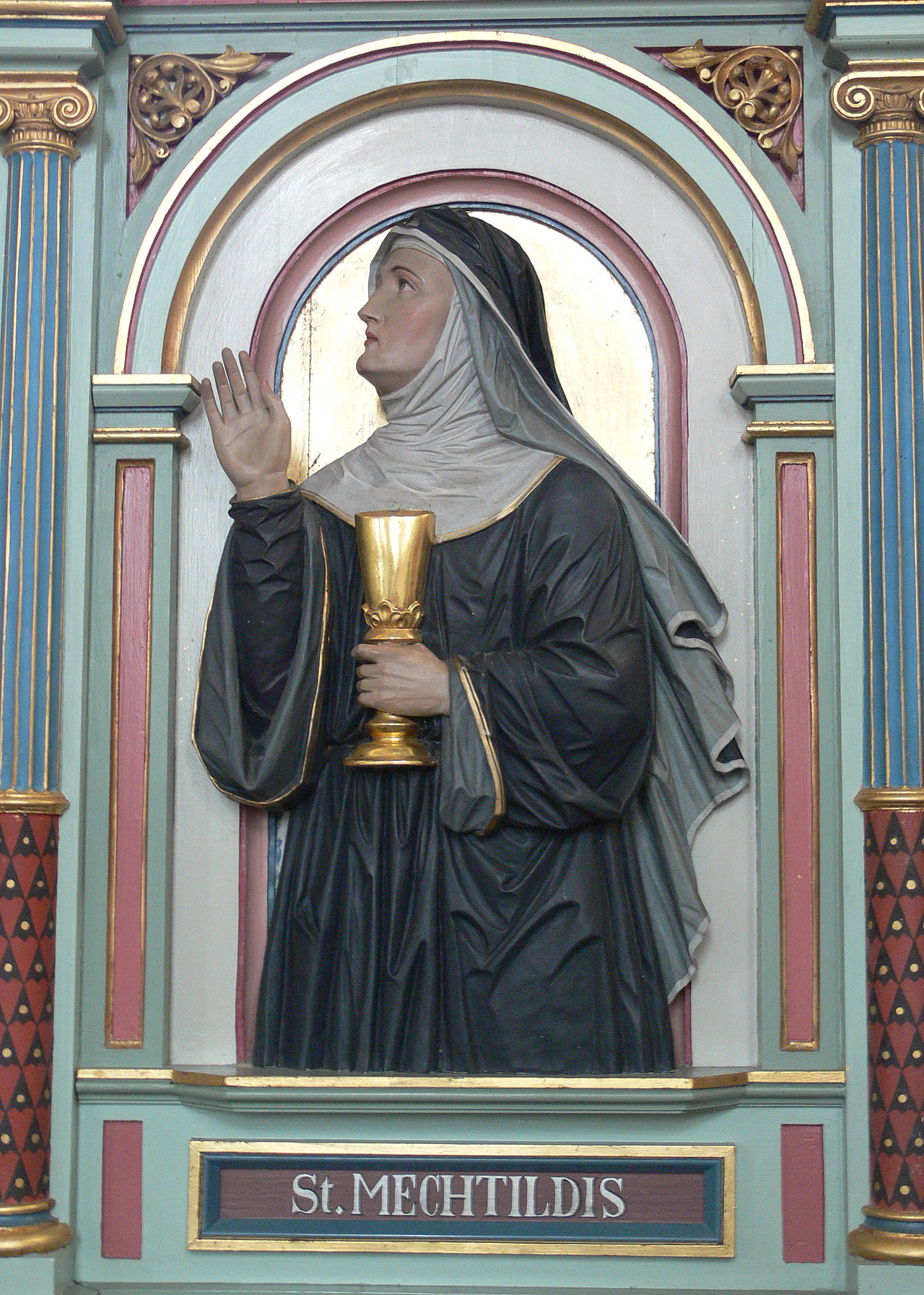
Mechthild of Magdeburg
Dates: c. 1207–c. 1282/1294 Domain: Christian Mysticism, Beguine Movement, Vernacular Literature, Erotic Mysticism
Biography
Mechthild of Magdeburg was born around 1207 in the vicinity of Magdeburg, Saxony — the family and circumstances are unrecorded. She received a grace, as she describes it, from the Holy Spirit at age twelve, and from that point her spiritual life was governed by the experience of God's love as a force that alternately consumed and withdrew, producing both ecstatic union and agonized longing. She joined the Beguine movement in Magdeburg around 1230 — choosing the unaffiliated, unprotected life of the beguinage over the institutional protection of a religious order — and began dictating her visions and spiritual experiences to her Dominican confessor Heinrich von Halle around 1250.
Das Fliessende Licht der Gottheit, The Flowing Light of the Godhead, was composed in Low German over approximately thirty years (c. 1250–1282), making it the earliest major work of German vernacular mysticism and one of the most extraordinary texts in medieval spiritual literature. It is not structured as a theological treatise or a systematic spiritual itinerary; it moves freely between poetry and prose, between dialogue and vision, between direct address to God and description of the soul's interior states. The God who speaks in its pages is not a distant judge but a lover — and the soul who responds is not a supplicant but a partner who can reproach, argue, and withdraw.
She faced opposition in Magdeburg — her book was reportedly threatened with burning — and around 1270 she moved to the Cistercian convent at Helfta, which was also home to Gertrude of Helfta and Mechthild of Hackeborn, making the convent the most concentrated center of mystical experience in thirteenth-century Germany. She continued dictating there until near her death, which occurred around 1282 or as late as 1294.
The erotic vocabulary of the Flowing Light is not metaphor in the sense of something that points to something else — it is the most direct available language for the quality of the experience Mechthild is describing. The soul goes to God as a young woman goes to her lover; she dances before him; he leads her into a secret chamber; there is consummation that she cannot describe in any other terms; there is withdrawal that is as physical as the union was; and the longing between encounters is as specific as the longing of the Song of Songs, which Mechthild knew well. Bernard of Clairvaux's commentary on the Song of Songs is her most direct predecessor, and she exceeds him in the directness with which she applies the erotic language to her own first-person experience rather than to an allegorical figure.
Key Works (in library)
| Work | Year | Relevance |
|---|---|---|
| The Flowing Light of the Godhead | c. 1250–1282 | Erotic mysticism in German vernacular; the soul as lover rather than supplicant |
Role in the Project
Mechthild completes the Women's Mysteries track's trilogy alongside Teresa and Porete. Teresa maps the stages; Porete reaches the annihilation; Mechthild inhabits the erotic intensity between them — the soul fully present in its longing, not yet dissolved into the divine, not yet charting the stages of approach, but living in the continuous oscillation of encounter and withdrawal that erotic mystical literature makes its central subject.
Her contribution to the track is specific: the gendered, embodied quality of her mystical language. She speaks as a woman to a God who relates to her soul as a lover relates to the beloved — and this is not merely a literary convention. It is her account of the actual quality of the experience, the way the divine approaches and withdraws with a specificity that only the erotic vocabulary can capture. No other figure in the KB makes this claim with this combination of phenomenological precision and literary force.
The connection to Bataille (FIG-0064) is structural though not direct: Bataille's analysis of eroticism as the dissolution of the bounded self into continuity is the secular philosophical account of what Mechthild is describing from within mystical theology. The longing she describes is the bounded self pressing against its own boundary; the consummation is the temporary dissolution of that boundary; the withdrawal is the restoration of bounded selfhood that makes the longing possible again. Mechthild does not need Bataille's framework; Bataille's framework helps us see what Mechthild is doing.
Key Ideas
- The Flowing Light: Mechthild's central image — the light that flows from God into the soul and the soul's response as a flowing back. Not a static illumination but a dynamic exchange, a circulation of love that is also a transformation of the soul.
- The Soul as Dancer Before God: Her recurring image of the soul's initial approach — a young woman who dances before God with complete freedom and beauty. The dance is the soul's proper mode of existence, freely expressing its nature before the divine.
- The Desert of the Godhead: Mechthild also knows the divine as desert — vast, empty, without the consolations of image or feeling. This dimension of the mystical experience, parallel to the Spanish mystics' noche oscura, complicates the erotic warmth of the Flowing Light's most famous passages.
- God's Longing for the Soul: One of Mechthild's most distinctive theological contributions — not the soul's longing for God. It is God's longing for the soul. The divine love is not self-sufficient condescension but genuine desire that requires the soul's response.
Connections
- Women's Mysteries track: FIG-0061 Teresa (stages of union), FIG-0067 Porete (annihilation vs. Mechthild's persistent selfhood), FIG-0062 Hildegard (cosmic vision vs. Mechthild's intimate encounter)
- Erotic mysticism comparison: FIG-0064 Bataille (secular philosophical account of what Mechthild's erotic language describes from within mystical theology), FIG-0041 Rumi (the longing-and-union dynamic in the Islamic Sufi tradition)
- German mystical tradition: FIG-0040 Eckhart (her contemporary — Eckhart and Mechthild both at the peak of German medieval mysticism)
Agent Research Notes
[AGENT: perplexity | DATE: 2026-03-22] The date of Mechthild's death is uncertain; the convent chronicles at Helfta are incomplete. Her Fliessende Licht was preserved partly through a Latin translation made by Heinrich von Halle and a complete Middle Low German version discovered in Einsiedeln in 1861. Frank Tobin's English translation (Paulist Press, 1998) is the standard scholarly edition. Saskia Murk-Jansen's Brides in the Desert: The Spirituality of the Beguines (Darton, Longman & Todd, 1998) contextualizes Mechthild within the Beguine movement. The connection between erotic mysticism and the theological concept of the soul's femininity in relation to God is analyzed in Bynum's Jesus as Mother (1982).