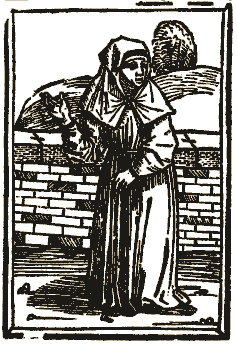
Marguerite Porete
Dates: d. 1310 Domain: Christian Mysticism, Beguine Movement, Vernacular Theology
Biography
Almost nothing is known of Marguerite Porete's life before her trial and execution. She was a Beguine — a member of a lay religious movement of women who lived a devotional life without taking formal vows, outside any recognized religious order, with no institutional protection and no male authority to speak for them. The Beguines occupied an ambiguous position in late medieval Christendom: their piety was genuine and often intense, but their independence from the Church's official structures made them objects of persistent suspicion. Marguerite was from Hainaut (in what is now Belgium), wrote in Old French, and at some point before 1296 completed Le Mirouer des simples ames anienties — The Mirror of Simple Souls Annihilated in the Will of Love.
The book was condemned and publicly burned by the Bishop of Cambrai, and Marguerite was warned not to circulate it. She continued to circulate it. She was brought before the Inquisition, refused to swear to answer questions, refused to present her case — a silence that, in the inquisitorial framework, constituted heretical obstinacy. She was burned in Paris on June 1, 1310. Her keeper, an inquisitor named Guillaume de Paris who was also the confessor of King Philip IV, attended the execution and reported that the crowd was moved to tears by the manner of her death.
The book survived anonymously. For centuries it was attributed to a male author; it was translated into Latin, Italian, and English and circulated in Carthusian and Augustinian monasteries. The identification of Marguerite Porete as its author came through the work of historian Romana Guarnieri in 1946, who found a reference in a trial record. The Mirror thus entered the scholarly record not as a condemned heretic's text but as the anonymous mystical treatise it had become — and its reception history is part of its meaning.
The Mirror of Simple Souls is structured as a dialogue between Love (Amour), Reason, and the Soul — three figures whose conversations enact the argument the book makes. Its central claim is that the soul, through successive stages of self-abandonment, can arrive at a condition in which it has no will of its own — not the suppression of will but its complete dissolution into divine will, so complete that the distinction between divine will and no-will ceases to be meaningful. Reason is not the antagonist but the stage that must be left behind: Reason can bring the soul to the threshold of this condition, but it cannot enter with her. What Porete calls the seventh stage, the state of the Annihilated Soul, is described as total freedom, because there is no self remaining to be constrained. This is the position the Church found threatening: a soul so dissolved into God that it requires no priest, no sacrament, no institutional mediation.
Key Works (in library)
| Work | Year | Relevance |
|---|---|---|
| The Mirror of Simple Souls | c. 1296 (burned 1310) | The only surviving text; seven-stage annihilationist mystical theology in vernacular French |
Role in the Project
The Women's Mysteries series positions Porete as the limit case against which Teresa's negotiation with institutional authority takes its full meaning. Teresa wrote under obedience, submitted to theological scrutiny, and produced an account of the seventh mansion that was certified orthodox by her confessors — partly because she carefully described the soul's experience in terms that preserved its dependence on God and Church. Porete reached the same destination, or claimed to reach it, and described it in terms that made institutional mediation structurally unnecessary. The Church's response was consistent with its logic: it burned her.
What this contrast reveals is not simply a biographical tragedy but a structural fact about mystical authority in Western Christianity: the further the contemplative goes, the more the experience itself becomes evidence against the institution's indispensability. Teresa survived this logic through a combination of diplomatic skill, strategic reticence, and the protection her Carmelite reform gave her. Porete did not survive it, and did not try to. The difference between them is the Women's Mysteries series' most precise exhibit of how institutional power intersects with the deepest levels of contemplative experience.
Key Ideas
- The Seven Stages of the Soul: Porete's map of the soul's journey into dissolution — not identical to Teresa's seven mansions but structurally parallel and theologically more radical, since Porete's seventh stage involves the complete annihilation of the soul's separate will.
- The Annihilated Soul: The soul in the final stage has no will, no desire, no selfhood that is separable from divine love. It is not God, the distinction is not quite dissolved, but it no longer has a perspective from which to relate to God as other.
- Reason's Limit: Reason is portrayed in the Mirror not as an enemy but as a stage — necessary, honorable, and ultimately inadequate. The soul must take Reason to the threshold and then leave it behind. This anticipates Eckhart and goes further.
- Anonymous Transmission: The book's centuries of anonymous circulation in monastic settings, read as an orthodox mystical text by people who did not know its author was a condemned heretic, raises the question of what counts as transmission and what counts as interruption.
Connections
- Women's Mysteries tradition: FIG-0061 Teresa (the contrast: institutional navigation vs. institutional refusal), FIG-0062 Hildegard (sanctioned visionary authority), FIG-0106 Mechthild (flowing light, erotic annihilation)
- Mystical annihilationism: FIG-0040 Eckhart (Gelassenheit, the grunt, the ground where God and soul meet — Eckhart was indicted and died before his case was decided; Porete was not offered that exit), FIG-0015 Weil (decreation as willed self-annihilation in a modern secular key)
- CON-0007 Apophatic (the negative theology tradition Porete inhabits at its most extreme)
Agent Research Notes
[AGENT: perplexity | DATE: 2026-03-22] Romana Guarnieri's identification of Porete published in 1946 in L'Osservatore Romano; full scholarly publication in Archivo Italiano per la Storia della Pietà (1965). The 1310 execution date and the detail about Guillaume de Paris come from the inquisitorial trial records partially preserved in Vatican archives. The English Middle English translation of the Mirror (preserved in Pembroke College, Cambridge MS 221) was likely made by a Carthusian monk in the early fifteenth century. Modern scholarly edition by Romana Guarnieri; English translation by Ellen Babinsky (Paulist Press, 1993). Michael Sells's Mystical Languages of Unsaying (University of Chicago, 1994) contains important analysis of Porete's negative mystical language.