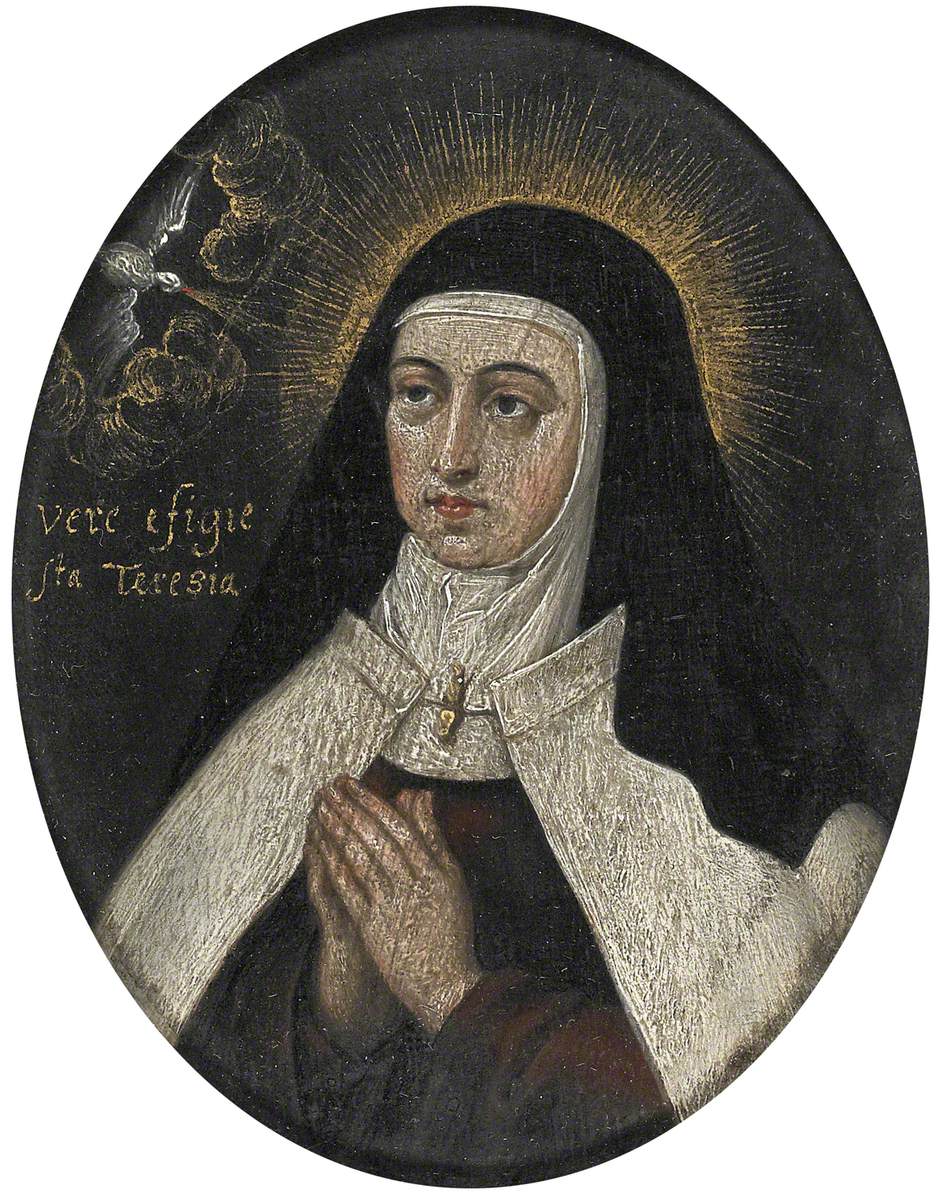
Teresa of Ávila
Dates: 1515–1582 Domain: Christian Mysticism, Carmelite Reform, Contemplative Psychology
Biography
Teresa de Cepeda y Ahumada was born in Ávila, Castile, in 1515, to a family of converso origin — her grandfather had been forced to undergo public penance for secretly practicing Judaism. This heritage of concealed interiority, of an inner life held apart from official scrutiny, runs through her entire career as a mystic and reformer. She entered the Carmelite Convent of the Incarnation at Ávila in 1535 and spent the next twenty years struggling with illness, distraction, and the gap between the prayer life demanded by her vocation and the actual texture of her interior experience. Her account of this period in La Vida: the autobiography written under obedience to her confessor — is one of the most honest documents of the contemplative life's difficulty that Christian literature has produced. She does not claim early mastery. She describes failure, backsliding, and the long years during which she could not settle into mental prayer at all.
The transformation came in her early forties, around 1555, when she began experiencing what she described as oración de quietud and later oración de unión — progressively deeper states in which the normal operations of the mind were suspended and the soul was, as she put it, entirely occupied by God. These experiences needed both description and defense: the Spanish Inquisition was actively investigating alumbrados — "illuminated" Christians suspected of claiming direct divine access that bypassed the Church's mediation — and a woman describing mystical states without clerical endorsement was in genuine danger. Teresa's response was to document everything with scrupulous attention to detail and to submit it all to theological review. The Way of Perfection (c. 1566) and The Interior Castle (1577) are the fruits of this double labor: they are simultaneously spiritual instruction and implicit argument that what she describes is orthodox, recognizable, and reproducible.
The Interior Castle (Las Moradas del Castillo Interior) structures the soul's approach to God as movement through seven concentric dwelling-places, each representing a stage of prayer and self-knowledge. The first three mansions involve practices within normal human capacity — vocal prayer, meditation, recollection. The fourth begins the transition to what Teresa calls oración sobrenatural: states that cannot be induced by will but can be prepared for. The fifth mansion brings the first genuine union, brief and unmistakable. The sixth is the long ordeal of mystical betrothal — periods of intense grace alternating with darkness, humiliation, and what she describes with characteristic plainness as spiritual torment. The seventh mansion is the spiritual marriage: a permanent, stable transformation of the soul's center, not a repeated ecstatic state but a change in what the soul fundamentally is. The architecture of the Castle maps psychic territory with a specificity that is without parallel in the Christian mystical tradition.
She died in 1582 having founded seventeen Discalced Carmelite convents across Spain and cofounded the men's branch of the reform with John of the Cross. She was canonized in 1622 and declared a Doctor of the Church in 1970 — the first woman to receive that designation.
Key Works (in library)
| Work | Year | Relevance |
|---|---|---|
| The Interior Castle (Las Moradas) | 1577 | Seven-stage initiatory map of the soul's approach to union |
| The Life (Vida) | c. 1565 | Spiritual autobiography; phenomenology of contemplative failure and breakthrough |
| The Way of Perfection | c. 1566 | Practical instruction for Carmelite community; theology of mental prayer |
| The Book of Foundations | 1573–1582 | Account of the reform; mystical authority exercised in institutional context |
Role in the Project
Teresa's contribution to the Women's Mysteries series is structural, not merely illustrative. The Interior Castle provides a seven-stage initiatory map of the Christian interior life that has genuine structural analogies to initiatic schemata in other traditions — and genuine differences that matter. The seven mansions are not the same as the Neoplatonic ascent, because the subject of the Castle is not the soul climbing toward the One but the soul discovering that God is already at its center, and that all the stages are stages of removing what prevents the soul from inhabiting what is already there. This is a different topology from Plotinian ascent, and the difference is theologically and experientially significant.
What Teresa reveals that no other figure in the KB captures is the phenomenology of mystical experience from within a Christian institutional structure that simultaneously licensed and constrained it. Pseudo-Dionysius theorizes the ascent; Eckhart philosophizes it; Teresa describes what it is like to be in it, the exact quality of the dryness in the third mansion, the specific sensation of what she calls recogimiento as it differs from ordinary recollection, the way the intellect goes quiet before the will follows. This precision makes the Interior Castle the most practically informative document of contemplative experience the project draws on from the Christian tradition.
Key Ideas
- The Seven Mansions: The soul's movement toward its divine center as seven stages of deepening interiority — each with specific phenomenological characteristics, specific resistances, specific indicators of authentic progress versus self-deception.
- Oración Mental vs. Sobrenatural: The defining distinction between prayer as active human effort (which the first three mansions engage) and prayer as passive reception of divine action (which begins in the fourth). The transition is not achieved but received.
- The Silk Worm: Teresa's central metaphor for the soul in the fifth mansion — the silkworm building its cocoon from the material of its own activity, dying inside it, and emerging transformed as something that cannot fly back into what it was.
- Spiritual Marriage: Not ecstasy or vision but a permanent alteration in the soul's center — what she distinguishes carefully from spiritual betrothal, which is intense but unstable. The seventh mansion is not a peak but a new ground.
- Authority Through Experience: Teresa wrote under obedience and with institutional permission, but her authority derives not from that permission but from the specificity and consistency of what she describes. Her argument is that the experiences are real because they are precise.
Connections
- In the Women's Mysteries track alongside: FIG-0062 Hildegard (vision as cosmos), FIG-0067 Marguerite Porete (annihilation beyond the Church), FIG-0106 Mechthild (erotic mystical language)
- Theological kinship with: FIG-0040 Eckhart (the ground of the soul, Gelassenheit), FIG-0010 Pseudo-Dionysius (apophatic trajectory), FIG-0015 Weil (decreation, the soul's abdication)
- In tension with: FIG-0067 Marguerite Porete (Teresa navigated institutional constraint; Marguerite refused it and was burned)
Agent Research Notes
[AGENT: perplexity | DATE: 2026-03-22] Teresa canonized 1622 by Gregory XV; declared Doctor of the Church by Paul VI, September 27, 1970. Las Moradas written in 1577 in approximately four months at the urging of her confessor Jerónimo Gracián. The Vida was written c. 1562–1565 under instruction from confessor Pedro Ibáñez and submitted to the Inquisition; it circulated only in manuscript during her lifetime. Her converso ancestry documented by scholarship including Teófanes Egido's work. The distinction between her approach and Porete's is the project's organizing contrast for the Women's Mysteries institutional question.