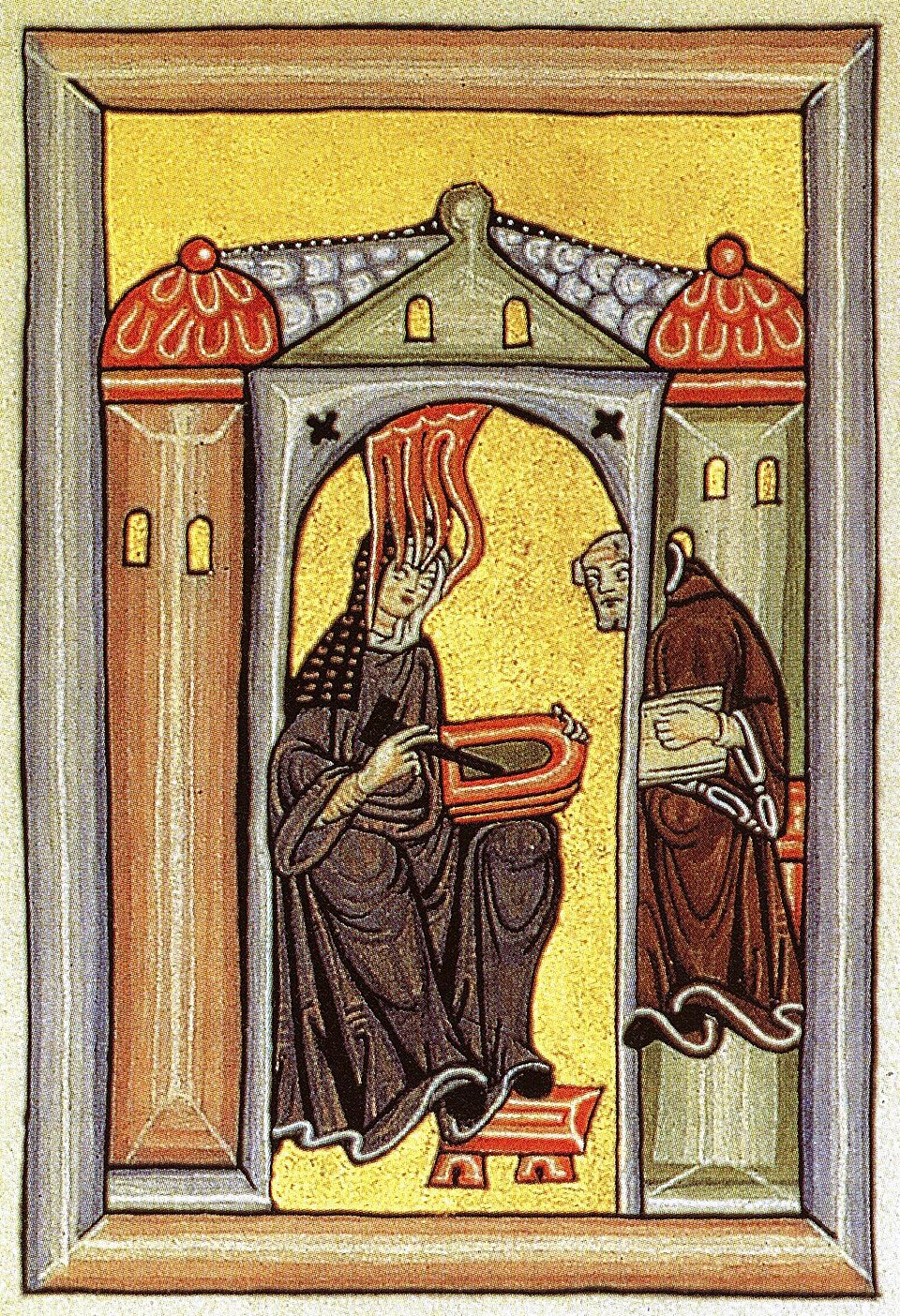
Hildegard of Bingen
Dates: 1098–1179 Domain: Christian Mysticism, Benedictine Theology, Music, Natural Philosophy
Biography
Hildegard was born in 1098 in Bermersheim vor der Höhe in the Rhineland, the tenth child of a noble family, and was offered to the Church as a tithe — literally her parents' tenth. She was enclosed with the anchoress Jutta of Sponheim at Disibodenberg from childhood, living under Benedictine rule as part of a small female community. From early childhood she experienced what she called the umbra viventis lucis, the reflection of the living light, a continuous luminous field through which she perceived not ordinary objects but their inner forms and divine meanings. She did not initially write about these experiences, describing them as a burden she had borne since infancy in silence. The command to speak came in 1141, when she was in her early forties, arriving with such force that she fell ill and recovered only when she began dictating Scivias to her monk-secretary Volmar.
Scivias, Know the Ways, was completed around 1151 and contains twenty-six visions, each described in elaborate visual detail and then interpreted in extended theological commentary. The visions include a cosmic egg, a figure of the Church as a crowned woman, a city of virtues in which the personified virtues combat vices, and the architecture of salvation as Hildegard sees it laid out in living light. These are not allegories in the ordinary sense: Hildegard insists, with considerable force, that she sees these things while fully awake — not in dreams or ecstatic states but in what she calls the living light itself, which she perceives in and through ordinary waking perception. This claim of visionary authority in a full waking state was unusual enough that she sought and received official endorsement from Bernard of Clairvaux and Pope Eugenius III, which partly accounts for why her works survived when so many female mystics' texts were lost.
Her two subsequent major visionary works, Liber Vitae Meritorum and De Operatione Dei, complete a cosmic trilogy. The former maps the moral life through a series of dialogues between virtues and vices; the latter presents an elaborate cosmological vision in which the human body replicates the cosmos and the cosmos reflects the divine body. Central to all three is the concept of viriditas — greenness, living vitality, the greening force that God breathes into creation and that contemplative life must keep flowing. Sickness, both physical and spiritual, is a drying-out, a loss of viriditas. Her medical writings (Physica, Causae et Curae) extend this insight into systematic natural philosophy: the same vital force that animates prayer animates plants, and the same force that dries up in spiritual desolation manifests as bodily disease.
Her musical output — over seventy surviving compositions, the largest medieval single-composer body of plainchant outside the liturgical tradition — is not separable from her theology. She described herself as a feather on the breath of God (pluma de vi Dei portata), a phrase that captures the precise phenomenology she ascribes to composition: not creation but reception. Her Ordo Virtutum, the earliest surviving morality play with music, stages the drama of the soul's temptation and return, with the Devil unable to sing — he can only shout. Music, for Hildegard, is the mode of being that preceded the Fall and to which the soul returns in mystical union.
Key Works (in library)
| Work | Year | Relevance |
|---|---|---|
| Scivias | c. 1141–1151 | First major visionary work; cosmic architecture of salvation described from vision |
| De Operatione Dei | c. 1163–1174 | Cosmological trilogy's culmination; human-cosmos correspondence |
| Symphonia armonie celestium revelationum | c. 1150s | Complete musical works; music as theology, not illustration |
| Physica | c. 1150s | Natural philosophy; viriditas as medical-spiritual concept |
Role in the Project
In the Women's Mysteries series, Hildegard represents a mode of female mystical authority that operates through cosmological scope rather than interiority alone. Teresa maps the soul's inner rooms; Hildegard maps the soul within the cosmos, which is itself the soul writ large. No other figure in the KB joins these domains — music, medicine, cosmology, and visionary theology — in a single operative concept (viriditas) that is neither metaphor nor doctrine but a perceived reality.
Her insistence on waking vision rather than ecstatic trance gives the project a precise phenomenological datum to work with: what is the difference between seeing in trance and seeing in the umbra viventis lucis during ordinary wakefulness? Hildegard's descriptions of this distinction anticipate, in different vocabulary, the project's broader distinction between mystical states that require abnormal conditions and the more radical claim that reality is permanently available to a differently organized perception. That question — whether the Mysteries cultivated temporary states or permanent perceptual transformation — is one the project carries, and Hildegard presses on it from the twelfth century.
Key Ideas
- Viriditas: The greening force, divine vitality as it flows through creation — present in plants, human bodies, and the spiritual life equally. Its absence is illness; its presence is health in every dimension simultaneously.
- The Living Light and Its Shadow: Hildegard's two modes of visionary perception — the lux vivens (living light) itself, which she glimpsed only in moments of great intensity, and the umbra viventis lucis (shadow of the living light), the continuous luminous field through which she perceived the forms of things.
- Music as Pre-lapsarian Language: Hildegard's theology of music as the mode of being that preceded the Fall. Speech is fallen; song returns the soul toward its original condition. This is why the Devil cannot sing.
- Cosmic Body / Human Body: The De Operatione Dei vision of the cosmos as a living body whose proportions are reproduced in the human form — microcosm-macrocosm correspondence as visionary datum rather than inherited doctrine.
Connections
- In the Women's Mysteries track with: FIG-0061 Teresa (interior stages), FIG-0067 Porete (annihilation), FIG-0106 Mechthild (erotic mystical language)
- Rhineland mystic lineage: FIG-0040 Eckhart (Gelassenheit, Godhead); theologically precedes the Rhineland movement
- Cosmological resonance with: FIG-0005 Plotinus (emanation as cosmic vitality), FIG-0026 Bruno (cosmos as living body), CON-0026 Anima Mundi
Agent Research Notes
[AGENT: perplexity | DATE: 2026-03-22] Hildegard declared Doctor of the Church by Benedict XVI on October 7, 2012 — the fourth woman and 35th person to receive the title. The feather on the breath of God phrase comes from her preface to Scivias and has been widely used by subsequent commentators. The Ordo Virtutum predates the next known liturgical drama by several decades. Her endorsement by Bernard of Clairvaux and Pope Eugenius III at the Synod of Trier (1147–1148) was the institutional validation that protected her from charges of presumption. Sabina Flanagan's Hildegard of Bingen: A Visionary Life and Barbara Newman's Sister of Wisdom are standard scholarly sources.