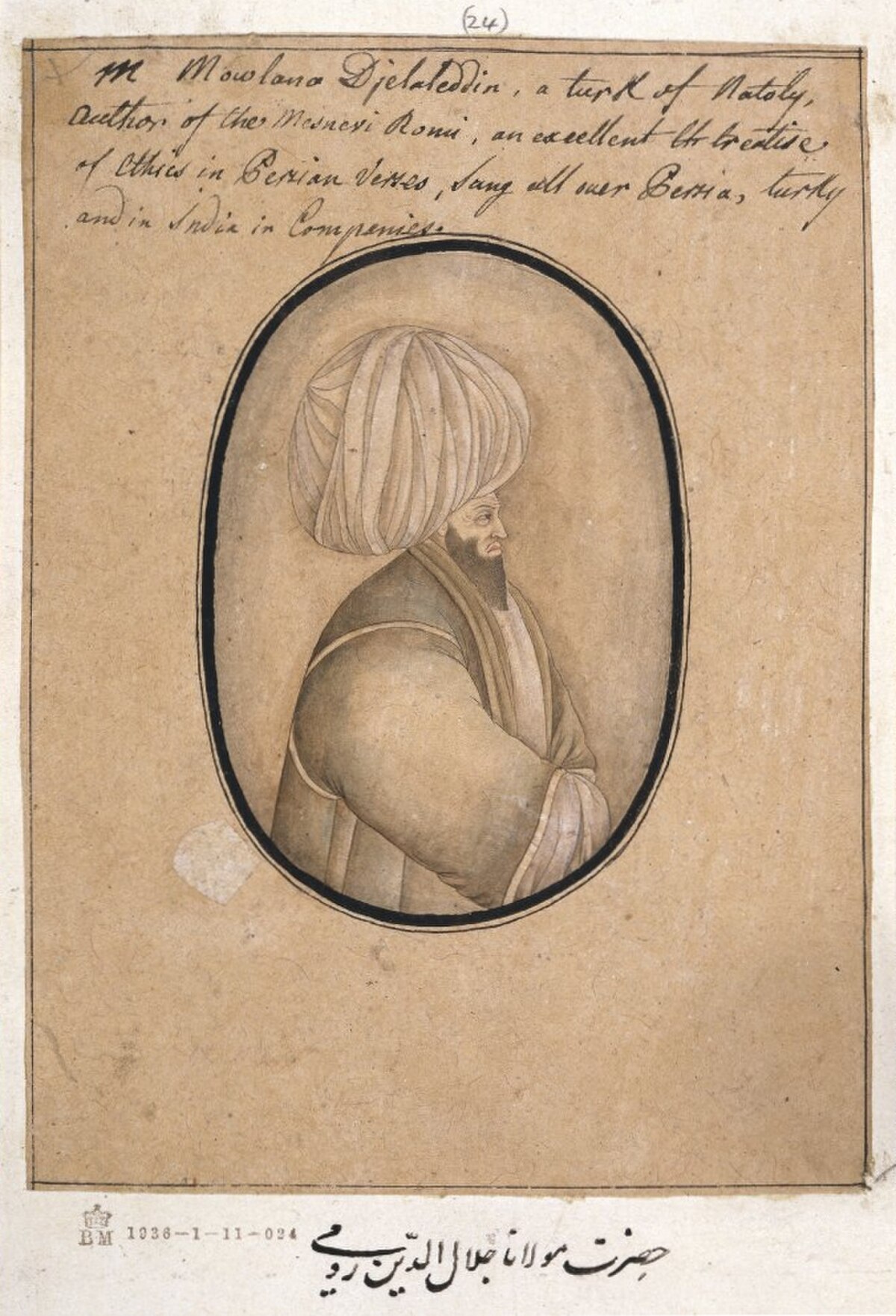
Jalāl al-Dīn Rūmī
Dates: 1207–1273 Domain: Sufi Poetry, Mystical Theology, Persian Literature
Biography
Jalāl al-Dīn Rūmī was born in Balkh (in present-day Afghanistan) in 1207 and emigrated with his family westward during the Mongol invasions, eventually settling in Konya (in present-day Turkey), then part of the Seljuk Sultanate. His father Bahā' al-Dīn Walad was a Sufi scholar and teacher, and Rumi was educated in Islamic jurisprudence, theology, and Sufi thought from childhood. He had established himself as a respected legal scholar and Sufi teacher in Konya when, in 1244, he encountered the wandering dervish Shams-e Tabrizi — a figure of such spiritual intensity and such uninstitutionalized wildness that the meeting broke Rumi open entirely. The two men engaged in extended seclusion, conversation, and what can only be called mutual spiritual transformation. Shams provoked in Rumi the dissolution of his established scholarly identity and the emergence of the poet.
Shams disappeared twice — once driven away by the jealousy of Rumi's students, and finally disappearing for good (probably murdered, possibly by those same students) around 1248. Rumi responded with the Divan-e Shams-e Tabrizi, the "collected works of Shams", a vast collection of lyric poetry written in the voice of love, loss, and dissolution, in which the absent Shams functions as the beloved whose loss catalyzes the poem's movement toward the divine. The Divan is a document of grief that is simultaneously a manual of transformation: Shams becomes identified with the divine Beloved, and the poems' longing for the absent teacher becomes the longing of the soul for its source.
The Masnavi-ye Ma'navi (Spiritual Verses), composed from approximately 1258 until his death in 1273, is the work on which Rumi's enduring reputation rests. Six books, approximately 25,000 couplets, written in rhyming Persian verse with a narrative core that continually dissolves into digressions, stories within stories, and extended meditations on Quranic verses, Sufi teaching stories, and philosophical arguments. The opening eighteen verses, the Nay poem, the reed's lament, are among the most concentrated and most analyzed poems in world literature. The reed (the flute cut from the reed bed) cries from separation from its origin; everyone who hears the cry recognizes their own longing. This is not a metaphor for spiritual yearning; it is the direct enactment of it. Rumi's claim is that the poem works on the reader the way music works on the body: not by transmitting information but by inducing a state.
The Mevlevi Order — founded by Rumi's son Sultan Walad after Rumi's death in 1273 — institutionalized the practice of sama (spiritual listening and movement) and developed the sema ceremony that Westerners know as the Whirling Dervishes. The rotating movement is not performance but practice: a physical enactment of the soul's orbit around the divine center, the way the planets orbit the sun. The right hand is raised to receive divine blessing; the left hand is lowered to transmit it to the earth. The turning is both the methodology and the argument: by making the body an instrument of circular motion, the dancer moves the ordinary self aside and allows something larger to turn through it.
Rumi's popularity in the modern West — he has been, by some metrics, the best-selling poet in the United States — is both a tribute to the genuine power of the work and a warning about its domestication. The translations most widely circulated (particularly those by Coleman Barks, who does not read Persian) strip the Islamic theological context from the poems and present them as a kind of universal spirituality of love and acceptance. The project engages Rumi in the full context of his Islamic Sufism, reading him alongside Corbin's account of the imaginal world and Ibn Arabi's metaphysics of unity.
Key Works (in library)
| Work | Year | Relevance |
|---|---|---|
| Masnavi-ye Ma'navi | c. 1258–1273 | The central work; 25,000 couplets of Sufi teaching in narrative-lyric form |
| Divan-e Shams-e Tabrizi | c. 1244–1248 | The lyrics of loss and transformation; Shams as the absent divine Beloved |
| Fihi Ma Fihi (In It What Is in It) | c. 1258–1273 | Prose talks; the accessible entry to Rumi's thought |
Role in the Project
Rumi is the project's evidence that the initiatory tradition in the Islamic world operated through a different vehicle than in the West — through poetry and music rather than through the philosophical dialogue and ritual of the Western Mysteries — but was aiming at the same transformation. The Masnavi's structure, which continually breaks its narrative line through digressions and returns, enacts in literary form the initiatory pattern: the ordinary self (the narrative line) is repeatedly interrupted, dissolved, and reconstituted at a different level. The reader who follows the poem with full attention is, Rumi's tradition claims, doing the equivalent of the Sufi practice of dhikr (remembrance): the repetition of divine names as a technique for dissolving the ego's identification with its ordinary contents. The project also uses Rumi to challenge the assumption that the initiatory tradition is primarily a Western or a Greek phenomenon.
Key Ideas
- The Reed's Longing: Separation from the source as the very condition of the soul's existence; the cry of longing is not a problem to be solved but the engine of the spiritual path.
- Sama (Spiritual Listening): The use of music, poetry, and movement to induce states of consciousness that ordinary speech cannot produce; the Mevlevi ceremony as technology.
- The Absent Beloved: The structure of Rumi's mature poetry, organized around the absent Shams/God, as itself a teaching: the soul's most productive state is one of active longing rather than comfortable possession.
- Performative Poetry: The poem as enactment rather than description — not telling the listener about transformation but inducing it; form and content as inseparable.
- Fana (Annihilation): The Sufi concept of the dissolution of the individual self in the divine — not destruction but transformation; the ego as the reed cut from the reed bed, which can only make music because it has been cut.
Connections
- Influenced by: Shams-e Tabrizi (the transformative encounter), FIG-0042 Ibn Arabi (the metaphysical framework; whether direct influence is disputed, the parallel is structural), the Sufi tradition generally, Sanai and Attar (Persian Sufi poets)
- Influenced: The Mevlevi Order (institutional perpetuation), the global Sufi movement, the modern Western reception of Persian poetry
- In tension with: FIG-0042 Ibn Arabi (different approach — Ibn Arabi is metaphysical, Rumi is lyrical and performative), the legalist and literalist traditions within Islam
Agent Research Notes
[AGENT: perplexity | DATE: 2026-03-22] Rumi's dates are confirmed 1207–1273. The Masnavi was begun around 1258 at the instigation of Rumi's disciple Husam Chelebi and continued until Rumi's death; it was not completed — the sixth book ends mid-sentence. The Mevlevi Order was suppressed in Turkey in 1925 under Atatürk's reforms; it was revived as a cultural rather than religious institution and is now UNESCO-recognized as "Intangible Cultural Heritage." The most scholarly English translation of the Masnavi is by Jawid Mojaddedi (Oxford, 2004–). For the project's use, William Chittick's The Sufi Path of Love (1983) provides the best contextual analysis.