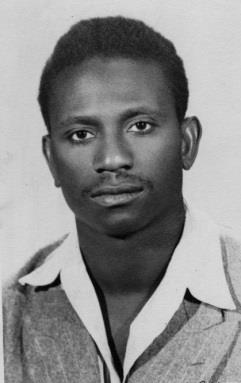
Cheikh Anta Diop
Dates: 1923–1986 Domain: African History, Anthropology, Linguistics, Egyptology
Biography
Cheikh Anta Diop was born in Diourbel, Senegal, in 1923, and spent much of his career at IFAN (Institut Fondamental d'Afrique Noire) in Dakar, where he built a physics laboratory alongside his historical and anthropological research — an unusual combination that reflects his commitment to bringing scientific methodology to his historical claims. He received his doctorate from the Sorbonne only in 1960, after two doctoral committees had rejected his work; the eventual acceptance came only after he had already achieved international recognition.
His central thesis — that ancient Egypt was a Black African civilization in its origins, its population, and its cultural character, and that Greek civilization drew heavily from Egyptian sources — was developed across multiple works over four decades. Nations nègres et culture (1954), his first major work, established the framework; L'Antiquité africaine par l'image and the later Civilization or Barbarism (1981) elaborated it with increasingly systematic evidence. His methodology combined linguistic analysis (arguing that ancient Egyptian was closely related to modern Wolof and other Berber-Nilotic languages), physical anthropological data (melanin analysis of Egyptian mummies), classical sources (Greek historians' descriptions of the physical appearance of Egyptians), and iconographic evidence (the visual record of Egyptian art).
His work was contested and remains contested in mainstream Egyptology, which tends to view ancient Egyptians as a distinct North African population not straightforwardly identical with either sub-Saharan African or Semitic peoples. But his challenge to the European treatment of Egypt — which had consistently minimized or denied its African character — opened questions that serious scholarship cannot close without engaging his evidence.
Key Works (in library)
| Work | Year | Relevance |
|---|---|---|
| The African Origin of Civilization: Myth or Reality | 1974 | The central thesis; English synthesis of his earlier French works |
| Civilization or Barbarism | 1981 | The mature systematic statement; evidence assembled with full rigor |
| The Cultural Unity of Black Africa | 1959 | The cultural framework; matriarchal vs. patriarchal civilizational types |
Role in the Project
Diop belongs in the Living Traditions series because his work forces the project to engage the question of whose mystery tradition it is investigating. If the Egyptian tradition — which stands at the source of the Hermetic, Neoplatonic, and early Christian mystical streams the project traces — was an African civilization, then the "Western" mystery tradition is partly an African tradition that was appropriated through Greek, Roman, and Christian intermediaries. The project acknowledges this without resolving it: Diop's thesis is contested, the evidence is complex, and the question of what "African" means at civilizational scale requires care.
What is not contested is that his challenge is serious and his evidence is substantial, and that the engagement with Egypt (through FIG-0036 Hermes Trismegistus, FIG-0038 Apuleius, FIG-0095 Plutarch) cannot be complete without acknowledging this dimension.
Key Ideas
- Egypt as African Civilization: The central claim — that Egypt's civilization was African in origin, population, and cultural character, not a Mediterranean civilization distinct from its sub-Saharan neighbors.
- The Linguistic Evidence: Diop's argument that ancient Egyptian and modern Wolof (and related West African languages) share foundational vocabulary and grammatical structures that point to a common ancestor.
- Two Cradles Theory: Diop's framework distinguishing a Northern (Indo-European, patriarchal, nomadic) and Southern (African, matriarchal, agricultural) cradle of civilization — a schema the project engages critically while using it heuristically.
- Civilizational Continuity: The argument that the mystery tradition — initiation, the divine king, the cosmological cycle — originated in sub-Saharan Africa and was transmitted to Egypt and from there to Greece.
Connections
- Egyptian tradition: FIG-0036 Hermes Trismegistus (the Hermetic tradition's Egyptian sources are what Diop challenges the European tradition's ownership of), FIG-0038 Apuleius, FIG-0095 Plutarch
- Living Traditions: FIG-0101 Deren (another figure engaging African diasporic religious tradition seriously), FIG-0071 Black Elk (tradition on its own terms)
Agent Research Notes
[AGENT: perplexity | DATE: 2026-03-22] Diop died February 7, 1986 in Dakar. His doctoral thesis was initially rejected by the Sorbonne; he was awarded a doctorate in 1960. The physics laboratory he built at IFAN was one of only a few carbon-dating laboratories in Africa at the time. Mainstream Egyptological response is surveyed in Frank Yurco's Were the Ancient Egyptians Black or White? (1989) and the Cambridge Encyclopedia of Africa. Molefi Kete Asante's Cheikh Anta Diop: An Intellectual Portrait (2007) is a sympathetic scholarly assessment.