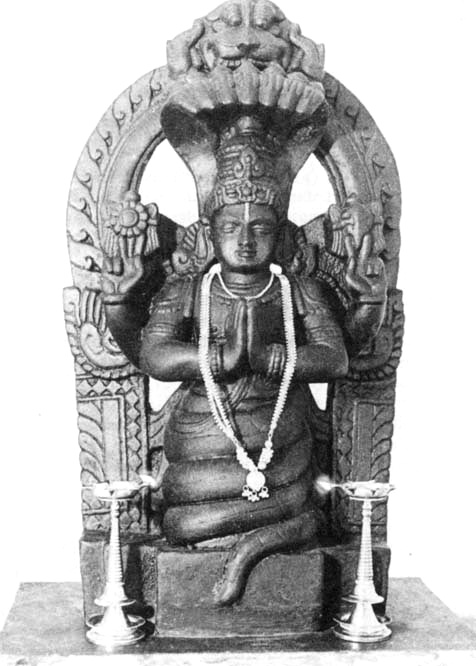
Patanjali
Dates: c. 2nd century BCE or CE Domain: Yoga Philosophy, Sanskrit Grammar, Contemplative Practice
Biography
Patanjali is a name attached to a text, the Yoga Sutras, whose date and authorship have been debated for over a century without resolution. The traditional identification of Patanjali as a single author who also wrote the Mahabhashya (a commentary on Panini's Sanskrit grammar) is contested by most modern scholars, who tend to date the Yoga Sutras to approximately the 2nd–4th centuries CE and regard it as a compilation rather than the work of a single author. For the project's purposes, the text is the figure: what matters is the system, not the biography.
The Yoga Sutras is composed of 196 brief aphorisms (sutras) in four chapters (padas): Samadhi (samadhi-pada), Practice (sadhana-pada), Powers (vibhuti-pada), and Liberation (kaivalya-pada). The text presupposes the Samkhya philosophical framework (purusha, pure consciousness, and prakriti, undifferentiated nature, as the two ultimate realities) and maps the path by which pure consciousness is disentangled from its identification with the modifications of the mind.
The eight-limbed path (ashtanga) — ethical observances (yama), personal disciplines (niyama), physical posture (asana), breath control (pranayama), withdrawal of the senses (pratyahara), concentration (dharana), meditation (dhyana), and samadhi — is the text's most influential contribution. The first two limbs (ethical and personal disciplines) correspond to what Teresa calls the first three mansions: the preparation of the instrument before the deeper work can begin. The final three limbs (dharana, dhyana, samadhi), collectively called samyama, are the concentrated inner practice that produces the deepest states. Kaivalya (liberation, "aloneness") is the Samkhya-Yoga equivalent of moksha: pure consciousness fully disentangled from all identification with the movements of the mind.
The three types of samadhi — samprajnata (with an object of cognition) and asamprajnata (without an object) — provide the framework for distinguishing grades of contemplative depth that have parallels in Neoplatonic, Christian, and Sufi mystical literature.
Key Works (in library)
| Work | Year | Relevance |
|---|---|---|
| Yoga Sutras | c. 400 CE (date disputed) | Eight-limbed path; stages of samadhi; the systematic map of contemplative development |
Role in the Project
Patanjali's Yoga Sutras provide the Eastern Traditions track with its most systematic comparand for the Western contemplative maps the project uses (Teresa's Interior Castle, the Neoplatonic ascent, Eckhart's Abgeschiedenheit). The eight-limbed path is more specific in its developmental stages than most Western accounts and provides a cross-cultural test of its thesis that contemplative traditions map the same territory.
The comparison with Teresa is the track's most instructive exercise: both texts describe the progressive interiorization of consciousness through stages that involve increasing subtlety of attention, decreasing identification with ordinary mental activity, and culminating states that are described as silent, effortless, and without ordinary cognitive content. The differences — Samkhya's dualism vs. Teresa's theism, kaivalya as isolation of pure consciousness vs. Teresa's spiritual marriage as union with the divine other — are as informative as the parallels.
Key Ideas
- Citta-Vrtti Nirodha: "Yoga is the stilling of the modifications of the mind" — the second sutra, which is also the definition. Citta (mind-stuff), vrtti (fluctuation, modification), nirodha (cessation). What remains when the fluctuations stop is pure consciousness (purusha).
- Eight-Limbed Path: From ethical foundation through physical and respiratory discipline to progressive interiorization of attention. Each limb prepares the instrument for the next.
- Samyama: The combined practice of dharana, dhyana, and samadhi applied to a single object — the concentrated attentional practice that produces the deepest states and, according to the vibhuti-pada, various supernormal capacities.
- Kaivalya: Liberation as the "aloneness" of pure consciousness from all identification with the modifications of prakriti. Not annihilation but discrimination — purusha and prakriti finally seen as distinct.
Connections
- Eastern Traditions: FIG-0097 Shankara (Advaita Vedanta as the non-dualist philosophical framework adjacent to Yoga; they share the goal of liberation but differ on metaphysical presuppositions), FIG-0099 Nagarjuna (Buddhist samadhi tradition as parallel to Yoga's samadhi)
- Western parallel: FIG-0061 Teresa (Interior Castle as the Western comparand for Patanjali's eight-limbed map)
- Contemplative stages: CON-0001 Initiation (the eight-limbed path as a systematic initiatory curriculum)
Agent Research Notes
[AGENT: perplexity | DATE: 2026-03-22] The dating controversy is substantial: Georg Feuerstein proposed a date of 200–500 CE in The Philosophy of Classical Yoga (1980); David Gordon White's The Yoga Sutra of Patanjali: A Biography (Princeton, 2014) provides the most rigorous recent scholarly treatment. The identification with the grammarian Patanjali is traditional but almost certainly anachronistic. Edwin Bryant's The Yoga Sutras of Patanjali (North Point Press, 2009) is the most thorough English commentary for scholarly and practical purposes.