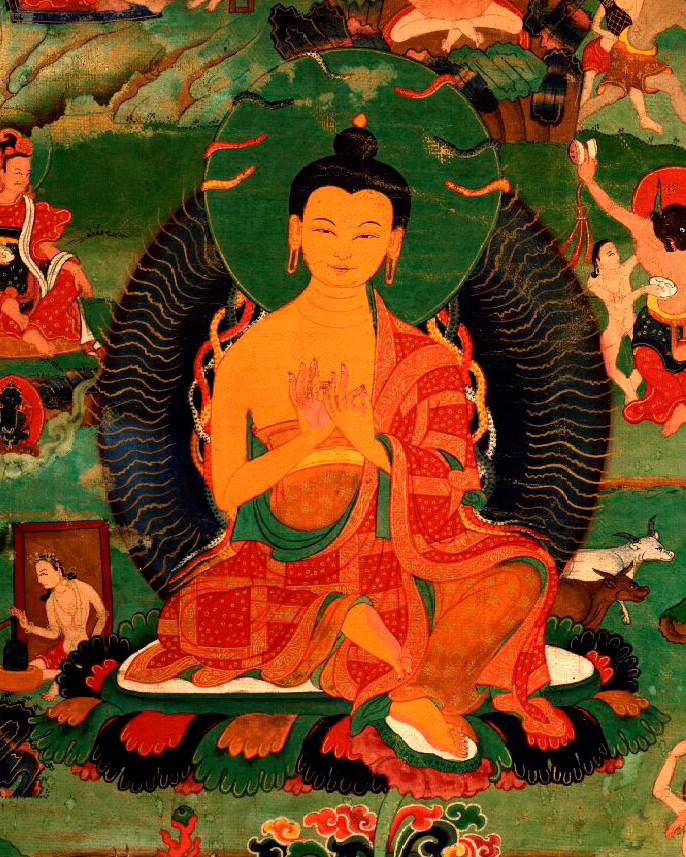
Nagarjuna
Dates: c. 150–c. 250 Domain: Buddhist Philosophy, Madhyamaka, Sanskrit Polemics
Biography
Nagarjuna is one of the most significant figures in the history of Buddhist philosophy and one of the most contested in terms of biography. The tradition attributes to him a prodigious output including tantric treatises, alchemical texts, and devotional hymns alongside the definitive philosophical works, and most scholars now distinguish between an "early Nagarjuna" (the philosopher of the Mulamadhyamakakarika) and later figures who wrote under the same name. He is associated with Nalanda university and with a South Indian Buddhist community, but almost nothing is historically verifiable.
What is verifiable is the Mulamadhyamakakarika (MMK) — the Fundamental Verses on the Middle Way — a text of 447 verses in 27 chapters that systematically demonstrates, through the prasanga method (reduction to contradiction of the opponent's thesis), that no phenomenon has svabhava — inherent, independent, self-established existence. Not just that things are impermanent (which any Buddhist would grant), but that even the concepts by which we analyze reality — causation, motion, time, the self, the Buddha — have no inherent existence. This is sunyata: not void or nothingness but the absence of inherent existence, which is simultaneously the condition of possibility for all dependent arising.
The critique of causation (MMK Chapter 1) is characteristic: Nagarjuna argues that the four possible accounts of how a cause produces an effect are each internally contradictory, and that therefore causation, as usually conceived, cannot be the ultimate nature of things. The conclusion is not that nothing is caused but that causation is a conventional designation applied to processes that, at the level of ultimate truth, are empty of inherent existence. The conventional and the ultimate are not two separate worlds but two ways of looking at the same world.
Key Works (in library)
| Work | Year | Relevance |
|---|---|---|
| Mulamadhyamakakarika | c. 150–250 CE | The systematic demonstration of sunyata; the Middle Way between existence and non-existence |
| Vigrahavyavartani | c. 150–250 CE | Nagarjuna's response to objections; the self-reflexive status of the sunyata thesis |
Role in the Project
The Eastern Traditions track uses Nagarjuna as the primary Buddhist philosophical interlocutor with Shankara's Advaita Vedanta. The project holds this tension open rather than resolving it: is the ground of reality the positive non-dual absolute of Advaita (Brahman, pure consciousness, atman = Brahman) or the radical absence of inherent existence in anything, including any absolute (sunyata)? Both positions arrive at liberation; they arrive by different routes and describe what they arrive at differently.
This is the primary Eastern philosophical question, and holding it in genuine tension is more productive than either resolving it into a perennialist synthesis or dismissing one side. Nagarjuna presses on the Advaita claim that Brahman has positive content, ultimate reality as pure consciousness, with the same rigor he brings to every other claim about inherent existence.
Key Ideas
- Sunyata (Emptiness): The absence of inherent existence (svabhava) in all phenomena — not void or nothingness but the condition of possibility for dependent arising. Things are empty of inherent existence and therefore able to arise dependently, to change, to interact.
- Two Truths: The conventional truth (things exist, causation operates, the Buddha taught) and the ultimate truth (no thing has inherent existence). The two truths are not two worlds but two registers of description.
- The Prasanga Method: Nagarjuna's primary logical tool — showing that the opponent's position entails a contradiction, without asserting a positive counter-thesis. This is the via negativa in its most rigorous logical form.
- Sunyata of Sunyata: Nagarjuna's self-reflexive move — emptiness itself is empty of inherent existence. This prevents sunyata from becoming a new absolute.
Connections
- Eastern philosophical tension: FIG-0097 Shankara (Advaita Vedanta vs. Madhyamaka — the primary Eastern philosophical debate), FIG-0098 Patanjali (Yoga's kaivalya vs. Madhyamaka's nirvana)
- Western parallels: CON-0007 Apophatic (sunyata as the most rigorous non-Western apophatic position), FIG-0040 Eckhart (Eckhart's Godhead as the Western position structurally closest to sunyata)
Agent Research Notes
[AGENT: perplexity | DATE: 2026-03-22] The Mulamadhyamakakarika was commented on by Chandrakirti (c. 600–650 CE) in the Prasannapada, the only complete Sanskrit commentary to survive. Jay Garfield's translation with extensive commentary (The Fundamental Wisdom of the Middle Way, Oxford, 1995) is the standard English scholarly edition. David Kalupahana's Nagarjuna: The Philosophy of the Middle Way (1986) takes a more analytic-philosophical approach. The question of a "negative" vs. "positive" reading of sunyata is addressed in Thomas Wood's Nagarjunian Disputations (1994).