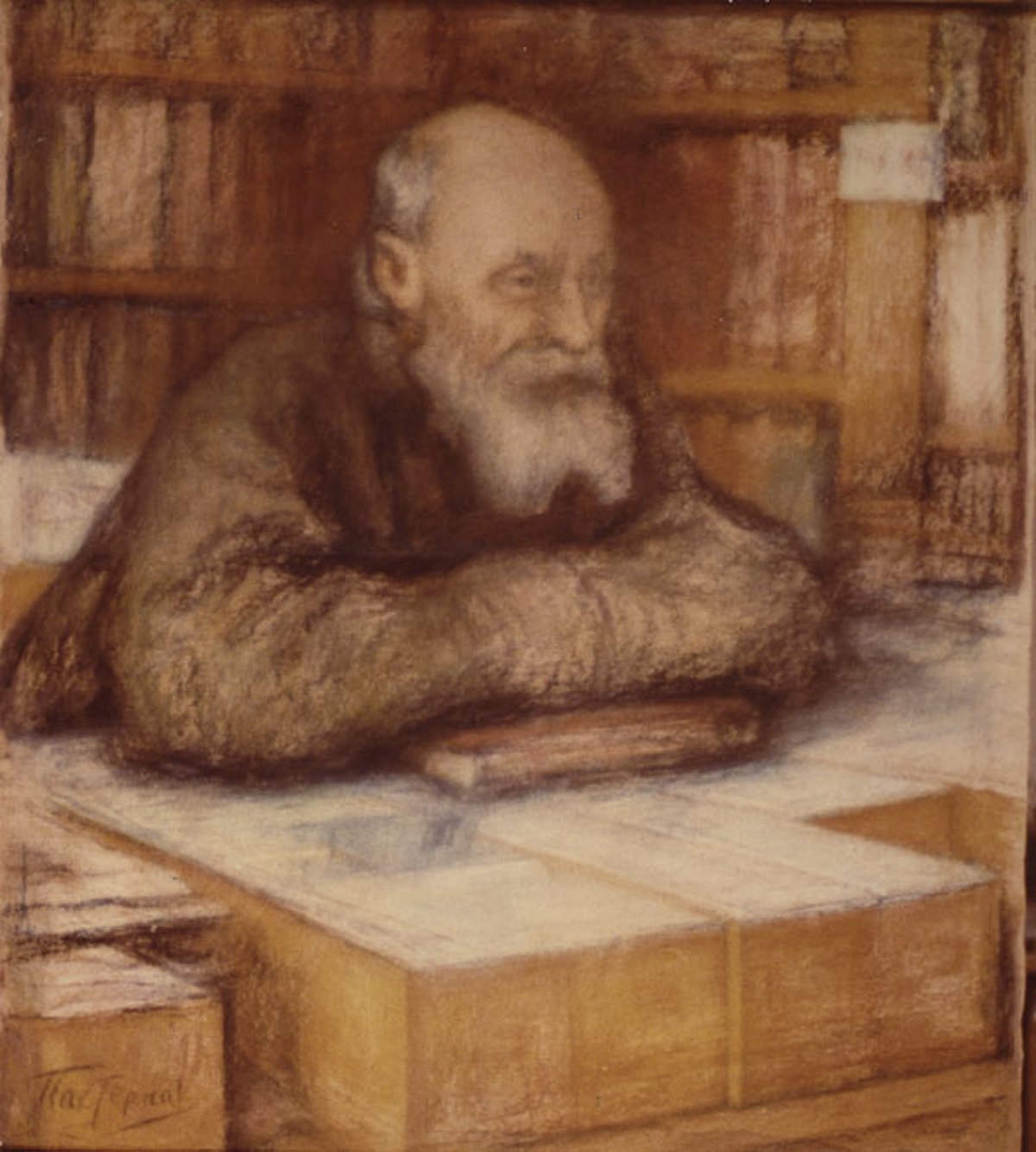
Nikolai Fyodorovich Fedorov
Dates: 1829–1903 Domain: Philosophy, Theology, Russian Cosmism
Biography
Nikolai Fyodorovich Fedorov was born in 1829 as the illegitimate son of Prince Pavel Gagarin — a biographical fact that he apparently experienced as a kind of cosmic orphanhood and that shaped his lifelong preoccupation with ancestors, ancestry, and the obligation of the living to the dead. He was educated but never graduated from the Richelieu Lyceum in Odessa (reportedly expelled for organizing a student protest); he spent much of his adult life as a librarian, first in provincial towns and then, from 1874, at the Rumyantsev Museum Library in Moscow. He was a genuinely modest man who refused to publish his own writings, lived ascetically, and gave his salary away. His ideas circulated in manuscript and in conversation among a circle that included Tolstoy, Solovyov, and eventually Tsiolkovsky — the founder of modern rocketry.
His work was published posthumously (the first and second volumes of The Philosophy of the Common Task appeared in 1906 and 1913) by his disciples, who did their best to reconstruct his thought from his manuscripts, notes, and their own recollections of his conversations. This makes Fedorov, like Pythagoras and Gurdjieff, a figure whose teaching was transmitted through devoted students rather than through his own systematic writings — a pattern the project has noted elsewhere.
The Philosophy of the Common Task is the title his editors gave to the system Fedorov spent his life developing. The "common task" is the literal physical resurrection of all human beings who have ever died — the recovery of the scattered atoms and molecules of every ancestor, reassembled by the cooperative technological work of all humanity, across all of space (which rocketry and space exploration would eventually make accessible). This is not metaphor. Fedorov believed, and argued in considerable detail, that if Christianity's central promise, the resurrection of the dead, is genuinely true, then it is the moral obligation of humanity to work toward its fulfillment by every available means. The fact that science and technology are developing the tools to manipulate matter at the molecular level, to travel beyond the Earth, and to recover and preserve information means that the resurrection is no longer only an eschatological hope but a practical project.
The audacity of this claim is matched only by the consistency with which Fedorov developed its implications. Human beings should stop competing with each other over resources and instead cooperate in the single task that matters: recovering the dead. All scientific and technological progress should be evaluated by whether it serves this goal. The entire cosmos should be restructured for human habitation and the housing of the resurrected. Death itself — not merely natural death but all forms of dissolution and entropy — is the enemy to be overcome. This is the most ambitious statement of what we now call transhumanism, produced a century before the transhumanist movement, grounded in Orthodox Christian theology rather than secular rationalism.
The connection to Russian space exploration is not merely symbolic. Tsiolkovsky — the mathematician and physicist who derived the rocket equation and theorized space travel in the 1890s — was directly influenced by Fedorov and acknowledged the debt. The Russian Cosmist movement (which Fedorov anchors) held that humanity's destiny was literally cosmic — not in the metaphorical sense of "large" but in the sense of the actual space beyond the Earth's atmosphere. The early Soviet space program drew on this tradition, sublimating the religious content while preserving the technological ambition.
Fedorov's treatment of the museum is a minor but distinctive element of his thought. As a librarian and museum worker, he argued that the museum is the institution of memory — the place where the past is preserved against dissolution. The museum is the precursor and prototype of the resurrection project: it does on a small scale, with artifacts, what the Common Task will do on a cosmic scale, with persons.
Key Works (in library)
| Work | Year | Relevance |
|---|---|---|
| The Philosophy of the Common Task, Vol. 1 | 1906 (posthumous) | The central argument for physical resurrection as human obligation |
| The Philosophy of the Common Task, Vol. 2 | 1913 (posthumous) | The elaboration: space, cosmology, and the practical theology of resurrection |
Role in the Project
Fedorov is one of the project's most provocative figures because he takes a theme central to the Mysteries — the overcoming of death, the recovery of what has been lost to dissolution — and develops it with technological literalism. The Mysteries offered symbolic death and symbolic resurrection; Fedorov demands the real thing, achieved by human effort. This is either the most brilliant or the most catastrophically misguided response to the initiatory tradition available in modernity. The project argues that Fedorov's literalism is instructive: it shows what happens when the resurrection-logic of the tradition is pressed to its extreme without the corresponding transformation of the knower. The Common Task without the inner work is the transhumanist project in its most honest and most exposed form.
Key Ideas
- The Common Task: The collective human project of resurrecting all ancestors — the one task that would make competition, war, and individual ambition unnecessary; the social form of the resurrection hope.
- Literal Resurrection: Against all allegorical or spiritual interpretations, the physical reconstruction of every human body from its scattered atoms; the technological fulfillment of the theological promise.
- The Regulation of Nature: The extension of human control over natural processes, weather, solar energy, cosmic forces, as the necessary infrastructure of the resurrection project.
- Space as Resurrection Space: The cosmos as the physical space required to house the resurrected billions; space exploration as a theological imperative.
- Memory as Resurrection Precursor: The museum, the archive, and the library as institutions that practice on a small scale the same recovery of the past that the Common Task will accomplish universally.
Connections
- Influenced by: Eastern Orthodox eschatology (the bodily resurrection), Nikolai Solovyov (FIG-0049, knew personally), Dostoevsky (transformed by Fedorov's ideas, received them through common circles)
- Influenced: Tsiolkovsky (rocketry), the Russian Cosmist movement, the Soviet space program's ideological self-understanding, contemporary transhumanism (which rediscovered him in the late twentieth century)
- In tension with: Any purely spiritual or allegorical interpretation of resurrection, Buddhist and Hindu acceptance of death as part of the natural order, the initiatory tradition's emphasis on inner transformation
Agent Research Notes
[AGENT: perplexity | DATE: 2026-03-22] Fedorov's dates are confirmed 1829–1903. He died December 28, 1903. The Philosophy of the Common Task was published in limited editions by his disciples Kozhevnikov and Peterson. The standard modern English translation is What Was Man Created For? The Philosophy of the Common Task (London: Honeyglen/L'Age d'Homme, 1990), translated by Elisabeth Koutaissoff and Marilyn Minto. Michael Hagemeister's essay "Nikolaj Fedorov" in Russian Thought After Communism (ed. James Scanlan, 1994) is the best English-language scholarly introduction. George Young's The Russian Cosmists (2012) situates Fedorov within the broader movement.