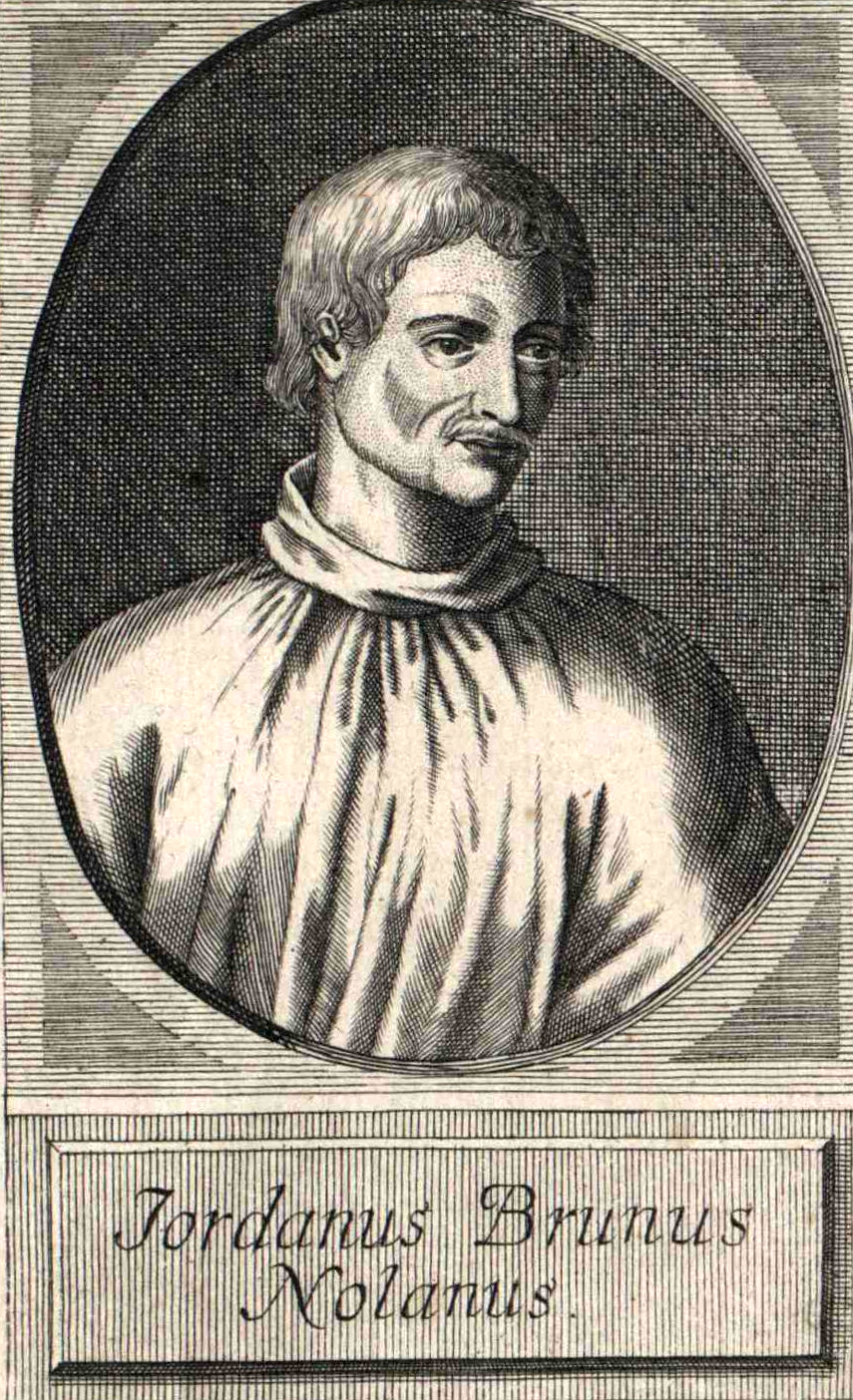
Giordano Bruno
Dates: 1548–1600 Domain: Philosophy, Cosmology, Mnemonics, Hermeticism
Biography
Giordano Bruno was born in Nola, near Naples, in 1548 and entered the Dominican Order at seventeen. Within the order he began to manifest the intellectual independence that would define, and ultimately end, his life: he removed images of saints from his cell and was found reading a commentary by Erasmus, then on the Index of Forbidden Books. He fled the order before formal proceedings could begin and spent the next twenty years in continuous itinerant movement across Europe — Geneva, where Calvinist authorities arrested him; Lyon; Paris, where he lectured before Henri III; London, where he had a famous stormy reception at Oxford and wrote the Italian dialogues that represent his philosophical peak; Marburg, Wittenberg, Prague, Frankfurt. In 1591 he accepted an invitation to return to Venice — a fatal mistake. Within a year he was arrested by the Venetian Inquisition and eventually handed to Rome, where after eight years of imprisonment and trial he was burned at the stake in the Campo de' Fiori on February 17, 1600. He refused to recant.
The content of his alleged heresies has always been somewhat unclear — the Inquisition's documents are incomplete — but his philosophical positions are well-attested: the infinity of the universe, the plurality of worlds, pantheism (or panentheism: the idea that God is in all things and all things are in God), and the rejection of transubstantiation. These positions are genuinely incompatible with Catholic dogma. But Frances Yates, in her landmark study Giordano Bruno and the Hermetic Tradition (1964), argued that what made Bruno genuinely dangerous was not primarily his cosmological speculation but his magical practice: his development of an Art of Memory that was simultaneously a system for restructuring consciousness.
The classical Art of Memory — the ars memorativa going back to Cicero and the Ad Herennium — prescribed that the practitioner build an elaborate imaginary architectural space (the "memory palace") and populate it with vivid, emotionally charged images representing what he wanted to remember. The trained practitioner could then mentally walk through the palace and recover the information. Bruno took this system and transformed it. In works like De Umbris Idearum (On the Shadows of Ideas, 1582) and Ars Memoriae (1582), he populated the memory palace not with images of arbitrary content but with astrally charged, Hermetically potent images — images that, through their correspondence to celestial archetypes, could act on the soul of the practitioner and produce genuine transformation of consciousness. This is not a mnemonic device; it is, Yates argued, a technology for magically restructuring the mind from the inside. The magus who uses Bruno's system does not merely memorize more efficiently; he reorganizes his entire psyche in alignment with the cosmic order.
His cosmological speculations deserve attention in their own right. In De l'infinito universo et mondi (On the Infinite Universe and Worlds, 1584), Bruno argued — drawing partly on Copernicus but going far beyond him — that the universe is infinite, populated by an infinite number of worlds, each potentially inhabited. This is not the Copernican argument, which simply relocated the center; it is the abolition of center altogether. Bruno's cosmos is homogeneous, centerless, infinite — a direct consequence of his pantheistic metaphysics. An infinite God expresses himself in an infinite universe. The implications for the human position in the cosmos are severe: we are no longer at the center, but we are also not merely peripheral — everywhere is equally central, because there is no privileged point.
Key Works (in library)
| Work | Year | Relevance |
|---|---|---|
| De Umbris Idearum | 1582 | The foundation of Bruno's magical Art of Memory |
| The Ash Wednesday Supper (La Cena de le Ceneri) | 1584 | Cosmological dialogue; the Copernican system as Hermetic revelation |
| On the Infinite Universe and Worlds | 1584 | The infinite cosmos as theological-metaphysical argument |
| The Expulsion of the Triumphant Beast | 1584 | Moral-allegorical reform of the heavens; Bruno's ethical philosophy |
| Cause, Principle and Unity | 1584 | The metaphysical foundation of his pantheism |
Role in the Project
Bruno's execution stands in the project as the historical emblem of the foreclosure of the Renaissance magical project. The Hermetic tradition, as Yates and Couliano argued, was not refuted by the Scientific Revolution — it was suppressed. Bruno is not a figure who was simply on the wrong side of scientific progress; he was a figure whose synthesis of magic, philosophy, and cosmology was extinguished by institutional power at the precise moment when it might otherwise have influenced the emerging scientific worldview. The project argues that the dominant Western epistemology — which separates knowing from being, observer from phenomenon, and severs the link between cosmology and moral-spiritual practice — is not the natural outcome of the advance of knowledge. It is is the outcome of a struggle in which Bruno's side lost. His memory palace was not merely a mnemonic technique; it was a technology for preserving participation in an age that was moving rapidly toward disenchantment.
Key Ideas
- Magical Art of Memory: The memory palace populated with astrally potent images as a technology for restructuring consciousness in alignment with cosmic archetypes.
- Infinite Cosmos: The universe is infinite and homogeneous; there is no privileged center; the Earth is not the only world; God is expressed in infinite extension.
- Pantheism: God is not separate from the world but is the immanent soul and life of all things; the world itself is a divine expression.
- Hermetic Cosmology: The universe is a living, ensouled organism structured by correspondences — the magus works with these correspondences rather than against them.
- The Martyr as Argument: Bruno's refusal to recant, and his execution, are themselves arguments about the incompatibility of the initiatory tradition with institutional religious authority.
Connections
- Influenced by: FIG-0024 Ficino (the Hermetic framework), FIG-0025 Pico (the synthetic ambition), FIG-0059 Llull (the combinatorial Art of Memory systems), Copernicus (cosmology)
- Influenced: FIG-0017 Yates (her central subject), FIG-0044 Couliano (the thesis of magical suppression), FIG-0027 Dee (contemporary parallel)
- In tension with: the Roman Inquisition, Aristotelian scholasticism, the institutionalized Christianity that could not accommodate pantheism
Agent Research Notes
[AGENT: perplexity | DATE: 2026-03-22] Bruno's date of birth is sometimes given as 1548; the execution date of February 17, 1600 is confirmed. Frances Yates's Giordano Bruno and the Hermetic Tradition (1964) is the foundational study for the project; her thesis about the magical Art of Memory has been both influential and contested — Alexander Dicit and others have challenged the degree to which Bruno was primarily a Hermetist vs. a philosopher. The Campo de' Fiori in Rome has a statue of Bruno erected in 1889, which has been a site of freethought commemoration. The Inquisition records of Bruno's trial were partially discovered in 1940 in a Paris archive.