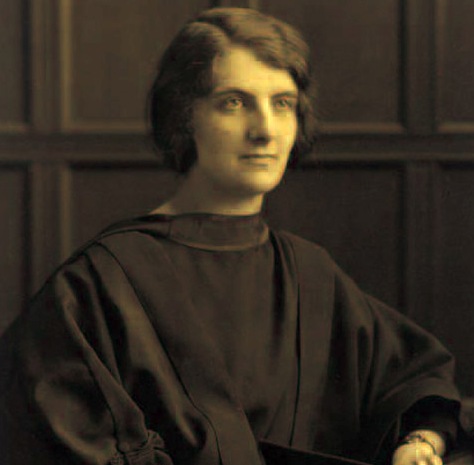
Frances Yates
Dates: 1899–1981 Domain: History of Renaissance Thought, History of Western Esotericism
Biography
Frances Amelia Yates was born on November 28, 1899, in Portsmouth, England, into a middle-class family that provided no university education for its daughters. She was, in significant part, self-educated; her early research into French Renaissance theatre and the life of John Florio (Shakespeare's Italian tutor) was carried out at the British Museum without institutional support. It was not until 1941 that she was employed by the Warburg Institute in London, the great repository of the history of the classical tradition and its survival in Western culture, founded by the Hamburg scholar Aby Warburg. There she found her intellectual home and remained for the rest of her working life. She was elected a Fellow of the British Academy in 1967, appointed OBE in 1972, and made a Dame Commander of the Order of the British Empire in 1977.
The Warburg Institute provided her with the methodological framework her work required: the Warburgian approach to the history of ideas, which traced the movement of symbolic forms, images, and ideas across cultures and centuries, emphasized the persistence of the classical tradition in forms that official histories ignored, and took the history of art and material culture as seriously as the history of texts. Through the Warburg's extraordinary library, organized not by subject category but by thematic association, Yates gained access to the Renaissance primary sources that formed the basis of her major works.
Her breakthrough came with Giordano Bruno and the Hermetic Tradition (1964), a book that transformed the historiography of Renaissance philosophy and the history of science. Yates argued that the late Renaissance figure Giordano Bruno, burned by the Inquisition in Rome in 1600 and traditionally celebrated as a martyr for the Copernican heliocentric worldview, was not primarily a scientific forerunner but a Hermetic magician: his enthusiasm for Copernicanism was driven not by empirical observation but by Hermetic reverence for the sun as the divine center of the universe. More broadly, Yates argued that the Hermetic tradition, the corpus of texts attributed to the mythical Egyptian sage Hermes Trismegistus rediscovered in fifteenth-century Florence and translated by Marsilio Ficino, had been the animating philosophical spirit of much Renaissance intellectual life, including key moments in the development of what would become the Scientific Revolution. Magic and science, esotericism and empiricism, were not opposites in the early modern period but intertwined.
The Art of Memory (1966) traced a different thread: the classical and medieval mnemonic tradition, the technique of constructing imaginary buildings populated with vivid images in order to memorize vast amounts of material, through its Renaissance transformations in the work of Giulio Camillo, Ramon Llull, and culminating in Bruno's elaborate magical memory systems, which used the mnemonic architecture as an instrument for aligning the imagination with cosmic forces. The Rosicrucian Enlightenment (1972) continued the story into the early seventeenth century, arguing that the mysterious Rosicrucian manifestos of 1614–1615, the short-lived political project around Frederick V Elector Palatine, and the early scientific movement associated with Francis Bacon and his circles were all connected by a shared Hermetic and alchemical vision of universal reform. Occult Philosophy in the Elizabethan Age (1979) extended the analysis into the English context, with the magician John Dee as its central figure.
Key Works (in library)
| Work | Year | Relevance |
|---|---|---|
| Giordano Bruno and the Hermetic Tradition | 1964 | Establishes the Hermetic tradition as a central force in Renaissance intellectual history; essential for the Western Canon track (LIB-0125) |
| Occult Philosophy in the Elizabethan Age | 1979 | English context: John Dee, Cabala, and the esoteric strands of Elizabethan culture (LIB-0126) |
| The Art of Memory | 1966 | The mnemonic tradition from antiquity through Bruno; the imagination as an esoteric and philosophical instrument (LIB-0127) |
| The Rosicrucian Enlightenment | 1972 | The Rosicrucian moment and its connection to early science, politics, and the esoteric tradition (LIB-0128) |
Role in the Project
Yates is the indispensable historical scholar for the project's Western Canon track. Before her work, the Hermetic tradition (the Corpus Hermeticum, Ficino's Platonic Academy, Bruno's memory magic, the Rosicrucian manifestos) had been either ignored by mainstream history or treated as a series of embarrassing marginalia to the serious history of science and philosophy. Yates changed this permanently. She demonstrated that these traditions were central to how Renaissance intellectuals understood their own project: the renovation of knowledge, the reunification of ancient wisdom with natural philosophy, the reform of European civilization through a recovered prisca theologia (ancient theology) that predated the division of Western thought into science, philosophy, and religion.
For the project's purposes, Yates provides three things. First, documentary legitimacy: her meticulous scholarship established that the Western esoteric tradition is a recoverable intellectual history, not a set of fantasies, and can be studied with the same rigor as any other historical period. Second, the Hermetic framework: her account of how the rediscovery of the Corpus Hermeticum in 1463 transformed Florentine Neoplatonism into something more magical, more participatory, and more oriented toward the transformation of the whole human being illuminates a crucial node in the transmission of mystery-school themes into early modernity. Third, the memory-magic connection: her analysis of the art of memory as a vehicle for esoteric practice, the imagination structured to align with cosmic forces, is directly relevant to the project's treatment of ritual, symbol, and the trained imagination as instruments of initiatory experience.
Yates's specific claims have been contested and partially revised by subsequent scholars. Her "Yates thesis," that Hermeticism was a significant driver of the Scientific Revolution, has been substantially qualified by later historians of science who find the evidence for direct causation weaker than she claimed. But the broader argument, that the esoteric and the scientific traditions were intertwined in the Renaissance rather than opposed, has been enormously productive and has generated the entire academic field of Western esotericism as a scholarly discipline.
Key Ideas
- The Hermetic tradition: The philosophical and magical tradition associated with the texts of the Corpus Hermeticum and attributed to Hermes Trismegistus, an ancient Egyptian sage imagined as a predecessor of Moses and Plato. Ficino's 1463 translation inaugurated its Renaissance influence: a vision of the cosmos as animated, magically interconnected, and accessible to human transformation through the trained will and imagination.
- Renaissance magic: Not the degraded stage magic of popular tradition but a philosophical practice: the manipulation of natural and spiritual sympathies to align the practitioner with cosmic forces. Bruno's memory systems are the most systematic example: the mnemonic architecture becomes a magical instrument for restructuring the mind in accordance with the celestial archetypes.
- The art of memory: The ancient and medieval mnemonic technique (imaginary architectural spaces populated with vivid image-stations) transformed by Bruno into a magical-philosophical instrument for the reformation of knowledge and the alignment of imagination with cosmic pattern.
- The Yates thesis: The claim (subsequently qualified but historically productive) that the Hermetic tradition was a significant positive driver of the Scientific Revolution: that the magician's desire to understand and operate on nature preceded and motivated the natural philosopher's.
- John Dee: The Elizabethan mathematician, astrologer, and ceremonial magician whom Yates identified as the central figure in the transmission of Renaissance Hermeticism into the English context and into the Rosicrucian movement.
Connections
- Influenced by: Aby Warburg (the Warburgian approach to the survival of symbolic forms), Paul Oskar Kristeller (Renaissance Platonism), Edgar Wind (iconological method)
- Influenced: D. P. Walker (Music, Spirit, and Language), Anthony Grafton, Ioan Culianu, Wouter Hanegraaff (ESSWE and the academic study of Western esotericism), Peter French (biography of John Dee)
- In convergence with: FIG-0004 (Iamblichus: Yates traces the Neoplatonic and theurgic lineage that runs from Iamblichus through Ficino and into the Renaissance magical tradition), FIG-0009 (Corbin: parallel effort to establish the legitimacy of an esoteric tradition through historical scholarship)
Agent Research Notes
[AGENT: perplexity | DATE: 2026-03-20] Yates is well-represented in the library with four entries (LIB-0125 through LIB-0128). Her dates are definitively 1899–1981 (Dame Frances Yates, DBE, FBA). The British Academy memorial essay (available as a PDF from the British Academy) provides the most detailed biographical account. The subsequent scholarly debate around the Yates thesis is important context: historians of science including Brian Vickers and Robert Westman have substantially revised or disputed the causal claims, while broadly accepting the historical significance of Hermeticism as an intellectual phenomenon. The project should represent this revision honestly while still relying on Yates's core contribution: the establishment of Western esotericism as a legitimate scholarly field and the recovery of the Renaissance Hermetic tradition as a serious intellectual force.