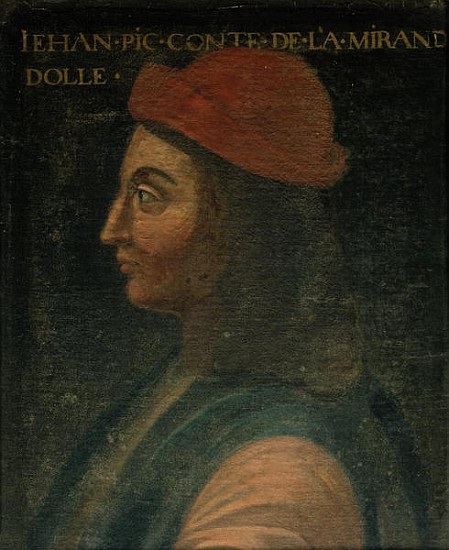
Giovanni Pico della Mirandola
Dates: 1463–1494 Domain: Philosophy, Kabbalah, Hermeticism, Christian Theology
Biography
Giovanni Pico della Mirandola was born in 1463 in the small lordship of Mirandola, near Modena, the youngest son of a minor noble family. Gifted beyond any rational expectation, he had absorbed Greek, Latin, Hebrew, and Arabic by his mid-twenties and was reading in the Arabic Averroist tradition while simultaneously mastering the Kabbalistic corpus under the tutelage of Jewish scholars — an extraordinary act of cross-traditional synthesis that was, in the 1480s, genuinely dangerous. He moved in the orbit of Ficino's Platonic Academy, but where Ficino was cautious and conciliatory in his engagement with institutional Christianity, Pico was audacious almost to the point of recklessness. He died in 1494 at the age of thirty-one — possibly by arsenic poisoning, a possibility that acquired new credibility when analyses of his exhumed remains in 2008 suggested elevated arsenic levels. The brevity of his life is not incidental to his significance; like Keats, the incompleteness of the work intensifies it.
In 1486, Pico circulated 900 Theses (Conclusiones nongentae) — propositions drawn from philosophy, theology, Kabbalah, magic, and the Hermetic tradition — and invited scholars from across Europe to Rome to debate them publicly. He was twenty-three years old. The Oration on the Dignity of Man, written as an introductory address for this debate that never took place (the Church condemned thirteen of the 900 theses as heretical and issued an injunction), is the document for which Pico is best remembered. Its famous opening — in which God addresses the newly created Adam, telling him that he has no fixed nature but can descend into the animal world or ascend to the divine at his own choosing — is the most direct statement of the Renaissance esoteric anthropology: the human being as the uniquely plastic creature, defined not by any essential nature but by its capacity for self-transformation. "We have made you neither of heavenly nor of earthly stuff, neither mortal nor immortal, so that with free choice and dignity, you may mold yourself into whatever form you choose."
This is not merely a humanist celebration of human potential in the modern motivational sense. It is an esoteric claim about the metaphysical structure of the human being. Pico is arguing, in the Kabbalistic framework that shapes much of his thought, that the human being stands at the axis of creation — between the material and spiritual worlds — and that this position enables a kind of theurgic self-transformation. To ascend the ladder of being is not a metaphor; it is a real movement through different modes of existence, catalyzed by the right forms of knowledge and practice. The human being is not fixed at any rung of the ladder; this is both the danger (the possibility of bestial descent) and the extraordinary promise.
Pico was the first Christian thinker to argue systematically that Kabbalah confirms Christian truth — a claim that inaugurated the tradition of Christian Kabbalah that would run through Johannes Reuchlin, Johannes Pistorius, and, in a transformed version, through the Rosicrucian and later esoteric movements. His Heptaplus (1489) offered a sevenfold commentary on the opening of Genesis, drawing on Kabbalistic methods of interpretation to show that the creation narrative encoded the full structure of reality across all its levels. His unfinished work De Ente et Uno (On Being and the One) attempted a reconciliation of Plato and Aristotle on the supreme philosophical question. He was, in other words, attempting nothing less than the unified theory of everything, philosophical, theological, and magical, available to the late fifteenth century.
Key Works (in library)
| Work | Year | Relevance |
|---|---|---|
| Oration on the Dignity of Man | 1486 | The manifesto of Renaissance esoteric anthropology; the human as self-transforming being |
| Conclusions (900 Theses) | 1486 | The first systematic synthesis of the Western esoteric inheritance in a single document |
| Heptaplus | 1489 | Sevenfold Kabbalistic commentary on Genesis; applied synthesis in practice |
| De Ente et Uno | 1491 | Unfinished philosophical synthesis of Plato and Aristotle |
Role in the Project
Pico is the primary example of the synthesizing impulse at its most ambitious and most precarious. The 900 Theses represent the first time someone attempted to argue that the Greek philosophical tradition, the Hermetic corpus, the Kabbalistic tradition, and Christian theology were not merely compatible but were expressions of the same esoteric truth — and that this truth had practical implications for the transformation of the human being. The Church's condemnation of thirteen of the 900 theses — and the subsequent attempts on Pico's life and freedom — illustrates the institutional stakes of the initiatory project: the claim that human beings can transform themselves through direct encounter with divine truth is, from the perspective of an institution that manages access to divine truth, a subversive claim.
Key Ideas
- Human Plasticity: The human being alone among creatures has no fixed essence; this is the source of both its dignity and its vulnerability, requiring active self-formation through philosophical and spiritual practice.
- Christian Kabbalah: The first systematic argument that Kabbalistic methods of scriptural interpretation and metaphysical structure confirm rather than contradict Christian theological claims.
- Prisca Theologia Extended: Pico extended Ficino's lineage to include Kabbalah — Moses received not only the written Torah but an esoteric oral Torah that encoded the same metaphysical truths Plato articulated.
- The 900 Theses as Provocation: The project of inviting public debate on dangerous syntheses as itself a philosophical act — forcing the confrontation between conventional and esoteric modes of knowing.
- Self-Transformation as Metaphysical Act: Pico's ascent of the ladder of being is not spiritual development in a psychological sense. It is a real movement through ontological levels.
Connections
- Influenced by: FIG-0024 Ficino (teacher and collaborator), FIG-0005 Plotinus (Neoplatonic structure), Jewish Kabbalists (direct teachers, names not recorded), Averroes and the Arabic philosophical tradition
- Influenced: Johannes Reuchlin (Christian Kabbalah), FIG-0026 Bruno (the magical synthesis), the Rosicrucian movement (indirectly), FIG-0043 Luria (parallel though independent Kabbalistic development)
- In tension with: Pope Innocent VIII (who condemned the 900 Theses), Scholastic philosophy, the institutional Church's claim to exclusive mediation of divine truth
Agent Research Notes
[AGENT: perplexity | DATE: 2026-03-22] Pico's dates are confirmed 1463–1494. The 2008 forensic analysis of his remains, led by Giorgio Gruppioni at the University of Bologna, found elevated arsenic levels consistent with poisoning, though the cause of death remains officially uncertain. The Oration was written in 1486 but not published until after Pico's death (1496). The standard modern translation of the Oration is by Charles Glenn Wallis. The thirteen condemned theses included propositions about magic and Kabbalah. Pico fled to France after the condemnation but was captured; he was eventually taken in by Lorenzo de' Medici and spent his final years in Florence.