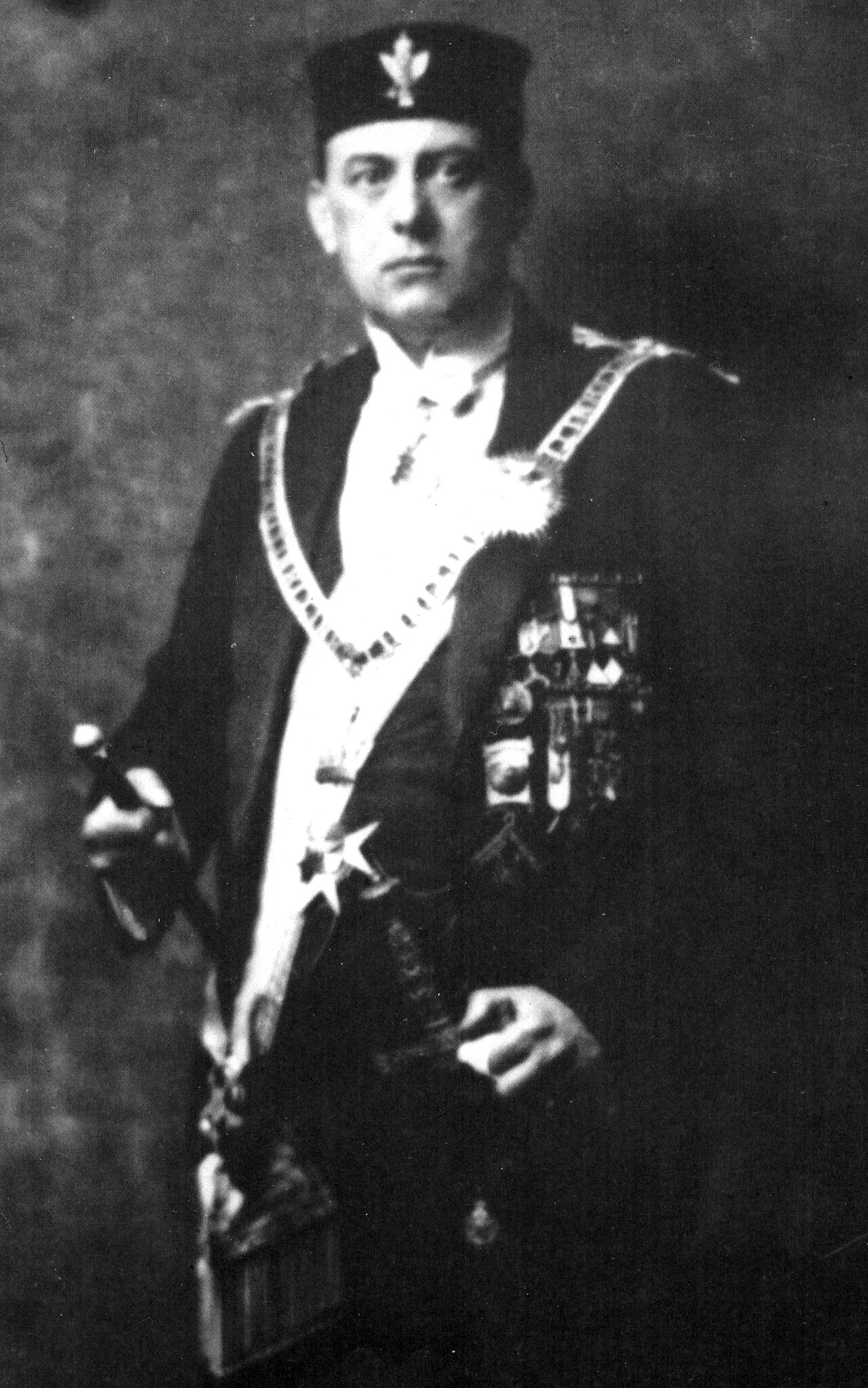
Aleister Crowley
Dates: 1875–1947 Domain: Western Esotericism, Ritual Magic, Mystical Philosophy
Biography
Edward Alexander Crowley was born in Leamington, Warwickshire, in 1875, the son of a brewing fortune and a Plymouth Brethren household whose strict Calvinist literalism he rebelled against systematically and with considerable wit. He arrived at the Hermetic Order of the Golden Dawn in 1898, a young man with money, intelligence, exceptional climbing ability (he attempted K2 and Kanchenjunga before such ascents were routine), and a genuine appetite for the operative dimension of the Western tradition that the Golden Dawn's more academic members largely avoided. His advance through the Golden Dawn grades was rapid and contentious; his expulsion in 1900 — following conflicts with MacGregor Mathers that involved both doctrinal disagreements and competing claims to authority — set him on a path of independent construction that would occupy the rest of his life.
The central event was April 8–10, 1904, in Cairo, when Crowley's wife Rose fell into a trance and dictated to him a text she claimed came from an entity named Aiwass. Crowley transcribed what she dictated over three days as Liber AL vel Legis — The Book of the Law. Whether this event is understood as a genuine reception from a discarnate intelligence, a product of Rose's unconscious, a collaborative literary creation, or something else entirely, the text produced is philosophically distinctive. Its central proclamation — "Do what thou wilt shall be the whole of the Law. Love is the law, love under will" — is not the license for self-indulgence that hostile critics (and enthusiastic misreaders) have construed it to be. Thelema (will) in Crowley's system is not personal preference but the soul's true direction: the deep will aligned with one's cosmic function, which requires as much discipline to discover and execute as any other path of self-knowledge.
Magick in Theory and Practice (1930) is his systematic exposition of ceremonial magic as he understood and practiced it — and it is a rigorous work. Its definition of magic ("the Science and Art of causing Change to occur in conformity with Will") is philosophically precise in ways that distinguish it from popular occultism. His analysis of the magical record, the role of the body in ceremony, and the relationship between magical and mystical work (he insisted they were complementary rather than opposed) shows a practitioner who had actually done the work rather than synthesized it from library sources. The Vision and the Voice (1911, 1909 as written) records his systematic exploration of the thirty Enochian Aethyrs — the same system John Dee and Edward Kelley had received in the 1580s — and is one of the most detailed records of sustained visionary work in the Western tradition.
His concept of the Knowledge and Conversation of the Holy Guardian Angel, the central operation of his system, deserves the project's careful attention. The HGA is not a personal daemon or spirit guide in the popular sense; it is the deepest self as distinct from the ordinary ego, the voice of one's true will, the intelligence that supervises one's development across the conditions of ordinary consciousness. This concept maps onto Jung's Self in interesting ways, onto Corbin's notion of the personal angel in Islamic mysticism in other ways, and onto the Neoplatonic concept of the daimon in yet others. The convergence is informative regardless of Crowley's own mixed record as a person.
Key Works (in library)
| Work | Year | Relevance |
|---|---|---|
| The Book of the Law | 1904 | The founding text of Thelema; received text as philosophical document |
| Magick in Theory and Practice | 1930 | Systematic exposition of ceremonial magic; the rigorous technical core |
| The Vision and the Voice | 1911 | Record of systematic Enochian visionary exploration |
| Liber 777 | 1909 | Tables of correspondence for the Western magical tradition |
| Eight Lectures on Yoga | 1939 | The relationship between yoga and magical practice; accessible theoretical statement |
Role in the Project
The Operative Tradition series requires Crowley because he is the most systematic modern Western practitioner-theorist, and the project's analysis of the Western magical tradition would be incomplete without engaging its most technically accomplished twentieth-century representative. The editorial principle is the same as for Evola: the person's biography and its various excesses do not determine the value of the technical observations. A geologist who is difficult in personal life can still produce accurate maps.
What Crowley provides specifically is an account of the Western magical tradition as a systematic initiation path — not a collection of rituals but a graduated path with coherent epistemological claims about what each grade produces in the practitioner. His analysis of the grades of the A∴A∴ system, the relationship between magical and contemplative practice, and the role of the Holy Guardian Angel as the organizing concept of the path is more technically precise than anything available in the scholarly or Traditionalist literature. It requires the same kind of reading the project gives to any demanding primary source.
Key Ideas
- Thelema: The philosophy that each person has a True Will — their specific cosmic function and deepest nature — and that the whole of the Law is the discovery and execution of that will. Agapē (love) is the mode of execution: will operating as love, love operating as will.
- The Holy Guardian Angel: The central operation of Crowley's system — the Knowledge and Conversation of the HGA. Neither a personal spirit guide nor an external entity but the practitioner's own deepest intelligence, approached through sustained ceremonial and contemplative work as if it were other, until the relationship is established on its own terms.
- Magick as Science: Crowley's consistent position that magical practice is an empirical discipline — that its claims can be tested, its results recorded, and its methods refined through practice. The magical diary as the practitioner's experimental record.
- The Aeons: Crowley's historical schema — the Aeon of Isis (matriarchal, nature religion), the Aeon of Osiris (patriarchal, death-and-resurrection, Christianity), the Aeon of Horus (the current period, which began in 1904 with the reception of The Book of the Law). The schema is speculative but provides a framework for the project's analysis of initiatic tradition's history.
Connections
- Golden Dawn lineage: FIG-0017 Yates (the Hermetic tradition behind it), FIG-0027 Dee (Enochian system that Crowley's Vision and the Voice explored), FIG-0063 Fortune (contemporary and rival; Fortune's refusal to adopt Thelema shaped her alternative)
- Comparison with: FIG-0032 Evola (parallel operator in esoteric tradition; Evola's Introduction to Magic volumes and Crowley's work overlap in their Italian UR Group context without direct citation)
- FIG-0053 Parsons (Parsons practiced Thelema seriously; his biography shows what the system produces in a practitioner without Fortune's psychological discipline)
Agent Research Notes
[AGENT: perplexity | DATE: 2026-03-22] Crowley was born December 12, 1875; died December 1, 1947 in Hastings. His birth in a Plymouth Brethren household is documented in The Confessions of Aleister Crowley (1929; published 1969). The Cairo Working of April 1904 is documented in multiple places including Rose Crowley's own later account. Marco Pasi's Aleister Crowley and the Temptation of Politics (2014) provides the most rigorous scholarly treatment of his political dimensions. Tobias Churton's biography is the most recent full treatment. The distinction between Crowley's public persona and his technical system is consistently noted in serious scholarly literature including Wouter Hanegraaff's Esotericism and the Academy (2012).