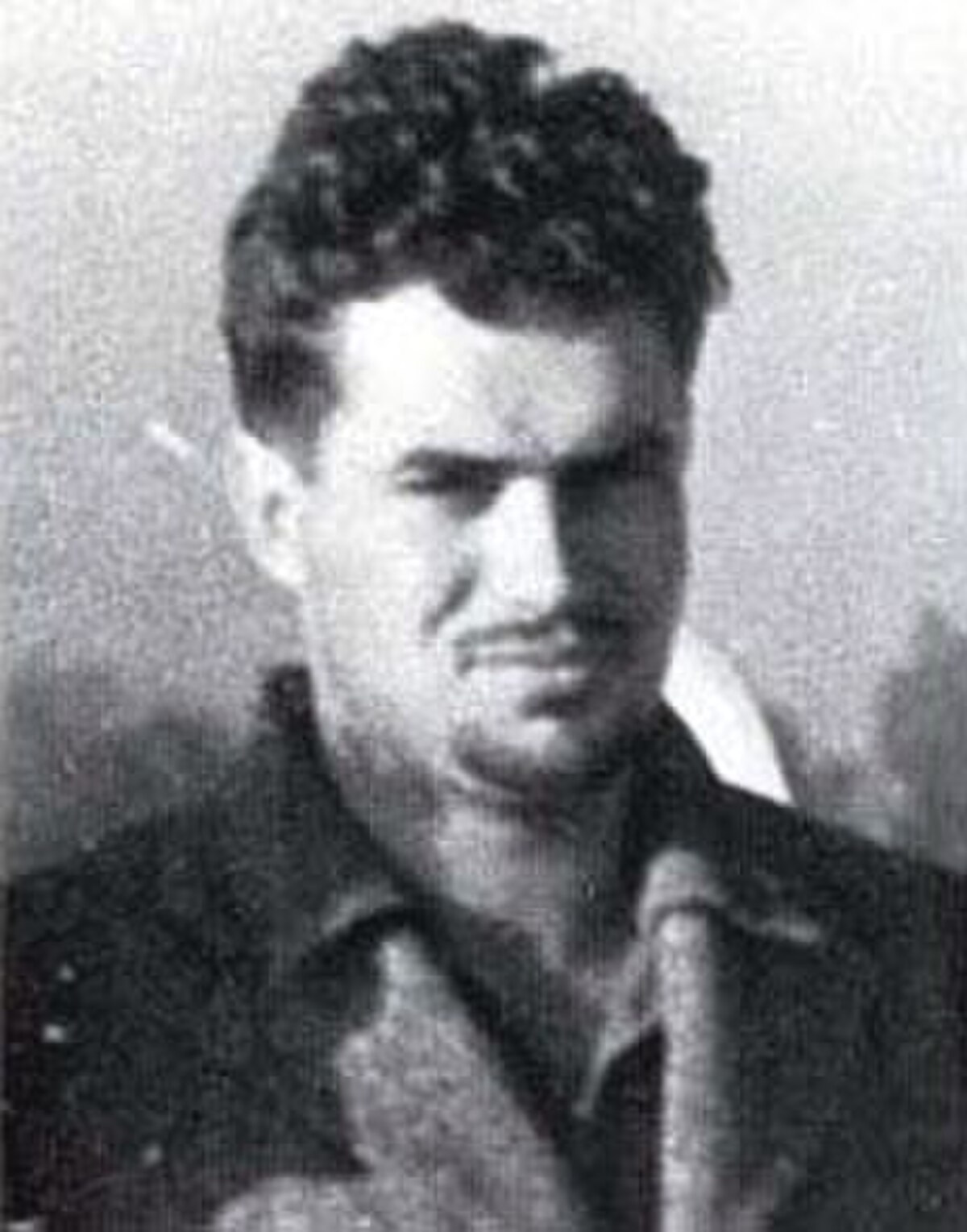
Jack Parsons
Dates: 1914–1952 Domain: Rocket Science, Thelemic Magic, Chemistry
Biography
John Whiteside "Jack" Parsons was born in Los Angeles in 1914 and died in an explosion in his home laboratory in Pasadena in 1952, aged thirty-seven. Between those dates he co-founded the Jet Propulsion Laboratory (JPL), developed the solid-fuel rocket propellant formulas that made the American space program possible, and conducted a series of magical workings that were, in his own understanding, of equal importance to his scientific work. He was, by all accounts, genuinely brilliant in both domains — a self-taught chemist and physicist whose practical contributions to rocketry were recognized by NASA, which named a crater on the moon after him in 1972, and a devoted student of Aleister Crowley's Thelema who corresponded with Crowley directly and was considered by Crowley one of his most capable students.
Parsons grew up in Pasadena in a wealthy family that soon lost its wealth; he educated himself through extensive reading and practical experiment. He was fascinated by rocketry from adolescence — science fiction, specifically Hugo Gernsback's pulp magazines, provided the early inspiration. By the late 1930s he was a member of the GALCIT Rocket Research Project at Caltech (later JPL) and was contributing fundamental experimental work on solid propellants. He was also, from around 1939, a member of the Agape Lodge of the Ordo Templi Orientis in Los Angeles — the California branch of the magical order that Aleister Crowley led. The lodge met regularly at his home on South Orange Grove Avenue, a large Pasadena house that became a center of bohemian, libertarian, and occult culture in wartime Los Angeles.
Parsons's magical practice was thoroughly Thelemic: organized around Crowley's Liber AL vel Legis (The Book of the Law) and its central injunction, "Do what thou wilt shall be the whole of the Law." Thelema is not simple antinomianism (do whatever you want); it is a specific metaphysical claim about the will — that each person has a "True Will" (analogous to the Platonic soul's proper nature, or the alchemical gold) that is distinct from the ordinary ego's desires, and that the task of magical practice is to discover and align with this True Will. The Thelemic system draws on the Hermetic and Rosicrucian inheritance, on Qabalistic symbolism, and on the erotic-magical practices of the OTO.
The Babalon Working (January-March 1946) is the most famous and most controversial of Parsons's magical operations. Conducted with L. Ron Hubbard — who had recently arrived at the Pasadena house and whom Parsons invited as a magical partner — the Working was an extended series of rituals designed to invoke Babalon (Crowley's name for the Scarlet Woman, the embodiment of divine feminine erotic force) and to produce a child of the moon who would inaugurate a new aeon. Whether the Working "worked" in any meaningful sense is a question the project does not need to resolve. What matters is that Parsons believed it had produced a real effect — and that Hubbard subsequently stole Parsons's girlfriend (who became his second wife) and a significant portion of his savings.
Parsons's death in a home laboratory explosion in 1952 was ruled accidental — he was working with mercury fulminate, a highly unstable compound — but rumors of suicide and murder have persisted. He was under investigation by the FBI and had his security clearance suspended, making his rocketry work essentially impossible. The explosion may have been deliberate, accidental, or caused by negligence born of depression.
Key Works (in library)
| Work | Year | Relevance |
|---|---|---|
| Freedom Is a Two-Edged Sword | 1989 (posthumous essays) | Parsons's most articulate statement of his philosophical position |
| The Book of Babalon | 1946 | His record of the Babalon Working |
| Liber 49 (Book of the AntiChrist) | 1949 | A channeled text; his self-identification with the magical current |
Role in the Project
Parsons is the project's case study for a specific failure mode of the initiatory impulse. He had genuine talent, genuine dedication, and genuine experiences that he took with complete seriousness. What he lacked — and what the Thelemic system, which emphasizes the absolute primacy of the individual will, may not be structured to provide — was the context of a genuine traditional lineage, with all the checks, balances, and demands for integration that a genuine tradition provides. The project argues that the initiatory tradition's emphasis on discipline, on the dissolution of the ego (not its empowerment), and on the guidance of a genuine teacher is not an arbitrary cultural artifact but a structural necessity. Without it, the genuine experiences become unintegrated, the genuine insights become inflated, and the consequences are, as in Parsons's case, psychologically and practically catastrophic.
Key Ideas
- True Will: Thelema's central concept — each being has a specific nature and trajectory (the True Will) that is both their deepest self and their alignment with the cosmic order; magic is the art of discovering and enacting it.
- The Convergence of Science and Magic: For Parsons, these were not contradictions but two aspects of the same investigation into the structure of reality — he moved between the laboratory and the lodge as easily as between two rooms.
- Babalon: Crowley's name for the divine feminine in its erotic, transgressive aspect — the force that dissolves all false order and conventional morality; Parsons's central magical focus.
- The Libertarian Mysticism: Parsons's essays in Freedom Is a Two-Edged Sword articulate a mystical anarchism — freedom as the condition for genuine spiritual development, and all institutional authority as the enemy of the True Will.
- The Failure Without Framework: The project's diagnostic reading — what happens when the initiatory impulse operates without the checks of a genuine traditional framework, without a genuine teacher, and without the discipline of genuine self-dissolution.
Connections
- Influenced by: Aleister Crowley (Thelemic system), the Hermetic and Rosicrucian tradition (via OTO), science fiction (the cultural form in which the magical imagination took its early shape)
- Influenced: The contemporary magical revival (particularly in Chaos Magick circles), counter-cultural occultism of the 1960s and 1970s
- In tension with: FIG-0028 Blavatsky's Theosophical tradition (parallel but different), the traditional frameworks that require genuine submission to a teacher and a lineage
Agent Research Notes
[AGENT: perplexity | DATE: 2026-03-22] Parsons's dates are confirmed 1914–1952. The Babalon Working took place January–March 1946. L. Ron Hubbard later founded Scientology; his relationship with Parsons is documented in Hugh B. Urban's The Church of Scientology (2011) and in John Carter's Sex and Rockets (1999). The standard biography is George Pendle's Strange Angel (2005). Parsons's contributions to solid-fuel rocketry are recognized in the development of JATO (Jet-Assisted Take Off); the JPL crater on the Moon is called "Parsons." His FBI file runs to hundreds of pages and is available through FOIA requests.