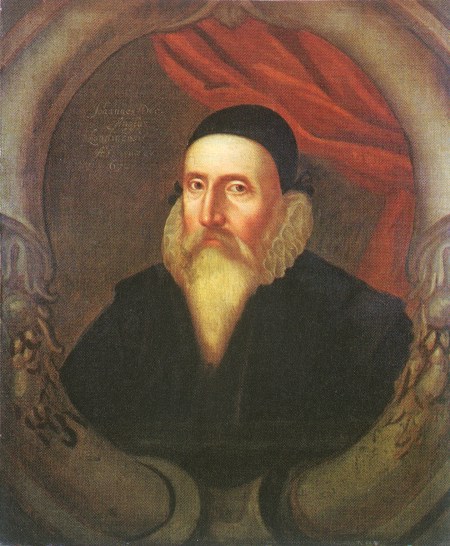
John Dee
Dates: 1527–1608/9 Domain: Mathematics, Astrology, Magic, Natural Philosophy
Biography
John Dee was born in London in 1527 to a Welsh father who served at the court of Henry VIII. He entered St. John's College, Cambridge at fifteen, where he worked with such extraordinary intensity that he reportedly slept only four hours a night and lectured to amazed audiences. He received his BA in 1545, went to Louvain to study with Gerard Mercator (the cartographer), returned to lecture at the newly founded Trinity College, Cambridge, and traveled extensively in Europe to acquire books and instruments for what he hoped would become a national library. He was twice imprisoned on suspicion of sorcery during the reign of Mary I, charges that amounted to nothing, and became an informal adviser and court astrologer to Elizabeth I. His library at Mortlake, numbering perhaps four thousand volumes, was one of the greatest private libraries in England. A mob ransacked and largely destroyed it during his absence in 1583.
The Monas Hieroglyphica (1564) is Dee's most explicitly esoteric work: a mathematical-alchemical commentary on a glyph he had designed that he believed encoded the unified secret of all philosophical knowledge. Elizabeth I received her own copy directly from Dee; the work was read and admired by European scholars, though its meaning has never been entirely decoded. It exemplifies Dee's characteristic mode: mathematics and magic not as separate pursuits but as aspects of a single investigation into the underlying structure of reality. His Propaedeumata Aphoristica (1558) applied mathematical reasoning to astrology, arguing that celestial influences on terrestrial bodies operated according to regular, quantifiable laws — a natural philosophy of the occult.
The angelic conversations with the scryer Edward Kelley, which occupied Dee from 1582 to 1589, represent the most dramatic and controversial dimension of his career. Dee, who appears to have had no talent himself for direct visionary perception, employed Kelley as a scryer — someone who gazed into a polished black obsidian mirror or crystal ball and reported the entities and messages that appeared. What followed was years of elaborate communication with beings who identified themselves as angels, who transmitted to Dee a complete language (Enochian), a cosmological system, and a set of instructions for the reform of Christianity and the unification of Europe. The authenticity of Kelley's visions and the good faith of his transmissions have been debated ever since. What is not debatable is that Dee took them with complete seriousness and organized his life around them.
Dee's career trajectory encodes the central argument about the unified field that the modern period split into separate disciplines. He was by any measure a serious mathematician — his preface to the first English translation of Euclid (1570) is a sophisticated philosophical account of mathematics as the foundation of all science. He was a skilled navigator and cartographer who contributed to the practical infrastructure of Elizabethan exploration. He was the queen's adviser on auspicious dates for state events. And he was a practitioner of a form of angelic magic that aspired to direct communication with the intelligences governing the cosmos. That one person could hold all of these commitments simultaneously without apparent cognitive dissonance is itself significant: the categories that make them incompatible were not yet fully formed.
The later years of Dee's life are tinged with disappointment and humiliation. The Enochian project did not produce the universal Christian reform he had hoped for. Kelley eventually broke with him, claiming the angels had demanded they share their wives — a demand Dee recorded with evident anguish. His library and instruments were largely destroyed or dispersed. He returned to England in 1589, died in poverty, and was buried at Mortlake in 1608 or 1609. His reputation would undergo dramatic posthumous transformations: condemned as a sorcerer, celebrated as a proto-scientist, and finally recognized as something that fits neither category cleanly.
Key Works (in library)
| Work | Year | Relevance |
|---|---|---|
| Monas Hieroglyphica | 1564 | The unified glyph as mathematical-alchemical-Hermetic synthesis |
| Propaedeumata Aphoristica | 1558 | Mathematical natural philosophy of astral influence |
| The Preface to Billingsley's Euclid | 1570 | Dee's most coherent account of mathematics as the foundation of natural knowledge |
| A True and Faithful Relation... | 1659 (posthumous) | Casaubon's edition of the angelic conversations; the Enochian record |
Role in the Project
Dee functions in the project as the limit case of the Renaissance magus — the figure who pressed the Hermetic program to its logical conclusion and encountered at that limit something that no category in his intellectual toolkit could contain. The Enochian conversations are not mere curiosity; they represent the attempt to close the gap between the natural philosopher and the intelligences of the cosmos — to move from indirect knowledge of celestial structures to direct dialogue with the beings that animate them. This is theurgy in the Iamblichan sense, adapted to the intellectual horizon of the Elizabethan court. Dee's career as evidence that the split between natural science and esoteric practice was not inevitable but contingent — a historical accident that produced the modern world's particular impoverishment.
Key Ideas
- Mathematical Magic: Mathematics as the key to both natural philosophy and magical practice; number as the interface between human reason and divine order.
- The Angelic Hierarchy: The structure of intelligences mediating between the human and the divine, accessible through disciplined scrying practice — Dee's operationalization of the Neoplatonic hierarchy of being.
- Enochian Language: The purported language of the angels, transmitted through Kelley's scrying; a complete grammatical and phonological system of uncertain origin.
- The Monas Hieroglyphica: A single glyph encoding the unity of all philosophical, mathematical, and alchemical knowledge — the dream of a single symbol that could hold everything.
- The Library as Magic: Dee's collection of four thousand books as itself a form of magical practice — the gathering of the written wisdom of all traditions as preparation for direct divine encounter.
Connections
- Influenced by: FIG-0024 Ficino (the Hermetic framework), FIG-0026 Bruno (parallel contemporary), FIG-0059 Llull (combinatorial logic), Trithemius of Sponheim (Steganographia — angelic cryptography)
- Influenced: The Rosicrucian movement (Dee's Hermetic synthesis became a source), subsequent Enochian practitioners (including twentieth-century ceremonial magic)
- In tension with: The Elizabethan Church's suspicion of scryers and cunning men, the emerging natural philosophy that would resolve his synthesis into separate science and religion
Agent Research Notes
[AGENT: perplexity | DATE: 2026-03-22] Dee's death date is uncertain; 1608 or 1609. His birth year of 1527 is confirmed. The obsidian mirror used in the scrying sessions is in the British Museum's collection. Benjamin Woolley's biography The Queen's Conjurer (2001) is an accessible modern account. The standard scholarly edition of the angelic diaries is by Joseph H. Peterson. Deborah Harkness's John Dee's Conversations with Angels (1999) is the best scholarly account of the Enochian project specifically. The Enochian system has been taken up extensively by twentieth-century magical orders, including the Golden Dawn and Aleister Crowley's system.