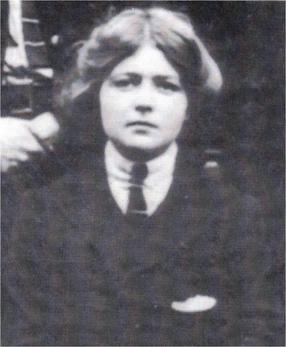
Dion Fortune
Dates: 1890–1946 Domain: Western Esotericism, Occult Philosophy, Psychotherapy, Fiction
Biography
Violet Mary Firth was born in Llandudno, Wales, in 1890. She adopted the motto Deo, non Fortuna, "By God, not fate", early in her occult career and contracted it into the pen name by which she is universally known. Her early training was in psychotherapy: she studied at the Medico-Psychological Clinic in London and wrote her first book, Machinery of the Mind (1922), from within the psychological rather than the esoteric tradition. The synthesis she would spend her career constructing — between depth psychology and Western occultism — grew from this dual apprenticeship. She joined the Alpha et Omega, a Golden Dawn successor organization run by Moina Mathers, was rapidly advanced through its grades, and by 1924 had broken away to found the Community (later Society) of the Inner Light, which she directed until her death in 1946.
The Mystical Qabalah (1935) is her systematic theoretical work and remains, after nearly a century, one of the most coherent introductions to the Hermetic Qabalah as a living operative system rather than a historical artifact. Fortune's argument — against both Guénon's exclusivism about authentic initiatic chains and the more credulous tendencies within Theosophy — is that the Western magical tradition is a genuine initiatic path available to modern Westerners, requiring serious study and group practice but not access to an unbroken Eastern transmission. The Qabalah, for Fortune, is not a document of Jewish mysticism appropriated by Renaissance scholars but a living map of the psyche and cosmos that can be worked with directly.
Her two major novels, The Sea Priestess (1938) and Moon Magic (completed posthumously, 1956), are not fiction in the ordinary sense. They are, by her own account, transmissions — texts written in a mode designed to activate in the reader something that doctrinal exposition cannot. The priestess Vivien Le Fay Morgan, who narrates and acts through both books, embodies a specific magical type: the lunar adept who works with the tides of the unconscious, with the dissolution of bounded ego, with the sacred sexuality that Fortune read through the lens of the Isis mysteries. These novels are the closest she came to writing liturgy.
The Magical Battle of Britain: a series of group visualizations and letters she wrote to her Society from September 1939 through July 1942 — occupies a peculiar position in the history of operative esotericism. Fortune's letters directed her students in sustained group meditations aimed at maintaining Britain's psychological and spiritual resistance. The work was explicitly magical: it involved the invocation of Arthurian figures, the maintenance of specific inner contact, and the claim that the Battle of Britain's outcome was influenced by occult work conducted from her basement in London. The letters survive and are direct documents of a practicing occultist believing, with apparent sincerity, that concentrated imaginative work at sufficient intensity constitutes a genuine causal intervention in the physical world.
Key Works (in library)
| Work | Year | Relevance |
|---|---|---|
| The Mystical Qabalah | 1935 | Systematic Western Qabalah as operative initiatic system |
| The Sea Priestess | 1938 | Fiction as initiatic transmission; lunar magical path, Isis mysteries |
| Psychic Self-Defence | 1930 | Operative psychology of occult attack and defence |
| Applied Magic | 1962 (posthumous) | Collected essays on the theory of magical practice |
Role in the Project
Fortune's specific contribution to the Operative Tradition series is the most explicit modern working-out of a question the project carries throughout: what is the difference between contemplative practice, which transforms the practitioner, and operative practice, which claims to affect the world? She took that distinction seriously and tried to honor both sides of it — the inner discipline without which the outward work is mere fantasy, and the outward work without which the inner discipline becomes spiritual self-regard.
No other figure in the KB spans the same coordinates: Golden Dawn successor, trained psychotherapist, novelist who intended her fiction to function as initiatic transmission, and director of a wartime occult operation. She triangulates between Crowley (operative without the therapeutic discipline), Guénon (doctrinally rigorous but contemptuous of the Western magical tradition as pseudo-initiatic), and the project's own position — that operative esotericism can be engaged seriously without either credulity or dismissal.
Key Ideas
- The Western Magical Tradition as Path: Fortune's argument that the Hermetic Qabalah, properly worked, constitutes a genuine initiatic system available to Westerners without recourse to Eastern transmission — a direct response to Guénon's exclusivity claims.
- Fiction as Transmission: The theory behind The Sea Priestess and Moon Magic — that certain material can only be communicated through narrative because the reader's identification with the protagonist activates something that doctrinal statement cannot.
- The Magical Battle: The 1939–1942 letters as a documented case of group operative esotericism applied to a geopolitical crisis. Whatever one thinks of its efficacy, the record shows how a serious occultist believed this kind of work functioned.
- Lunar vs. Solar Paths: Fortune's own version of Evola's polarity — the solar path of differentiated, rational ascent and the lunar path of dissolution, surrender, and tidal rhythms. Her work is explicitly with the lunar, and she grounds it in a theory of the unconscious drawn partly from Freud and partly from her own magical experience.
Connections
- Golden Dawn lineage: FIG-0017 Yates (who traced the Hermetic tradition behind the Golden Dawn's recovery of it), FIG-0027 Dee (Enochian tradition that influenced the Golden Dawn), FIG-0070 Crowley (contemporary and rival within the same current)
- Operative esotericism: FIG-0032 Evola (UR Group operative experiments; parallel but different framework), FIG-0053 Parsons (Thelemic operative practice)
- Conceptual connections: CON-0008 Theurgy, CON-0021 Counter-Initiation (Fortune's own concern with pseudo-initiatic organizations)
Agent Research Notes
[AGENT: perplexity | DATE: 2026-03-22] Dion Fortune died January 6, 1946, of leukemia. The Magical Battle of Britain letters were published posthumously as The Magical Battle of Britain (1993), edited by Gareth Knight. The Sea Priestess was self-published by Fortune's own Society of the Inner Light in 1938 because commercial publishers declined it. Her conflict with Moina Mathers over the Alpha et Omega involved both doctrinal and personal disputes. Gareth Knight and Alan Richardson have written biographical studies; Janine Chapman's Quest for Dion Fortune and Ithell Colquhoun's Sword of Wisdom are primary sources on the Golden Dawn milieu she inhabited.