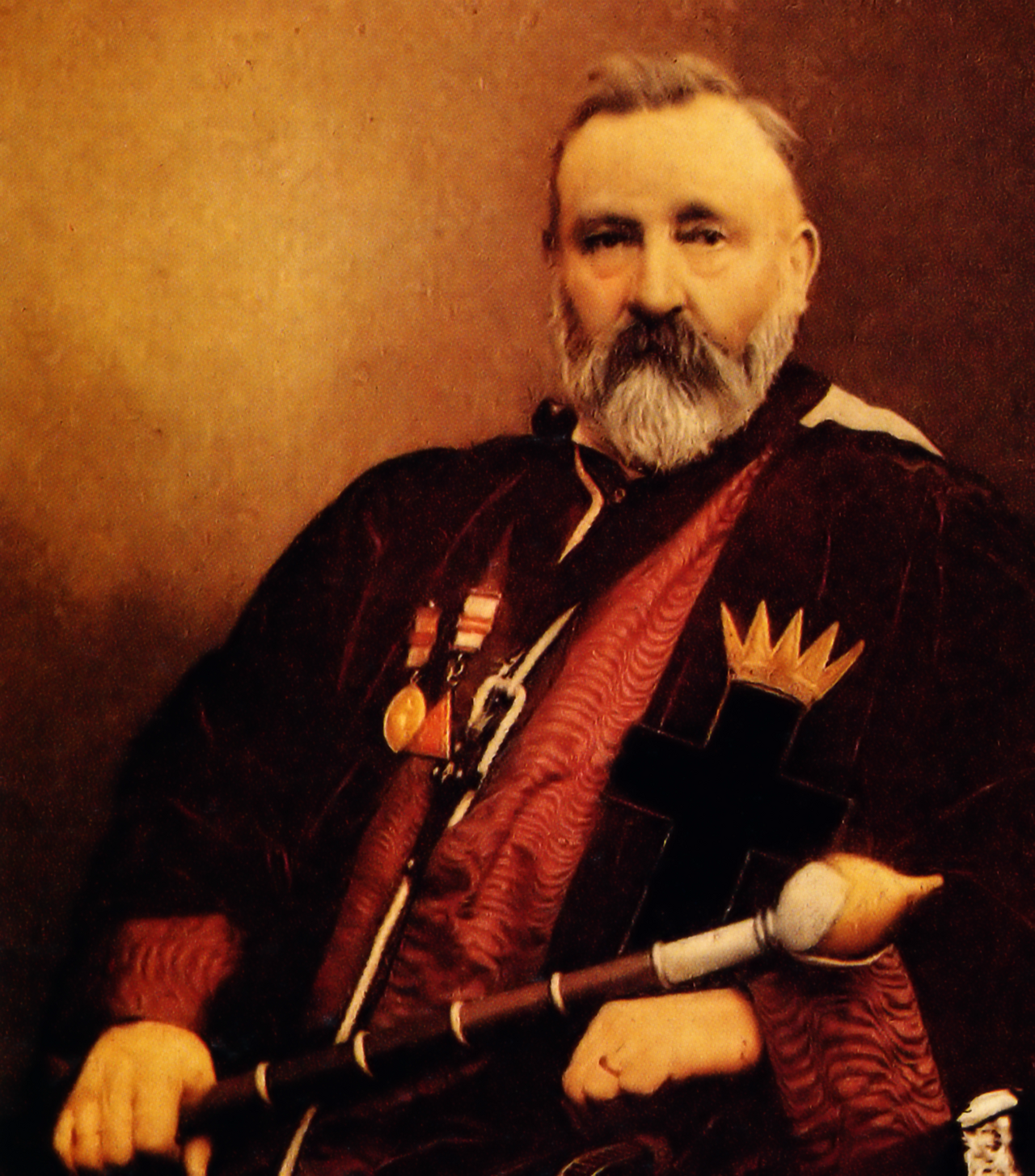
William Wynn Westcott
Dates: 1848–1925 Domain: Occultism, Hermeticism
Biography
William Wynn Westcott was born in Leamington Spa, England, in 1848, orphaned young, and raised by an uncle who was a surgeon. He studied medicine and became a coroner for northeast London, a position he held concurrently with his extensive occult activities. Westcott was a Freemason, a member of the Societas Rosicruciana in Anglia (he eventually became its Supreme Magus), and the co-founder of the Golden Dawn.
Westcott's role in the Golden Dawn's founding was organizational and legitimatory. He claimed to have discovered the Cipher Manuscripts (the coded ritual outlines that provided the Order's framework) in a London bookstall, and to have corresponded with a German Rosicrucian adept named Fraulein Anna Sprengel who authorized the founding of an English temple. The historical existence of Sprengel has never been confirmed, and many scholars regard the authorization as Westcott's fabrication. In 1897, Westcott was forced to resign his active role in the Golden Dawn when his official position as a coroner became incompatible with public association with an occult organization; official documents linking him to the Order had come to the attention of the authorities.
Key Works
Westcott's scholarly contributions include translations of the Sepher Yetzirah ("Book of Formation," 1887), the earliest Kabbalistic text, and The Isiac Tablet of Cardinal Bembo (1887), a study of an Egyptian-themed Renaissance artifact. He also edited a series of Hermetic and alchemical texts for the Collectanea Hermetica series (1893-1896). His primary legacy, however, is institutional: the Golden Dawn exists because Westcott created the organizational framework and the origin story that gave it legitimacy.
Role in the Project
Westcott co-founded the Golden Dawn and provided its initial legitimacy through the contested Cipher Manuscripts and the alleged authorization from the German Rosicrucian adept Anna Sprengel. His role illustrates a recurring pattern in the Western esoteric tradition: the creation of institutional authority through claimed lineage, whether or not the lineage is historically verifiable.