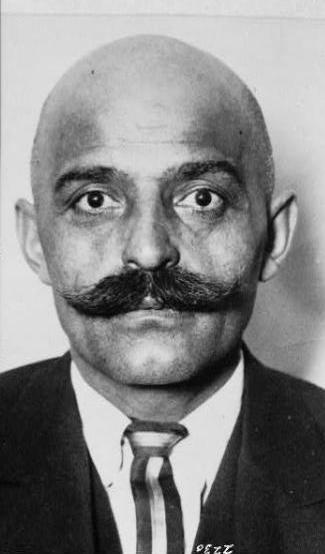
George Ivanovich Gurdjieff
Dates: c. 1866–1949 Domain: Esotericism, Philosophy of Consciousness, Movement Practice
Biography
George Ivanovich Gurdjieff was born in Alexandropol (now Gyumri, Armenia), probably around 1866, though the date and even the year are uncertain — Gurdjieff was not forthcoming about biographical details and actively obscured some of them. His father was a Greek ashokh (oral poet and musician), his mother Armenian; he grew up in the religiously and culturally diverse borderland of the Russian Caucasus, where Orthodox Christianity, Islam, and remnants of older traditions coexisted in proximity. His own account of his formative years — given in Meetings with Remarkable Men (1960, dictated earlier) — describes a young man driven by intense questions about the meaning of human life who spent decades seeking genuine esoteric knowledge across Central Asia, Egypt, Persia, and possibly Tibet. The historical accuracy of these travels is impossible to verify but immaterial to the teaching; they function, like Plato's myths, as the narrative form through which essential content is conveyed.
By the early twentieth century Gurdjieff had assembled in Moscow and St. Petersburg a group of students who found in his teaching something qualitatively different from the Theosophy, Spiritualism, and Eastern philosophy then fashionable in Russian intellectual circles. The Russian philosopher Pyotr Ouspensky, who documented his encounter with Gurdjieff in In Search of the Miraculous, captures the essential quality: Gurdjieff had practical knowledge, not theoretical. He could demonstrate through direct group exercises — movements, attention practices, psychological observations — that normal human beings are in a state of mechanicalness, automatism, and what he called "sleep" that they mistake for wakefulness. The path to genuine consciousness required not belief but specific work on the self: hence the Fourth Way.
The Fourth Way is Gurdjieff's term for a path of transformation that does not require the conditions of the monk (renunciation of ordinary life for a monastery), the yogi (withdrawal for years of solitary practice), or the fakir (the development of will through extreme physical disciplines). It is a path pursued in and through ordinary life — while working, in relationships, in the midst of the city — because ordinary life, properly used, provides the friction necessary for inner work. The fundamental practice is self-remembering: the deliberate maintenance of a divided attention that observes the self in the act of its ordinary functioning without identifying with what it observes. This sounds simple and is, in practice, extraordinarily difficult to sustain even for minutes at a time.
His three-volume series All and Everything — of which Beelzebub's Tales to His Grandson (1950) is the first and most important volume — is a deliberately and systematically obscure text. Gurdjieff revised it repeatedly, reportedly reading sections aloud to groups and then rewriting the parts they had found comprehensible, on the principle that what could be understood too easily would be absorbed by the wrong part of the reader. The book is written in the voice of Beelzebub, an extraterrestrial elder, recounting to his grandson during an interplanetary journey the history of the planet Earth and its "three-brained beings" (humans). It is a sustained satirical critique of human mechanicalness, institutional religion, pseudo-science, and the particular forms of sleep characteristic of each historical epoch — wrapped in an often excruciating prose style that requires active effort to penetrate. This deliberate difficulty is itself the teaching: the text is designed to work on the reader, not merely to inform.
The enneagram — the nine-pointed figure within a circle that Gurdjieff introduced in his teachings — deserves separate mention. He presented it as a universal symbol encoding the laws governing the transformation of energy (the Law of Three and the Law of Seven). Its application to psychological typology, which has produced the popular Enneagram personality system of the twentieth century, is a partial and arguably distorted version of Gurdjieff's original use. The project engages the enneagram as a cosmological-psychological tool while noting the gap between Gurdjieff's presentation and its subsequent popularization.
Key Works (in library)
| Work | Year | Relevance |
|---|---|---|
| Beelzebub's Tales to His Grandson | 1950 | The central initiatic text of the Gurdjieff teaching; the form is the content |
| Meetings with Remarkable Men | 1960 | The mythological autobiography; the search for genuine knowledge |
| Life Is Real Only Then, When 'I Am' | 1975 | Unfinished fragments on the practice of self-remembering |
Role in the Project
Gurdjieff matters to the project in two distinct ways. First, as a practitioner: he represents a serious twentieth-century attempt to transmit a genuine initiatory teaching adapted to the conditions of modernity. The Fourth Way's insistence on transformation within ordinary life rather than in retreat directly addresses the project's concern with what initiatory practice can look like in a post-traditional world. Second, as an epistemological challenge: Gurdjieff's claim that human beings are ordinarily asleep — that what passes for knowledge, opinion, or spiritual practice in normal life is mechanically produced and therefore unreliable — is a claim the project takes seriously. The Mysteries' diagnostic function (showing the initiate the condition from which they need to be transformed) is operative in Gurdjieff's work in a form adapted to the twentieth century.
Key Ideas
- Self-Remembering: The fundamental practice — maintaining a divided attention that observes oneself observing — as the seed of genuine consciousness within ordinary mechanicalness.
- Sleep: Gurdjieff's term for the normal state of human consciousness, characterized by mechanicalness, identification with passing states, and the absence of genuine will.
- Fourth Way: Transformation through engagement with ordinary life rather than through the specialized conditions of the monastery, the ashram, or the fakir's ordeal.
- The Law of Three and the Law of Seven: The two fundamental laws governing all transformation; the enneagram encodes their interrelation.
- Conscious Suffering: The deliberate acceptance of the friction produced by the gap between what one is and what one could be — the energy of transformation.
Connections
- Influenced by: Sources unknown but speculated to include Sufi orders (particularly Naqshbandi), Eastern Orthodox hesychasm, Zoroastrian practice, possibly Tibetan Buddhism
- Influenced: FIG-0030 Ouspensky (primary documented student and eventual critic), J. G. Bennett, P. L. Travers (author of Mary Poppins), A. R. Orage (New Age editor)
- In tension with: FIG-0028 Blavatsky (Theosophy as pseudo-knowledge), conventional religion (which he regarded as transmitting the forms without the substance), and FIG-0030 Ouspensky's eventual break
Agent Research Notes
[AGENT: perplexity | DATE: 2026-03-22] Gurdjieff's birth year is typically given as c. 1866–1877; the range reflects genuine uncertainty. He died October 29, 1949, in Neuilly-sur-Seine. The Institute for the Harmonious Development of Man was established at the Château du Prieuré in Fontainebleau-Avon in 1922 and closed in 1932 after a serious car accident nearly killed Gurdjieff. Beelzebub's Tales was privately circulated from the 1920s but first published in English (translated by A. R. Orage and others) in 1950. The Enneagram of Personality as used in popular psychology was developed separately by Óscar Ichazo and Claudio Naranjo from the 1960s, drawing on Gurdjieff's figure but transforming its application.