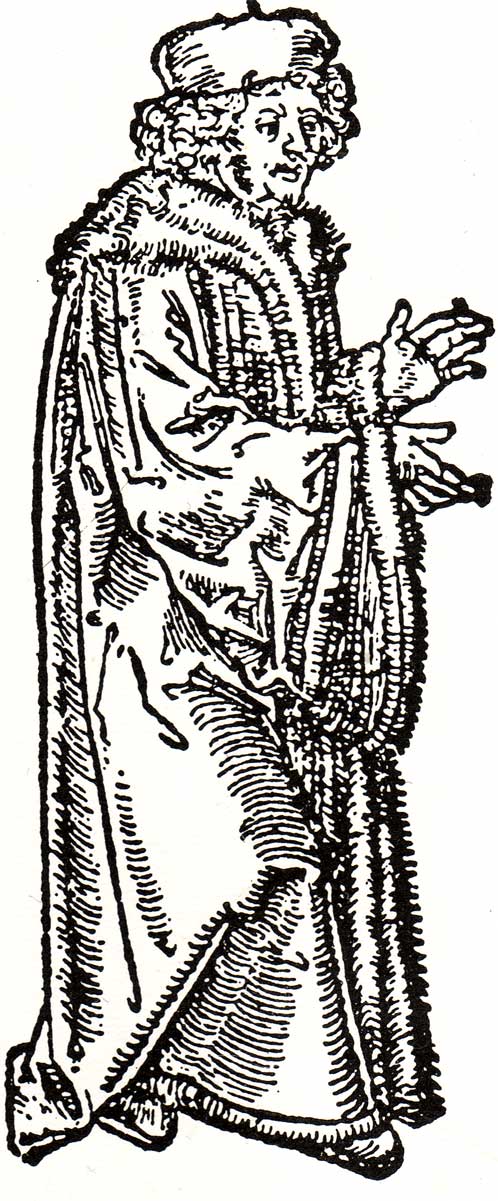
Johannes Reuchlin
Dates: 1455–1522 Domain: Christian Cabala, Hebrew Studies
Biography
Johannes Reuchlin was born in Pforzheim, Germany, in 1455 and educated at Freiburg, Paris, and Basel. He studied law and served as a diplomat and judge in the Duchy of Wurttemberg, but his intellectual passion was Hebrew. He was the first German Christian scholar to achieve genuine competence in the language, studying with Jewish teachers at a time when this was controversial and, in some circles, suspect.
Reuchlin's career was defined by two interlocking commitments: the scholarly study of Hebrew as a key to divine wisdom, and the political defense of Jewish books against destruction. In 1509, the converted Jew Johannes Pfefferkorn, backed by the Dominican Order, sought an imperial order to confiscate and burn all Jewish books except the Bible. Reuchlin was consulted and argued forcefully that the Talmud and Kabbalistic texts were valuable for Christian scholarship. The resulting controversy (the "Reuchlin affair") became a cause celebre of the humanist movement and anticipated the Reformation's challenge to Dominican and papal authority.
Key Works
De Verbo Mirifico ("On the Wonder-Working Word," 1494) argues that the divine name YHVH, augmented by the letter Shin to form YHShVH (Jesus), demonstrates that Kabbalistic letter-mysticism confirms the central truth of Christianity. The argument is both mystical and philological.
De Arte Cabalistica ("On the Art of Cabala," 1517; see TIM-0027) is the first systematic presentation of Kabbalah for a Christian audience. Structured as a dialogue between a Pythagorean, a Muslim, and a Kabbalist, it integrates Jewish mystical letter-symbolism with Neoplatonic and Pythagorean number mysticism.
Role in the Project
Reuchlin established Christian Cabala as a systematic intellectual enterprise, building on Pico della Mirandola's initial synthesis. His De Arte Cabalistica integrates Jewish Kabbalistic letter-mysticism with Pythagorean number symbolism and Neoplatonic metaphysics, creating a distinctively Renaissance form of esoteric practice centered on the divine names. His defense of Hebrew books against destruction by the Dominicans is also a key moment in the history of intellectual freedom.