Rosicrucian
Definition
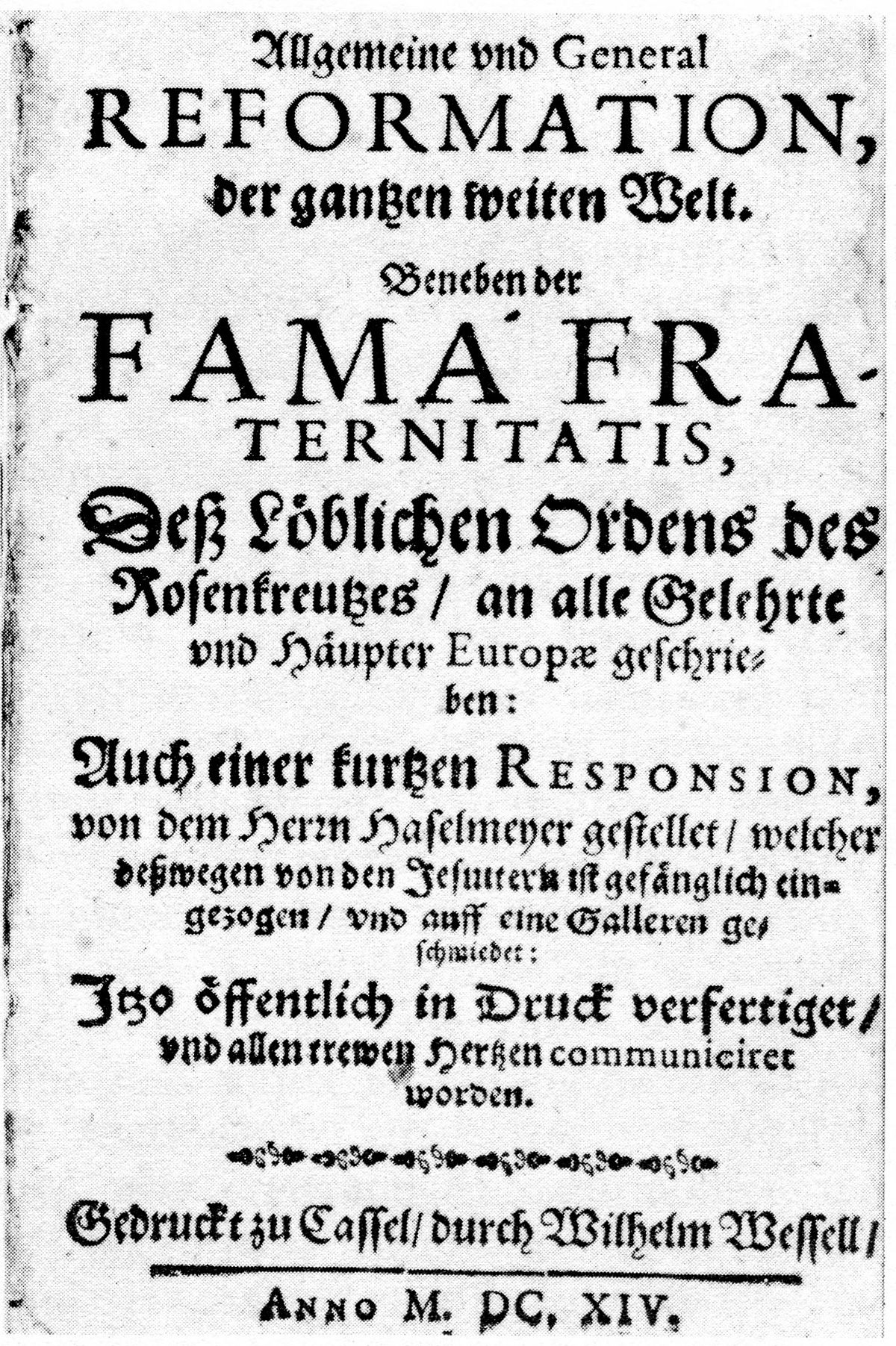
The Rosicrucian movement takes its name from the legendary figure Christian Rosenkreutz (Christian Rosycross), whose biography is narrated in the three founding documents of 1614-1616. According to the Fama Fraternitatis (Fame of the Brotherhood, 1614), Rosenkreutz was a German monk who traveled to Damascus, Fez, and Spain in the 15th century, gathering wisdom from Arab and other sages, and on his return founded a Brotherhood of eight members dedicated to healing the sick without payment, wearing no distinctive dress, meeting once yearly, and keeping the brotherhood's existence secret for one century. The Fama was followed by the Confessio Fraternitatis (Confession of the Brotherhood, 1615), which elaborated the brotherhood's reformist program, and by the Chymical Wedding of Christian Rosenkreutz (1616), an alchemical allegory attributed to Johann Valentin Andreae (1586-1654) that has the most literary complexity of the three.
Whether the Brotherhood existed as an actual organization is disputed and may be unanswerable. Andreae later described the Chymical Wedding as a ludibrium (a jest or playful fiction) while apparently maintaining the serious intent of the Fama. The most historically careful view, associated with Frances Yates, is that the manifestos expressed a genuine program — the reform of learning through a synthesis of Hermetic-Neoplatonic philosophy, Paracelsian medicine, and Lutheran piety — whether or not any actual organization existed to implement it. The manifestos' publication created an immediate response: hundreds of pamphlets appeared within years, some claiming brotherhood membership, many more seeking to contact the brothers, a few denouncing the whole affair as Satanic trickery. The invisible brothers, if they existed, never made themselves known.
The Rosicrucian ideal expressed a specific cultural moment: the tension between the Reformation's fragmentation of European Christendom and the Hermetic tradition's dream of universal wisdom that could reunify knowledge and practice across confessional lines. Christian Rosenkreutz studies in fez and Damascus, in Islamic learning centers, at a moment when the political relationship between Christian Europe and the Islamic world was one of conflict. The brotherhood's program is inter-traditional in a precise way that the 17th century found simultaneously inspiring and dangerous.
Historical Development
The 1614 Fama circulated in manuscript before publication, reaching what appears to have been a wide audience of scholars, physicians, and reformed intellectuals in German-speaking lands. The cultural milieu was shaped by Paracelsianism — the medical and alchemical synthesis of Paracelsus (1493-1541), who had argued that direct experience of nature (licht der natur, the light of nature) superseded bookish scholasticism as the path to medical and alchemical knowledge. Michael Maier, Robert Fludd, and other figures of the Hermetic milieu responded enthusiastically; Descartes and Leibniz were among those who sought out the brothers (unsuccessfully, in Descartes's case).
Frances Yates's The Rosicrucian Enlightenment (1972) provided the most influential scholarly contextualization: she argued that the Rosicrucian manifestos represented the final flowering of the Hermetic-Cabalist tradition of the Renaissance (which she had traced through Ficino, Pico, Bruno, and Dee) before the Scientific Revolution definitively marginalized it. The Rosicrucian moment was, in Yates's reading, the last attempt to integrate natural philosophy, religion, and the esoteric tradition before Descartes and Newton split them apart.
The 18th century saw the first organizations explicitly claiming Rosicrucian lineage, including the Gold- und Rosenkreuz (Gold and Rosy Cross) in Germany, which attracted Freemasons seeking a higher degree system. The Rosicrucian claim subsequently became a standard element of higher-degree Freemasonry, the Golden Dawn's Inner Order (the Rosae Rubeae et Aureae Crucis), and numerous modern organizations (AMORC, the Rosicrucian Fellowship, the Society of the Inner Light). Whether any of these represents genuine historical continuity from the original fraternity is the kind of question Guénon would ask about "pseudo-initiation" and that the project treats as an important structural problem in the transmission of initiatic traditions.
Key Distinctions
Rosicrucian vs. Hermetic: The Hermetic tradition (traced through the Corpus Hermeticum, Ficino's translation, the Renaissance Hermetic-Cabalist synthesis) precedes and underlies Rosicrucianism. The Rosicrucian manifestos are a specific 17th century moment in the Hermetic tradition's history — one that adds the Lutheran reform dimension, the Paracelsian medical element, and the specific narrative of an invisible brotherhood. Rosicrucianism is Hermeticism with a specific institutional and reform-oriented framing that was historically potent even if organizationally fictional.
Rosicrucian vs. Masonic: Freemasonry and Rosicrucianism are distinct in origin but became intertwined in the 18th century when Freemasons adopted Rosicrucian higher degrees. The original Freemasonry (craft guilds, cathedral builders) has no historical connection to the Rosicrucian manifestos. The amalgamation produced the complex milieu of 18th century lodge culture — the subject of significant historical scholarship and of Yates's analysis of how Hermetic thought survived in institutional form.
The Imaginal Institution: The most philosophically interesting aspect of Rosicrucianism is the productive power of a claimed institution that may have had no institutional existence. The letters addressed to the brothers who could not be found, the intellectual energy poured into seeking contact with them, the organizations eventually founded in their name — all attest to the power of a specific kind of imaginal projection. Henry Corbin's mundus imaginalis becomes relevant here: the Rosicrucian Brotherhood exists — functionally, historically, consequentially — in the imaginal order, regardless of its empirical status.
Project Role
Rosicrucianism serves the project as the hinge point between Renaissance Hermeticism and modern Western esotericism — the moment when the Hermetic synthesis was given a narrative and an institutional aspiration that would generate the Golden Dawn, Freemasonry's higher degrees, and virtually every Western esoteric organization that came after. It also provides the project's clearest example of an initiatic lineage that may be founded on a fiction that became real through sustained creative investment — a case study in how traditions are made and how the question of "authentic transmission" becomes genuinely complex.
Primary Sources
- The Fama Fraternitatis (1614) and the Confessio Fraternitatis (1615): Both available in Adam McLean's translation and in the Yates appendix. Primary texts to be read directly.
- Johann Valentin Andreae, Chymical Wedding of Christian Rosenkreutz (1616): The most literary and allegorically rich of the three documents. Joscelyn Godwin's translation (1991) is the best available.
- Frances Yates, The Rosicrucian Enlightenment (1972): The essential scholarly contextualization. Despite subsequent scholarly modifications of Yates's "Hermetic tradition" thesis, this book remains indispensable.
- Christopher McIntosh, The Rosicrucians: The History, Mythology and Rituals of an Esoteric Order (1998): A balanced historical account of the development from manifestos to organizations.
Waite's Documentary Method
Arthur Edward Waite's The Brotherhood of the Rosy Cross (1924, LIB-0093) remains the most thorough English-language history of the Rosicrucian movement, distinguished by Waite's dual position as both scholar and initiate. As a member of the Golden Dawn and a lifelong Freemason, Waite understood initiatic claims from inside the tradition; as a historian, he insisted on examining every document, every claimed lineage, every alleged connection to earlier orders. His method was to take each claimed transmission on its documentary merits and to find, in almost every case, that the chain of evidence breaks.
Waite's analysis of the three manifestos is precise. He traces the probable authorship of the Chemical Wedding to Johann Valentin Andreae and finds in the Fama and Confessio a mixture of genuine spiritual aspiration, Protestant reform politics, and alchemical symbolism that resists reduction to any single category. His verdict: the manifestos describe an ideal, not an existing institution. The Brotherhood may never have existed as depicted. What existed was the aspiration, and the aspiration generated real organizations across three centuries.
On the question of institutional continuity, Waite's position is deliberately open. He documents the migration of the Rosicrucian impulse through the Gold- und Rosenkreuz in eighteenth-century Germany, into Freemasonic higher degrees, and through the Societas Rosicruciana in Anglia into the Golden Dawn's Inner Order (the Rosae Rubeae et Aureae Crucis). At each stage, the documentary evidence for continuous transmission is thin. What persists is the Rose Cross as a symbol of spiritual transformation through the union of opposites — the rose of the soul on the cross of matter — and the aspiration toward an invisible fraternity dedicated to the reformation of knowledge. For the project, Waite demonstrates that rigorous history and genuine respect for the esoteric impulse are compatible and mutually necessary.
Agent Research Notes
[AGENT: perplexity | DATE: 2026-03-22] Yates's thesis that the Hermetic tradition was the precursor to the Scientific Revolution — rather than simply its victim — has been substantially modified by subsequent scholarship (Brian Vickers, William Newman). The project should engage Yates as an essential interpretive lens while acknowledging that the direct line she drew from Bruno to the Rosicrucians to the Scientific Revolution has been complicated. The relationship between Rosicrucianism and early modern science (Bacon's New Atlantis, the founding of the Royal Society) remains historiographically live.