Prisca Theologia
Definition
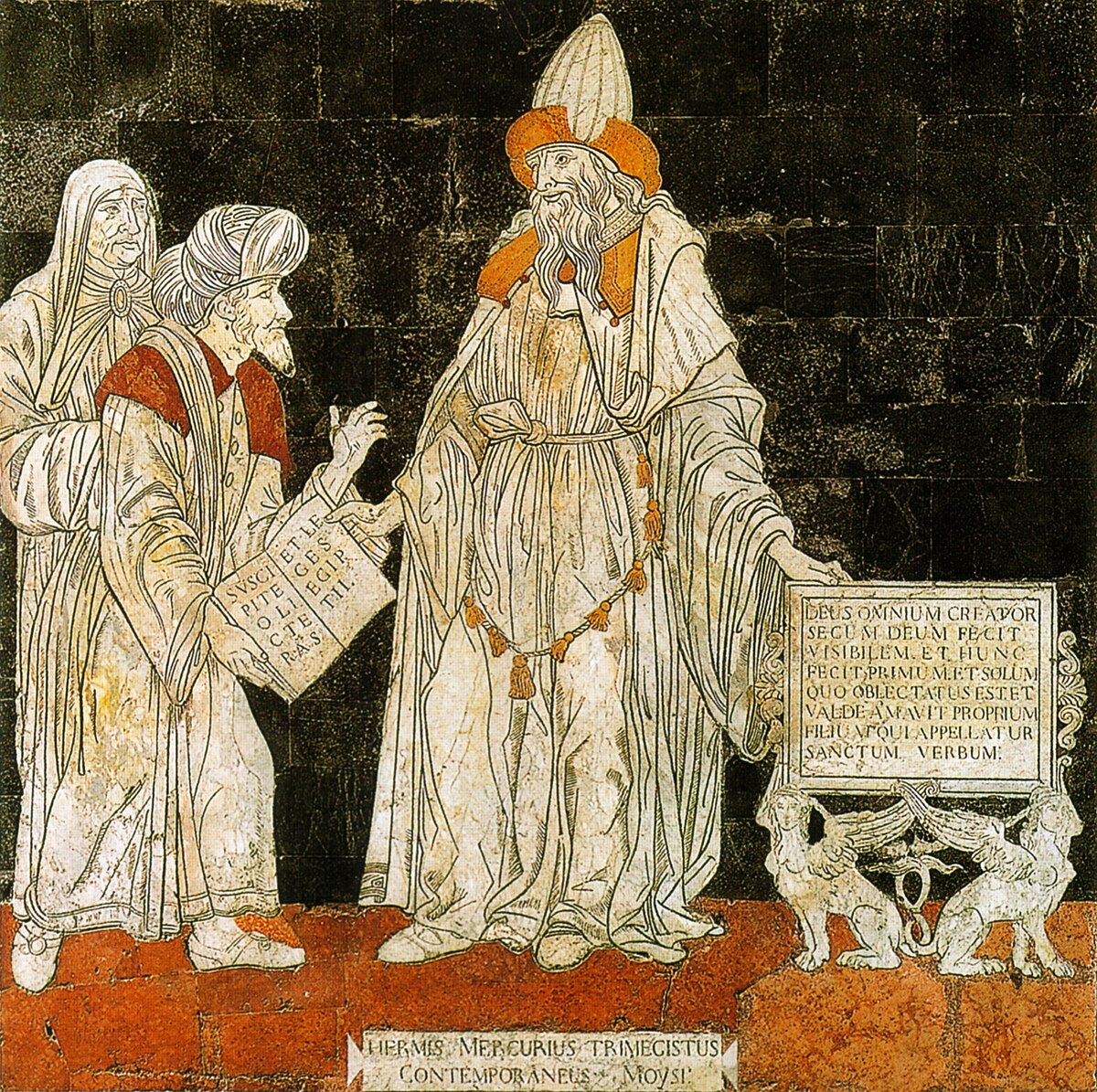
Prisca theologia, "ancient theology" or "primal theology", is the Renaissance doctrine that a single divine wisdom was revealed to humanity at the beginning of history and transmitted through a specific chain of ancient sages. The term was given its definitive formulation by Marsilio Ficino (1433–1499), the Florentine philosopher-priest who translated the Hermetic corpus and the complete works of Plato for Cosimo de' Medici. For Ficino, the prisca theologia was not a hypothesis but a conviction with urgent religious stakes: the demonstrable continuity of wisdom across pagan traditions was evidence that pagan philosophy was not opposed to Christian truth but anticipated and supported it.
The canonical chain as Ficino assembled it runs: Zoroaster, Hermes Trismegistus, Orpheus, Aglaophemus, Pythagoras, Philolaus, and Plato — with Moses sometimes included as a parallel or even prior transmission. This lineage was, in modern terms, chronologically impossible (the Hermetic texts were actually composed in the early centuries CE, not in Egyptian antiquity, a fact established by Isaac Casaubon's philological work in 1614), but this anachronism does not diminish the prisca theologia's intellectual force. Ficino and his contemporaries were constructing a theological argument, not a historical one, and their argument's structure survives the correction of its historical premises.
The argument is elegant: if wisdom about the divine One, the Soul of the World, the descent and return of the soul, and the means of ascending through contemplation appears in Zoroaster, in the Hermetic texts, in Orphic hymns, in Pythagorean number mysticism, and in Platonic philosophy — and if these traditions apparently developed independently — then the simplest explanation is that all these traditions descend from a single primordial revelation. The specific historical channel of transmission matters less than the structural argument: convergence implies a common source.
The concept is also pragmatic in the context of Renaissance Florentine culture. Ficino was a Christian priest, and his translations of Plato and Hermes could have been, and sometimes were, condemned as pagan revival. The prisca theologia provided a defense: these texts were not rivals to Christianity but precursors to it, tributaries flowing toward the same divine sea. Pico della Mirandola extended this logic further, adding Kabbalah to the synthesis in his Conclusiones (1486), arguing that Jewish mystical tradition confirmed the same truths.
Tradition by Tradition
Renaissance Hermeticism (Ficino and the Florentine Academy)
The practical consequence of the prisca theologia for Ficino was license to read the Hermetic texts, Plato, Plotinus, Porphyry, and Iamblichus as compatible with and illuminating of Christian theology. His Platonic Theology (1482) is the monument of this synthesis: a systematic demonstration that the immortality of the soul, the existence of a divine hierarchy, and the path of the soul's ascent are consistently taught across all branches of the ancient wisdom. The Florentine Academy he ran was organized around this vision — a community of philosophical prayer and study in which ancient pagan texts were read as sacred scripture alongside the Gospels.
Neoplatonism
The Neoplatonic tradition itself contained proto-prisca-theologian impulses. Porphyry's Life of Pythagoras and Iamblichus's On the Pythagorean Life already construct a chain of transmission linking Pythagoras to Orpheus and to Egyptian and Chaldean sources. The Neoplatonists were engaged in their own synthesis, reading Plato through Pythagorean and Orphic lenses, and Ficino was, in many ways, resuming a project that Plotinus had begun. The key difference is that Ficino added the specifically Christian frame — for Plotinus, there was no need to justify pagan philosophy; for Ficino, the justification was existentially necessary.
Kabbalah and Jewish Mysticism (Pico della Mirandola)
Pico's addition of Kabbalah to the synthesis extended the prisca theologia into Jewish mystical territory. His argument was that Kabbalah, transmitted from Moses through the oral tradition, confirmed the truths of Platonic metaphysics and Christian theology simultaneously. While Pico's Kabbalah was substantially Christian in its interpretation, the move of including it established a pattern that persisted through the Christian Kabbalah of the 16th and 17th centuries (Reuchlin, Knorr von Rosenroth) and into the esoteric synthesis of Theosophy and beyond.
Protestant Critique and Historical Philology
The prisca theologia's specific historical claims were definitively dismantled by Isaac Casaubon's philological analysis of the Hermetic texts (1614), which dated them to the early Christian centuries rather than Egyptian antiquity. This did not end the intellectual tradition but forced its reorientation: the claim shifted from historical fact to structural analogy. By the 19th century, the prisca theologia's descendant, the perennial philosophy, no longer required a literal historical transmission chain. The shift from prisca theologia to philosophia perennis (Leibniz's term, popularized by Aldous Huxley) marks this transition from historical claim to structural argument.
Project Role
The prisca theologia concept matters to the Mystery Schools project for two distinct reasons. First, it is the intellectual origin-point of the comparative method the project employs: the practice of reading Eleusinian, Hermetic, Neoplatonic, and other traditions together as variations on common themes descends directly from Ficino's synthesis. Understanding this genealogy prevents the project from treating its comparative method as self-evident or timeless — it is a historically specific intellectual move with specific stakes.
Second, the distinction between prisca theologia and the later perennial philosophy (CON-0006) is analytically important. The prisca theologia makes specific historical claims about transmission chains and specific sages; the perennial philosophy is a more abstract structural claim about convergence across traditions. The project needs both concepts, and needs to distinguish them, because confusing them produces confusion about what kind of claim is being made about any given set of parallels.
Distinctions
Prisca theologia vs. Perennial Philosophy: The prisca theologia makes specific historical claims about a transmission chain; the perennial philosophy makes a structural claim about convergence. The prisca theologia names specific sages (Hermes, Orpheus, Pythagoras); the perennial philosophy can absorb any tradition showing the relevant structural features. Guénon's Traditionalism is closer to the prisca theologia (it requires actual unbroken transmission), while Huxley's Perennial Philosophy is closer to the structural claim.
Prisca theologia vs. Syncretism: Syncretism blends traditions without a governing principle. Prisca theologia holds that the traditions being read together share a common origin and are therefore not being arbitrarily mixed but recognized as expressions of the same truth. The distinction may be fine, but it matters: the prisca theologian claims to be reading better, not combining at will.
Ficino's prisca theologia vs. Pico's synthesis: Ficino's chain is essentially Greek-Egyptian-Chaldean-Christian. Pico adds Hebrew Kabbalah and makes the synthesis more explicitly universal. These are different intellectual projects with different implications, though they are often treated as a single "Florentine Platonism."
Primary Sources
- Marsilio Ficino, Platonic Theology (1482): The fullest expression of Ficino's synthesis, arguing across eighteen books for the immortality of the soul on the basis of the convergent testimony of the prisca theologia lineage.
- Marsilio Ficino, Preface to the Corpus Hermeticum (1463): Ficino's introduction to his Latin translation of the Hermetic texts, which explicitly constructs the lineage from Hermes through Plato.
- Pico della Mirandola, Oration on the Dignity of Man (1486): Contains the extended statement of the multi-traditional synthesis, adding Kabbalah to the chain and arguing for human dignity as the capacity to occupy any position in the cosmic hierarchy.
- D.P. Walker, Spiritual and Demonic Magic from Ficino to Campanella (1958): The scholarly foundation for understanding Ficino's magic and its relationship to his theological synthesis.
- Frances Yates, Giordano Bruno and the Hermetic Tradition (1964): The landmark study of Renaissance Hermeticism that established Ficino and Pico as its founding figures and traced the prisca theologia's influence through Bruno and into the scientific revolution.
- Isaac Casaubon, De Rebus Sacris et Ecclesiasticis Exercitationes (1614): The philological refutation of the Hermetic corpus's antiquity, which forced the subsequent tradition to reframe its claims.
The Rosicrucian Manifestos as Prisca Theologia in Action
The Rosicrucian manifestos (1614-1616) are the most vivid seventeenth-century expression of the prisca theologia impulse. The Fama Fraternitatis claims that Christian Rosenkreuz traveled to Damascus and Fez, studied with Eastern sages, and returned to Europe with a wisdom older than any single tradition. Waite's Brotherhood of the Rosy Cross (1924, LIB-0093) traces how this claim operated: the manifestos positioned the Rosicrucian movement squarely within the prisca theologia tradition — the same conviction that animated Ficino and Pico, now given narrative form and institutional aspiration. Waite demonstrates, through decades of documentary analysis, that the claimed Eastern transmission is literary rather than historical. No evidence connects Rosenkreuz to any actual Eastern school. The alchemical symbolism draws on European traditions; the Kabbalistic elements arrive through the Latin Kabbalah of the Renaissance, not through direct Jewish transmission.
For the project, the Rosicrucian case illuminates how prisca theologia functions even when its historical claims are indefensible. Every Western esoteric movement from the Renaissance forward has asserted a connection to primordial wisdom, and the assertion operates on two levels simultaneously: as a legitimation strategy (our knowledge is ancient, therefore authoritative) and as a genuine expression of the intuition that the knowledge these movements seek is older than any institution. The Rosicrucian manifestos demonstrate that the prisca theologia need not be historically accurate to be culturally generative. The aspiration toward a unified spiritual science persists regardless of whether the chain of transmission is documented or imagined.
Agent Research Notes
[AGENT: perplexity | DATE: 2026-03-22] Key scholarly developments since Yates: Anthony Grafton and others have qualified the Yates thesis, arguing she overstated Hermeticism's role in the scientific revolution. But this debate does not affect the core prisca theologia concept as the project needs it. More relevant is the distinction scholars now draw between Ficino's "soft" prisca theologia (which operated within Christian orthodoxy) and the more radical uses to which it was put by Bruno and later by the Theosophical movement. The project should note that prisca theologia was never ideologically neutral — Ficino used it apologetically, Bruno used it to construct an alternative cosmology, and Theosophy used it to contest Christianity's exclusive claims to truth.