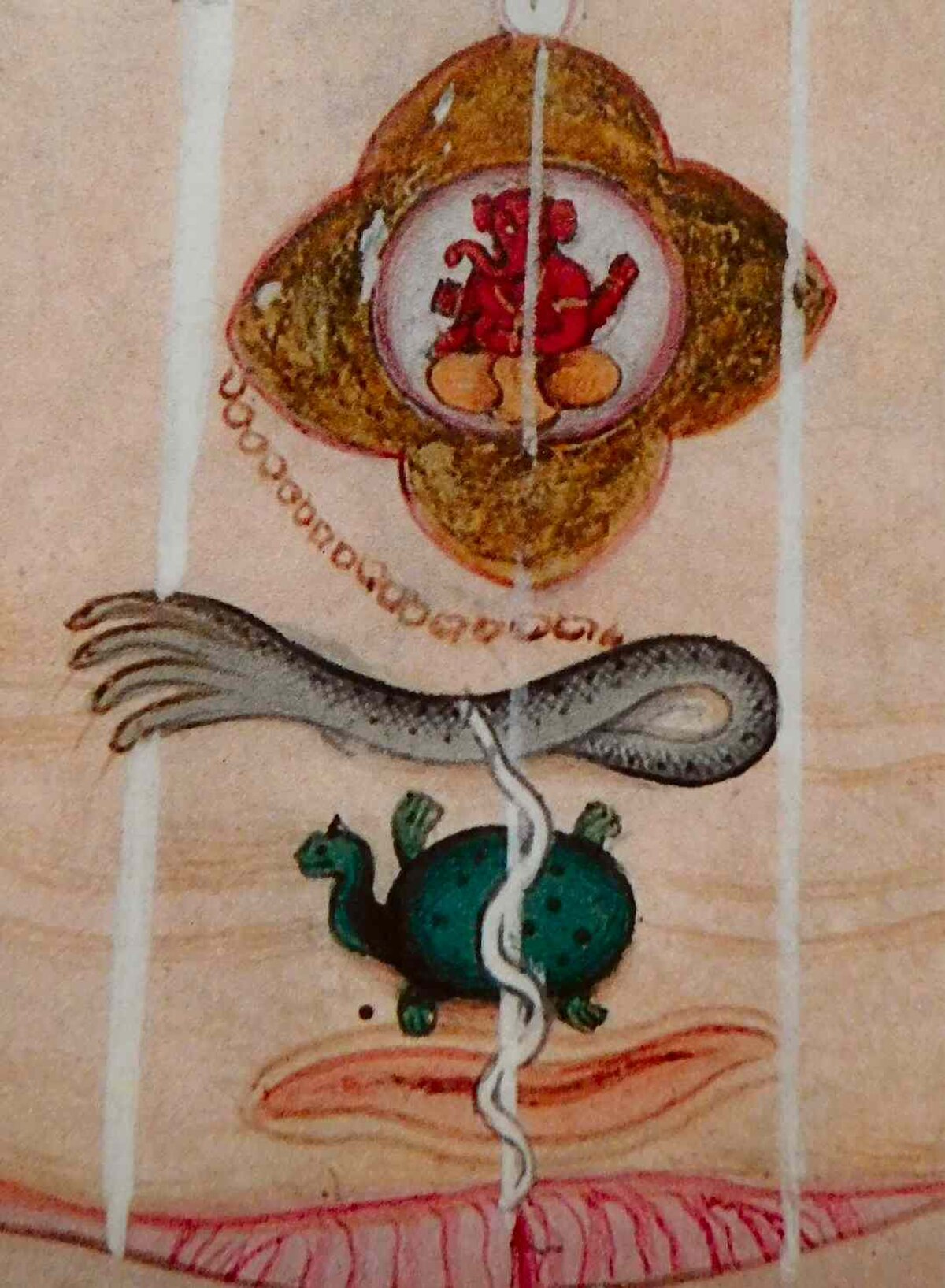
Kundalini
Definition
Kundalini (Sanskrit: कुण्डलिनी, "coiled") is the concept in Tantric yoga and Hindu spiritual physiology of a latent spiritual energy that resides, coiled like a serpent, at the base of the spine in the muladhara chakra (the root energy center). Through specific practices — pranayama (breath control), meditation, mantra, physical postures (asana), and ritual — this energy can be awakened and caused to rise through the spinal channel (sushumna nadi) through successive energy centers (chakras: muladhara at the base, svadhisthana at the sacrum, manipura at the navel, anahata at the heart, vishuddha at the throat, ajna between the eyebrows, sahasrara at the crown of the head). Each chakra corresponds to a specific level of consciousness; as the kundalini rises through each, the practitioner's awareness is transformed — expanded, purified, or elevated in a specific and graduated way. When the kundalini reaches the crown (sahasrara), union with the divine (samadhi, moksha) is achieved.
The concept belongs to the Tantric traditions of Hinduism, particularly the Shakta Tantra (which understands the kundalini as a manifestation of Shakti, the universal divine feminine energy) and Kashmir Shaivism (which understands it as the self-expressing power of pure consciousness). It should be distinguished from the broader and vaguer contemporary use of "kundalini" as a synonym for spiritual energy or psychological intensity. In its traditional context, kundalini is a specific physiological-spiritual concept grounded in a detailed anatomy of the subtle body (sukshma sharira) — a system of nadis (channels), chakras (centers), and vayus (winds) that is not identical with the physical body but is understood to interpenetrate it.
The significance of the kundalini concept is its insistence on embodiment. In the Hindu Tantric tradition, the body is not an obstacle to spiritual realization but its vehicle: the physical body is understood as a microcosm of the cosmos, and the kundalini's journey through the subtle body mirrors the soul's journey through cosmic levels of being. This is the opposite of the Cartesian-Platonic tendency to treat the body as the soul's prison and to seek liberation through escape from matter. In Tantra, liberation (moksha) is achieved through the transformation of the body's energies, not through their suppression.
Whether the kundalini concept is taken literally (as a description of an actual energy that moves through a subtle physiological system) or metaphorically (as a description of consciousness transformation through stages of deepening meditative absorption), the concept describes a process that is graduated, embodied, and structured by a specific developmental sequence. This is initiation as a physiological event — not a psychological or cognitive transformation. It is a transformation of the entire person including their somatic dimension.
Tradition by Tradition
Tantric Hinduism (Shakta)
The classical text of the kundalini tradition is the Sat-Cakra-Nirupana ("Description of the Six Chakras," 16th century), translated with extensive commentary by Sir John Woodroffe (Arthur Avalon) in The Serpent Power (1919). This text, composed by Purnananda, describes the six chakras (plus the crown) in elaborate detail — their forms, presiding deities, associated seed mantras (bija mantras), petals, colors, and the specific states of consciousness associated with kundalini's passage through each. The awakened kundalini is Shakti, the divine feminine creative power, rising to unite with Shiva (the transcendent divine masculine principle) at the crown. Their union is samadhi: the experience of the non-dual reality that underlies all phenomenal multiplicity.
Kashmir Shaivism (Abhinavagupta)
In Kashmir Shaivism, the kundalini is understood as the spanda: the divine creative vibration or pulsation — in its individual, embodied form. Abhinavagupta's Tantraloka and Paramarthasara describe the kundalini's awakening as the recognition of the individual soul's identity with Paramashiva (the supreme divine consciousness). The practice is not the effort to force the kundalini upward (which can be dangerous if done without proper preparation) but the cultivation of the recognition (pratyabhijna) that the kundalini is already divine and already active — the practitioner's task is to remove the ignorance that obscures this recognition.
Tibetan Buddhist Parallels (Tummo)
Tibetan Buddhist vajrayana tantra contains a direct parallel in the practice of tummo (inner heat): the generation and rising of psychophysical heat through visualization and breath control, which moves through the central channel (avadhuti) and purifies the subtle body's energy system (prana, nadi, bindu). The tummo practice does not use the language of kundalini or chakras in the Hindu sense, but the parallel is precise: a graduated, embodied transformation of consciousness through the deliberate manipulation of subtle physiological energies. The Six Yogas of Naropa, of which tummo is the first, represent Tibetan Buddhist esotericism's most intensive technology of embodied transformation.
Depth Psychology (Jung, Grof)
Jung's Psychology of Kundalini Yoga (edited by Sonu Shamdasani, 1999 — a transcript of Jung's 1932 seminar) represents his most systematic engagement with the kundalini concept. Jung read the chakras as a map of stages in the development of consciousness, with the lower chakras corresponding to more instinctual, unreflective levels of experience and the higher chakras to progressively more refined and integrated states. Stan Grof's transpersonal psychology, emerging from his decades of research with psychedelic and holotropic therapy, observed that the energies and experiences described by the kundalini tradition appeared spontaneously in non-ordinary states of consciousness — particularly Grof's "COEX systems" (systems of condensed experience organized by specific body regions) showed structural parallels with the chakra system.
Project Role
Kundalini gives the project its clearest vocabulary for the embodied dimension of initiatory transformation. The mystery traditions were not engaged in purely intellectual enlightenment — they worked with the whole person: the body's energies, sensations, and capacities were constitutive elements of the transformation, not obstacles to be transcended. Eliade's shamanic initiation involved bodily dismemberment and reconstruction; the Eleusinian Mysteries involved fasting, exhaustion, ritual bathing, and physical darkness before the light of the final revelation; Sufi practice involves specific postures, breathwork, and movement in the sema. The kundalini concept gives the project theoretical vocabulary for why this embodied dimension is not incidental but essential.
Distinctions
Kundalini vs. Life force (prana): Prana is the general vital energy that animates the body; kundalini is a specific, latent, concentrated form of this energy at the base of the spine. All living bodies have prana; kundalini awakening is a specific event distinct from normal vitality.
Kundalini awakening vs. Kundalini syndrome: The contemporary term "kundalini syndrome" (or "spiritual emergency," in Grof's vocabulary) refers to spontaneous, uncontrolled kundalini-like experiences that can be psychologically destabilizing. The tradition consistently emphasizes that kundalini practice requires careful preparation, a qualified teacher, and a graduated approach because premature awakening can cause serious harm. The project should note this: genuine initiation includes appropriate preparation and containment.
Tantric kundalini vs. New Age chakra work: Contemporary popular "chakra work" — energy healing, aura reading, chakra balancing workshops — typically bears a loose relationship to the rigorous Tantric tradition. The project should use the traditional concept while noting the significant gap between traditional practice and its popular derivatives.
Primary Sources
- Purnananda, Sat-Cakra-Nirupana (16th century) / Sir John Woodroffe (Arthur Avalon), The Serpent Power (1919): The classical Hindu text on the chakra system and kundalini, with Woodroffe's extensive scholarly commentary — the foundational Western source.
- Swami Muktananda, Kundalini: The Secret of Life (1979): The most prominent 20th-century Siddha Yoga teacher's account of kundalini awakening from lived experience, less academic but more experientially rich.
- C.G. Jung, Psychology of Kundalini Yoga (lectures 1932, published 1999): Jung's systematic attempt to read the kundalini as a map of psychological development stages.
- Gopi Krishna, Kundalini: The Evolutionary Energy in Man (1967): A first-person account of a spontaneous kundalini awakening with disorienting effects — important for the project's attention to the risks of premature awakening.
- Georg Feuerstein, The Yoga Tradition: Its History, Literature, Philosophy and Practice (1998): The thorough scholarly survey of the yoga tradition, with precise treatment of the kundalini concept in its Tantric context.
Agent Research Notes
[AGENT: perplexity | DATE: 2026-03-22] The kundalini concept raises the hardest empirical questions in the project's toolkit: is there literally a subtle body, literally energy centers, literally a serpent energy? Or is this an elaborate metaphorical description of psychological and neurological processes? The project's most defensible position: the phenomenology of kundalini awakening (the sensations, the experiences, the sequence of transformations) is real and cross-culturally attested. Whether the subtle body is a literal physiological system distinct from the physical body, or a language for describing the experiential dimension of neurological events, is a question the project can hold open while taking the phenomenology seriously.