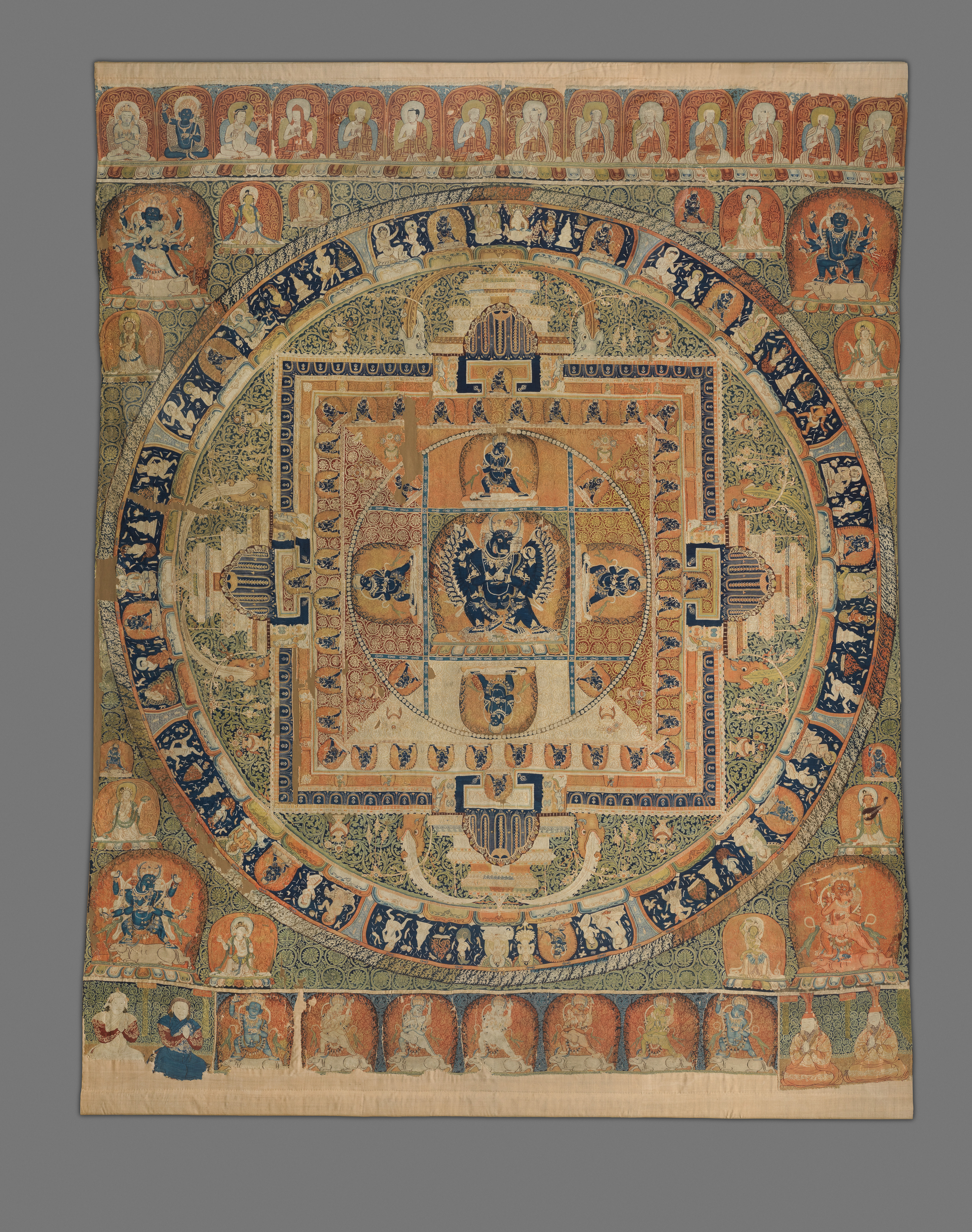
Mundus Imaginalis
Definition
Mundus Imaginalis is Henry Corbin's Latin rendering of the Arabic 'alam al-mithal, the World of Images, or the Imaginal World. The concept names a specific ontological plane that Corbin encountered in his decades-long study of Islamic mysticism, principally in the Persian philosopher and visionary Shihab al-Din Suhrawardi (1154–1191) and later in the Andalusian Sufi master Ibn 'Arabi (1165–1240). Corbin introduced the term in his 1964 essay "Mundus Imaginalis, or the Imaginary and the Imaginal" precisely to distinguish what these thinkers described from what the modern West means by "imagination."
The distinction is decisive and must be held clearly. Modern usage has degraded "imagination" to mean fantasy, subjective projection, the mind's capacity to make things up. The imaginal world of Corbin's Islamic theosophers is none of these things. It is a real ontological domain, as real as the sensory world and in some respects more real, accessible to a specific cognitive faculty that has its own epistemological status. Corbin chose the neologism "imaginal" (imaginale) rather than "imaginary" to mark this boundary: imaginary means invented, unreal, subjective projection; imaginal means belonging to the Mundus Imaginalis, a genuine ontological register.
The Mundus Imaginalis is intermediate; this is its defining feature. It lies between the sensory world ('alam al-mulk, the world of the kingdom, the physical) and the purely intelligible world ('alam al-jabarut, the world of divine power, accessible only to pure intellect). It is neither physical nor abstract. It is the world in which spiritual realities take on form without taking on matter: where angels appear, where prophetic visions occur, where the forms of earthly things subsist after death, and where the imagination of the mystic, when properly trained, becomes a genuine organ of perception.
The Arabic term mithal (plural muthul) means "likeness," "image," "exemplar." The images of the Mundus Imaginalis are not copies of physical things; they are the ontological originals of which physical things are, in a sense, the copies. Suhrawardi speaks of suwar mu'allaqa, "forms in suspension": images that subsist in the intermediate world, visible to the developed imagination, that are not located in matter but are genuinely real. Corbin renders this as "Images in suspense." The precise phrase captures the ontological oddity: these images are not supported by a material substrate, yet they are not mere mental constructs. They hang in an intermediate reality that has its own geography, its own cities (Suhrawardi's mystical narratives name them: Hurqalya, Jabalqa, Jabarsa), its own temporality.
Henry Corbin and the Rediscovery
Henry Corbin (1903–1978), the French Islamicist and philosopher, came to Suhrawardi through his early engagement with Heidegger; he translated Being and Time into French in 1938, and the Heideggerian question of Being and the modes of being's disclosure remained central to his thinking. But Heidegger could not, for Corbin, account for the visionary dimension of human experience. It was the Persian mystical tradition that provided what Western phenomenology lacked: a rigorous philosophical account of an intermediate ontological domain in which vision is not illusion but knowledge.
Corbin's discovery was not merely a retrieval of historical curiosities. He argued that the suppression of the Mundus Imaginalis from Western thought, the reduction of imagination to fantasy, the ontological flattening of the cosmos to two levels (matter and pure intellect, with nothing between), was a catastrophe of the same kind that Barfield names the Hardening (CON-0011). The intermediate world was not a cultural artifact of Islamic philosophy; it was a real domain that was lost to Western consciousness at a particular historical moment, and whose loss accounts for the poverty of modern spirituality and art.
The Islamic mystical tradition preserved what the West had abandoned. Ibn 'Arabi's elaborate metaphysics of divine self-disclosure (tajalli), in which the Real makes itself known through successive levels of image and symbol, is grounded in the reality of the Mundus Imaginalis as the domain in which this disclosure primarily occurs. The Ishraq school of Suhrawardi, his "Philosophy of Illumination" (Hikmat al-Ishraq), constructs a complete cosmology in which the intermediate world of lights and forms is as rigorous a subject of philosophical inquiry as logic or physics. These are not mystical rhapsodies. They are philosophical systems.
Tradition by Tradition
Islamic Mysticism and Ishraqiyyah
Suhrawardi's cosmology is the primary source. Departing from the Aristotelian-Avicennian intellectual tradition that dominated medieval Islamic philosophy, Suhrawardi draws on pre-Islamic Persian Zoroastrian cosmology and on Neoplatonic themes to construct a universe structured by light: the Light of Lights (Nur al-Anwar) at the apex, descending through hierarchies of angelic lights (anwar qahira, the "victorious lights") through the imaginal world of luminous forms to the material world of shadow. The imaginal world is the world of the Angel Gabriel, the angel of revelation, who acts as the vehicle through which celestial light takes form accessible to human perception. Mystical experience, for Suhrawardi, is experience of this world: the visionary journeys he narrates in his Persian recitals are travel reports from a real geography.
Ibn 'Arabi extends and elaborates. For him, the Mundus Imaginalis is the "Barzakh," the isthmus, the interval, the barrier between the world of absolute Being and the world of pure non-being. Nothing real can be experienced without the mediation of the imaginal; even our physical world is a form of the imaginal, being itself an image of divine realities. The mystic who has developed the faculty of the active imagination (khayyal) can perceive this mediation directly: can see the divine Names and Attributes clothed in imaginal form, can encounter the spiritual realities that underlie material appearances.
Eleusinian and Greek Parallels
Corbin drew explicit connections between the Mundus Imaginalis and Greek philosophical concepts, particularly the Platonic metaxu, the in-between, and the Neoplatonic nous poietikos (active intellect). The most significant parallel is with the Eleusinian epopteia (CON-0003): what the initiate beholds in the Telesterion, the supreme vision at the climax of the Mysteries, is best understood not as physical spectacle (mere stage tricks) nor as purely intellectual illumination (a philosophical insight), but as imaginal perception: an encounter with forms that are real in the way that the Mundus Imaginalis is real.
This reading transforms the scholarly debate about the Mysteries. The question is not simply "what did they see?" as if there were a specific image or event to be uncovered, but "by what faculty did they see it?" Corbin's answer: by the active imagination, the cognitive faculty that perceives the imaginal world. The kykeon, the fasting, the procession, the ritual drama: all may serve to activate this faculty by suspending the ordinary perceptual mode that keeps the hardened world in place.
Neoplatonism
The Neoplatonic tradition, particularly Iamblichus and Proclus, operates with a tripartite cosmology, the One, Intellect (nous), Soul (psyche), that creates structural space for an intermediate realm. Proclus's theory of "divine images" (agalmata) and the Chaldean Oracles' world of intermediary beings are philosophical neighbors of the Mundus Imaginalis. Iamblichus's theurgic synthemata (CON-0008), the material tokens through which divine reality becomes accessible, function in the imaginal register: they are neither purely material (they do not work as physical causes) nor purely intellectual (they are not concepts) but are imaginal bridges between the sensory and the divine.
Project Role
The Mundus Imaginalis provides philosophical precision for what the project claims the initiatory experience is. The initiate does not simply believe something new, nor does the initiate have a sensory experience. The initiate encounters a reality in the imaginal register: something genuinely given, not subjectively constructed, that requires a specific mode of consciousness to perceive. Without the Mundus Imaginalis, accounts of initiatory vision collapse into either credulity (they really did see gods) or reductionism (they had drug-induced hallucinations). Corbin's concept holds open a third possibility: they exercised a real cognitive faculty and perceived a real domain.
It also connects the Islamic mystical tradition to the Greek and Neoplatonic traditions without collapsing their differences. The project is not perennialist; it does not claim that Suhrawardi and the Eleusinian Hierophant were describing "the same thing." But the parallel, a real intermediate ontological domain, a specialized cognitive faculty required to perceive it, a path of development needed to cultivate that faculty, illuminates both traditions more clearly than either alone.
And it opens one of the project's most productive tensions with the AI question. The active imagination, for Corbin and his Islamic sources, is a genuine cognitive faculty: something the human being exercises, something that develops, something that can be cultivated or atrophied. Artificial intelligence processes symbols. The question of whether symbol processing can constitute imaginal perception, or whether the imaginal domain is constitutively inaccessible to any system that does not have the relevant kind of interiority, is the question the project carries.
Distinctions
Imaginal vs. Imaginary: Corbin's foundational distinction. "Imaginary" in modern usage means unreal, subjectively projected, invented. "Imaginal" means belonging to the Mundus Imaginalis: real, given, perceived by a specific cognitive faculty, ontologically intermediate between the sensory and the intellectual. The distinction is not semantic fussiness; it is an ontological claim.
Mundus Imaginalis vs. the Jungian Collective Unconscious: Jung's collective unconscious and his concept of "active imagination" share terrain with Corbin's concept, and Corbin was in dialogue with Jung. But for Jung, the archetypes are psychic structures, ultimately within the psyche, even if transpersonal. For Corbin's Islamic theosophers, the Mundus Imaginalis is genuinely ontologically independent of any individual or collective psyche. The images are not projections of the unconscious but perceptions of a real domain. The difference matters metaphysically, even if the experiential territory overlaps.
Mundus Imaginalis vs. the Platonic Forms: The Platonic Forms are purely intelligible, accessible only to pure intellect, beyond all image and form. The Mundus Imaginalis is explicitly intermediate: its denizens take form, they are imaginal, they can be perceived by a faculty that is cognitive but not purely intellectual. Corbin was explicit that the imaginal world is ontologically distinct from the Platonic noetic realm.
Primary Sources
- Henry Corbin, "Mundus Imaginalis, or the Imaginary and the Imaginal" (1964 essay, collected in Swedenborg and Esoteric Islam): The foundational text; Corbin's own account of the concept and its significance.
- Suhrawardi, The Philosophy of Illumination (Hikmat al-Ishraq): The primary Islamic philosophical source; the cosmological framework within which the intermediate world is a rigorous philosophical category.
- Henry Corbin, Alone with the Alone: Creative Imagination in the Sufism of Ibn 'Arabi: Corbin's major work on Ibn 'Arabi; essential for understanding the imaginal in its most developed Islamic form.
- Plato, Complete Works (LIB-0253): The Phaedrus, Symposium, and Republic for the Platonic background: the metaxu, the intermediate nature of eros, and the allegory of the cave as an account of the levels of perception.
- A History of Religious Ideas, Vol. 3 (LIB-0292): Eliade's account of Islamic religious ideas, providing the broader context for Sufism within which Suhrawardi and Ibn 'Arabi belong.
Plato's Intermediate Realm and Barfield's Representations
Plato's cosmology provides the earliest Greek architecture for what Corbin will call the mundus imaginalis. In the Timaeus (49a-52d), Plato describes the chora — the "receptacle" or "nurse of becoming" — as a third kind of reality, neither the eternal Forms nor the sensible copies, but the medium in which the copies appear. The chora receives all forms without being any of them; it is the space of manifestation itself. In the Phaedrus (247c-249b), the souls' pre-natal vision of the Forms occurs in a "place beyond the heavens" (hyperouranios topos) that is neither the physical world nor the purely intelligible — it is the visionary space where the soul's cognitive organs directly perceive reality. Both anticipate the mundus imaginalis as a domain ontologically intermediate between the sensible and the intelligible.
Barfield's Saving the Appearances (LIB-0240) provides a different angle: the collective representations through which consciousness constitutes its experienced world occupy an analogous intermediate position. They are neither purely subjective (they are the shared medium of a culture's experience) nor independently existing objects. The participatory consciousness that Barfield describes apprehends reality through these representations in a way that dissolves the subject-object boundary — precisely the cognitive act that the mundus imaginalis requires.
Plotinus and the Mirror of Imagination (LIB-0254)
The Neoplatonism subsection above credits Iamblichus and Proclus with the cosmological space for an intermediate world. Plotinus, their predecessor, is more cautious about the imagination, and the caution is itself instructive. He does not grant phantasia an ontological world of its own; he is wary of the image as a step down from pure thought. But in working out how the soul becomes aware of its own higher activity, he gives the imaginative faculty a precise and consequential role.
In the Enneads (notably I.4.10 and IV.3.30) Plotinus describes phantasia as a mirror. The intellect's activity is constant, but the soul becomes conscious of it only when that activity is reflected in the imaginative faculty, as a face becomes visible to its owner only when a mirror is present and undisturbed. When the mirror is broken or agitated, the higher activity continues but goes unregistered. Imagination, on this account, is not a source of illusion but the threshold at which noetic activity crosses into awareness.
This is the Neoplatonic seed of what Corbin would later develop into a full Mundus Imaginalis. Plotinus does not reach the imaginal world, but he identifies a faculty between sense and pure intellect and assigns it a real cognitive function: the mirror in which what is above the discursive mind becomes available to it. The later tradition expanded the mirror into a world (LIB-0254).
Agent Research Notes
[AGENT: perplexity | DATE: 2026-03-20] Corbin's influence on contemporary spiritual and philosophical culture is substantial but often unacknowledged: Tom Cheetham's work (Green Man, Earth Angel; All the World an Icon) extends Corbin's thought and is useful context. David Abram's phenomenological work on perception and the more-than-human world is a secular neighbor of Corbin's imaginal. The project should be alert to the difference between Corbin's Mundus Imaginalis as a philosophical concept with a specific Islamic intellectual history and its broader use as a cultural shorthand for "visionary experience"; the latter use flattens the philosophical precision that makes the concept valuable. One productive angle for the project: the training of the active imagination as a form of initiatory work in the Islamic tradition. The spiritual exercises Suhrawardi prescribes for contact with the imaginal world constitute an initiatic path structurally analogous to but experientially distinct from Eleusinian initiation.
[AGENT: claude-code | DATE: 2026-04-03] Deepened with material from LIB-0254 (Plotinus, The Enneads). Added "Plotinus and the Mirror of Imagination," on Plotinus's treatment of phantasia as the mirror in which noetic activity becomes conscious, the Neoplatonic seed of Corbin's imaginal faculty. Existing content was not rewritten.