Sacred Geometry
Definition
Sacred geometry is the doctrine that specific mathematical ratios, forms, and proportional relationships are not merely aesthetically pleasing or functionally efficient but ontologically significant — reflections of the mathematical structure of cosmic order itself. The sacred geometer holds that the universe is not merely describable in mathematical language (as modern physics affirms) but that it is constituted by mathematical principles, and that structures built according to these principles, temples, cathedrals, mosques, mandalas, thereby participate in cosmic order and function as concentrations of sacred presence.
The Pythagorean tradition is the foundational source in the Western lineage. Pythagoras (c. 570–495 BCE) and his school held that "all things are number" — that the mathematical ratios discovered in musical harmony (the octave is 2:1, the fifth 3:2, the fourth 4:3) were not arbitrary conventions but discoveries of the fundamental structure of reality. The same ratios that made musical harmony beautiful were the ratios according to which the cosmos itself was organized: the harmony of the spheres was not a metaphor but the actual inaudible music produced by the planets' proportional movements. The mathematical order of music and the mathematical order of the cosmos were the same order — and the human being who could attune themselves to this order through mathematical study and contemplative practice was aligning themselves with the deepest structure of reality.
Plato's Timaeus translates this Pythagorean insight into cosmological form: the Demiurge constructs the world according to mathematical ratios, and the Platonic solids (tetrahedron, cube, octahedron, dodecahedron, icosahedron) are the geometric forms of the four elements and the cosmos itself. This is not decorative science but ontological claim: the five regular solids are not curiosities of geometry but the building blocks of physical reality. The geometer who contemplates these forms is contemplating the mathematical structure through which the Demiurge organized matter.
Tradition by Tradition
Pythagorean and Platonic
The Pythagorean tradition developed the most systematic account of sacred geometry's philosophical foundations. The discovery of musical harmony's mathematical basis — attributed to Pythagoras's observation of blacksmiths' hammers producing different pitches in proportion to their weights — was understood as a revelation of the cosmos's mathematical constitution. The quadrivium (the four mathematical disciplines of the classical curriculum: arithmetic, geometry, music, astronomy) was the Pythagorean curriculum for accessing this mathematical order: arithmetic (pure number), geometry (number in space), music (number in time), astronomy (number in space and time). This curriculum persisted through the medieval university as the preparation for theological study.
Gothic Architecture
The Gothic cathedral is the most complete Western instantiation of sacred geometry in built form. The Gothic master masons worked with a vocabulary of proportional ratios derived from Platonic and Pythagorean sources — the golden ratio (phi, approximately 1.618), the square root of 2 (the diagonal of a unit square), the vesica piscis (the intersection of two equal circles, which generates the proportion 1:√3) — to create spatial structures that were understood as material cosmograms. Chartres Cathedral, in the analysis of scholars like John James and Keith Critchlow, embeds multiple overlapping systems of proportional ratios in its plan, elevation, and details, creating a built environment that functioned as a three-dimensional sacred geometry that physically immersed the worshipper in mathematical cosmic order.
Islamic Geometric Art
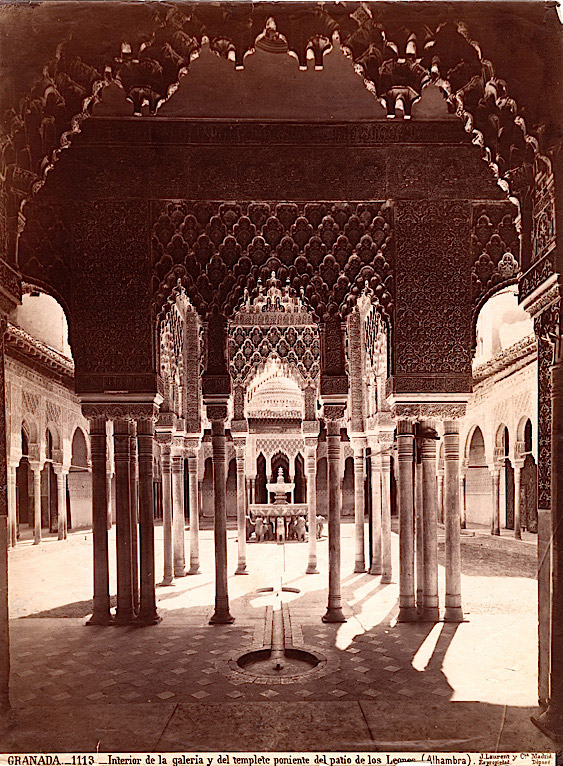
Islamic geometric art — the elaborate tile work of Alhambra, the muqarnas vaulting of Persian mosques, the geometric carpet patterns of Central Asian traditions — represents a different expression of the same principle. The Islamic prohibition on figural representation in sacred contexts directed artistic energy toward geometric abstraction, producing some of the world's most mathematically sophisticated visual art. The infinite geometric patterns that characterize Islamic surface decoration are understood theologically as expressions of divine infinity — the way a finite surface can gesture toward the infinite through the inexhaustible possibilities of geometric combination. The geometer who designed these patterns was engaged in a theological act: embodying the attribute of divine infinity in finite material form.
Hindu (Vastu Shastra)
The Indian tradition of Vastu Shastra (the science of sacred building) is the Hindu equivalent of the Western sacred geometry tradition: a complete system for orienting built structures according to cosmic mathematical principles, cardinal directions, and the spatial relationships between different functional zones. The mandala: the circular or square cosmogram that appears both as a meditation support and as the plan of the Hindu temple — is sacred geometry's most concentrated expression: a two-dimensional map of cosmic order that the three-dimensional temple instantiates in built form.
Project Role
Sacred geometry connects the mystery traditions' mathematical and architectural practices to the chain of being's ontological claim: the cosmos is hierarchically ordered, and built structures that instantiate this hierarchy in their proportions and orientations participate in cosmic order. The temple or cathedral is not merely a meeting place for worship but an initiatic environment — its geometry prepares and orients the worshipper's consciousness by immersing it in the mathematical structure of cosmic reality.
For the project's contemporary argument: the replacement of sacred geometry with purely functional or aesthetically arbitrary architecture is one of the most concrete material expressions of the Hardening. The built environment of the modern West no longer participates in cosmic order — it is calculated for maximum utility or maximum visual novelty, not for maximum alignment with the mathematical structure of the divine cosmos. The project explores what this loss of sacred spatial intelligence means for the possibility of genuine sacred experience in contemporary settings.
Distinctions
Sacred geometry vs. Mathematics: Modern mathematics studies mathematical structures independently of any ontological claim about their cosmic significance. Sacred geometry holds that specific mathematical relationships are reflect and participate in cosmic order. The difference is the ontological claim.
Sacred geometry vs. Numerology: Numerology attributes significance to numbers through largely arbitrary association. Sacred geometry derives significance from mathematical structures that are genuinely universal — the golden ratio, the Platonic solids, the harmonic ratios — and argues for their significance on the basis of their recurrence across natural and cosmic phenomena.
Participation vs. Mere symbolism: A building designed with sacred geometry does not merely symbolize cosmic order — it participates in it. This is the difference between a picture of a mountain and an actual ascent: the sacred building is understood to effect a genuine alignment of the space it creates with the cosmic order, not merely to represent it decoratively.
Primary Sources
- Plato, Timaeus (c. 360 BCE): The foundational Platonic account of the Platonic solids as the geometric forms of the elements and the cosmos, essential context for the Western sacred geometry tradition.
- Vitruvius, De Architectura (c. 30–15 BCE): The Roman architectural treatise that transmitted Pythagorean proportional principles into the Western architectural tradition, providing the source for Renaissance sacred geometry in architecture.
- Robert Lawlor, Sacred Geometry: Philosophy and Practice (1982): The most accessible and visually rich introduction to the practical and philosophical dimensions of sacred geometry, widely influential in contemporary esoteric culture.
- Keith Critchlow, Islamic Patterns: An Analytical and Cosmological Approach (1976): The definitive analysis of Islamic geometric art as a cosmological practice.
- John Michell, The Dimensions of Paradise: The Proportions and Symbolic Numbers of Ancient Cosmology (1988): A Platonic-Pythagorean analysis of sacred number and geometry in ancient architectural traditions.
Agent Research Notes
[AGENT: perplexity | DATE: 2026-03-22] The sacred geometry tradition in popular culture has been substantially contaminated by arbitrary numerological associations and poorly verified historical claims (ley lines as sacred geometry networks, specific sacred geometry claims about the Great Pyramid). The project should engage the genuine philosophical and historical tradition of sacred geometry — Pythagorean, Platonic, Gothic, Islamic — while maintaining critical distance from its popular elaborations. The genuine tradition has substantial scholarly support; the popular elaborations often do not.