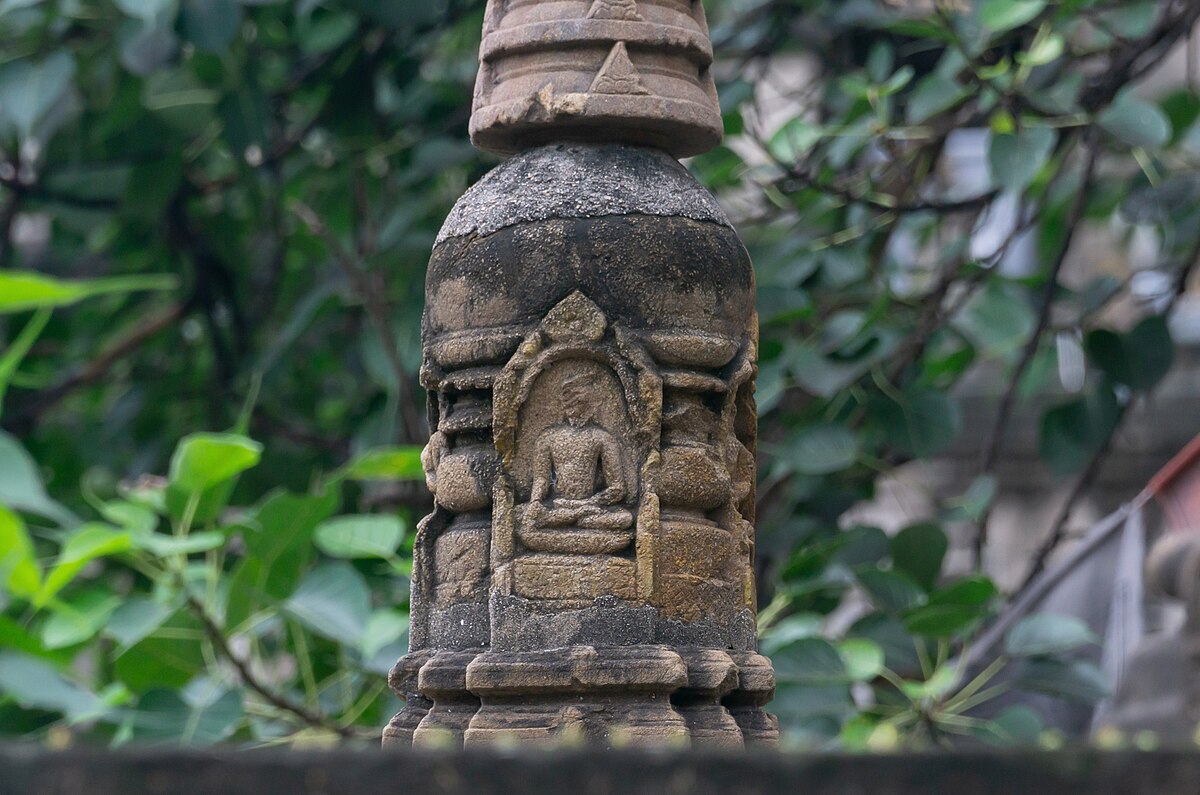
Nirvana
Definition
Nirvana (Sanskrit) or nibbana (Pali), literally "blowing out" or "extinguishing," designates the cessation of tanha (craving), dosa (aversion), and moha (delusion) — the three fires that, in the Buddha's Fire Sermon (Adittapariyaya Sutta), are said to be consuming all conditioned experience. The image is of a fire going out — but crucially, the early Pali texts leave the state of the extinguished fire deliberately undefined. When asked where the Tathagata (the awakened one) goes after death, the Buddha responds that the question does not apply: it assumes a self that goes somewhere, which is what the analysis of experience denies. Nirvana is the unconditioned (asankhata), not a place, not a state in the ordinary sense, not a heavenly domain, and emphatically not annihilation. The Buddha rejected annihilationism (uccheda-vada) as firmly as he rejected eternalism (sassata-vada).
The Pali Canon distinguishes two forms of nirvana: sa-upadisesa-nibbana (nirvana with remainder — liberation achieved in a still-living being, with the physical aggregates continuing until death) and anupadi-sesa-nibbana (nirvana without remainder — the complete cessation at the death of an awakened being, parinirvana). The arahant (one who has achieved liberation) experiences the former while alive and the latter at death. In Theravada, this is the complete account: there is nothing more to say about parinirvana without lapsing into speculation the Buddha explicitly refused.
Mahayana Buddhism complicated this picture. The Prajnaparamita literature's identification of nirvana with samsara from the standpoint of sunyata (emptiness) — and Nagarjuna's demonstration in the Mulamadhyamakakarika that nirvana cannot be characterized as existence, non-existence, both, or neither — pushed the concept toward a more radical silence than even the Pali Canon maintained. The Mahayana also introduced the concept of parinirvana as something other than final extinction: the tathagata-garbha (Buddha-nature) teachings suggest a positive luminous ground of consciousness that nirvana accesses rather than merely extinguishes — a development that brought Mahayana and certain Hindu brahman-atman teachings into closer proximity and generated vigorous debate about whether this represented convergence or contamination.
Historical Development
The earliest Buddhist texts present the Buddha as consistently reluctant to describe nirvana in positive terms. The Udana (8.1-4), a Pali text, contains some of the most explicit positive characterizations: "There is, monks, an unborn, unbecome, unmade, unconditioned. If there were not that unborn, unbecome, unmade, unconditioned, there would be no escape from the born, become, made, conditioned." This passage acknowledges a positive reality beyond conditioned existence without characterizing it further — a minimal, structurally significant affirmation that something exists beyond the cycle.
The Abhidharma scholastic traditions (approximately 3rd century BCE through 5th century CE in both Theravada and Sarvastivada schools) systematized the analysis of nirvana within their taxonomies of dharmas (irreducible elements of existence). In the Theravada Abhidhamma, nirvana is classified as a dharma: a real element, but unconditioned, unlike all other dharmas which are conditioned. It can be made the object of consciousness (specifically, nibbana is the object of nirodha-samapatti, the attainment of cessation), but it cannot be analyzed into further components and has no arising or passing away. This scholastic treatment stabilized a certain ontological status for nirvana while leaving its ultimate nature uncharacterizable.
In 8th century CE Tibet, the encounter between Mahayana philosophy (particularly Madhyamaka and Yogacara) and Vajrayana practice generated further elaborations. The concept of rigpa (pure awareness, vidya) in Dzogchen teaching is held by some scholars to represent a positive characterization of what nirvana opens onto — a luminous, aware ground of being that is neither a self nor nothing. This represents a significant development away from the Pali Canon's strategic silence and toward something more resembling the Vedantic brahman: a development that both represents genuine philosophical evolution within Buddhism and creates a risk of eliding the original no-self insight that distinguishes Buddhism from Hindu non-dualism.
The Western reception of nirvana has been shaped by two dominant misreadings. The first, common in 19th and early 20th century Western commentators (including Schopenhauer's influential use of the concept), read nirvana as annihilation — the extinction of the will and of all consciousness, a conclusion that the early Buddhist texts explicitly reject. The second, common in 20th and 21st century Western Buddhism influenced by Romanticism and perennialism, reads nirvana as a blissful mystical state equivalent to the Christian mystic's union with God or the Vedantin's samadhi: a reading that erases the specific Buddhist analysis of no-self that makes nirvana what it is.
Key Distinctions
Nirvana vs. Henosis: Plotinus's henosis is the soul's return to the One — its source, ground, and ultimate identity. The soul that achieves henosis realizes its kinship with the divine nous and through nous with the One itself. There is something, the soul, that achieves this return, and the return is to something, the One, that remains a positive, inexhaustible source. Nirvana makes no such claims. There is no soul that returns, no source-reality to return to. The phenomenological overlap (cessation of ordinary ego-operations, dissolution of subject-object separation) is real. The metaphysical accounts are incompatible.
Nirvana vs. Theosis: Eastern Orthodox theosis is the transformation of the human person through participation in the divine energies — a process that intensifies personhood rather than dissolving it, culminating not in extinction but in maximal communion. The human person does not cease to exist in theosis; it becomes more fully itself through participation in God. Nirvana involves the recognition that there was no substantial self to intensify in the first place. Both traditions describe the goal of the contemplative path as the most real state possible, but they disagree fundamentally on whether that state involves a self.
Nirvana vs. Moksha: The parallel is close — both describe liberation from the cycle of conditioned rebirth. The difference is in the metaphysical framing: moksha in Advaita Vedanta involves the recognition of the jiva's identity with Brahman, a positive absolute. Nirvana involves the cessation of the conditions that generate a jiva in the first place. The Mahayana tathagata-garbha teachings somewhat narrow this gap without fully closing it.
On the silence: The Buddha's refusal to characterize the post-parinirvana state is not evasion. It is a philosophical position: the questions being asked (does the Tathagata exist after death? not exist?) presuppose a subject, and the analysis of experience has shown that no such subject can be found. The silence is the teaching. Any positive characterization of nirvana that fills this silence runs the risk of reinstating exactly the self-concept the path dismantles.
Project Role
Nirvana is the project's test case for comparative precision. It can be placed alongside henosis, theosis, moksha, fana, and epopteia as structural parallels — states in which ordinary consciousness is fundamentally transformed through the cessation or transcendence of its habitual operations. The comparison is illuminating: these traditions are investigating related territory. The differences in how they describe what they find — whether a positive absolute, a personal God, an impersonal ground, or a strategic silence — are not details but the heart of the comparison. The project models how to hold both the parallel and the difference without collapsing either.
Primary Sources
- The Itivuttaka and Udana: Pali texts containing some of the most philosophically careful positive characterizations of nirvana the canon offers, including the key passage about the "unborn, unbecome, unmade, unconditioned."
- The Fire Sermon (Adittapariyaya Sutta, SN 35.28): The Buddha's analysis of conditioned existence as on fire with craving, aversion, and delusion — the negative diagnosis that nirvana resolves.
- Nagarjuna, Mulamadhyamakakarika, Chapter 25: The most rigorous philosophical analysis of the relationship between nirvana and samsara, demonstrating that neither can be characterized in any of the four possible modes (existence, non-existence, both, neither).
- The Lankavatara Sutra: A Mahayana text that explores the tathagata-garbha teaching and its relationship to liberation, navigating the question of whether there is a positive ground of awareness that nirvana accesses.
Agent Research Notes
[AGENT: perplexity | DATE: 2026-03-22] The question of whether the Pali Canon and Mahayana accounts of nirvana are genuinely compatible or represent different teachings has been actively debated among both scholars and practitioners. Paul Williams's Mahayana Buddhism (2nd ed., 2009) provides an authoritative academic treatment. The project should engage this as a live question within the tradition, not as a resolved matter of doctrinal unity. The Theravada critique of Mahayana tathagata-garbha as crypto-Vedantism (e.g., in certain contemporary Theravada scholarly literature) represents a genuine doctrinal position, not merely sectarian bias.