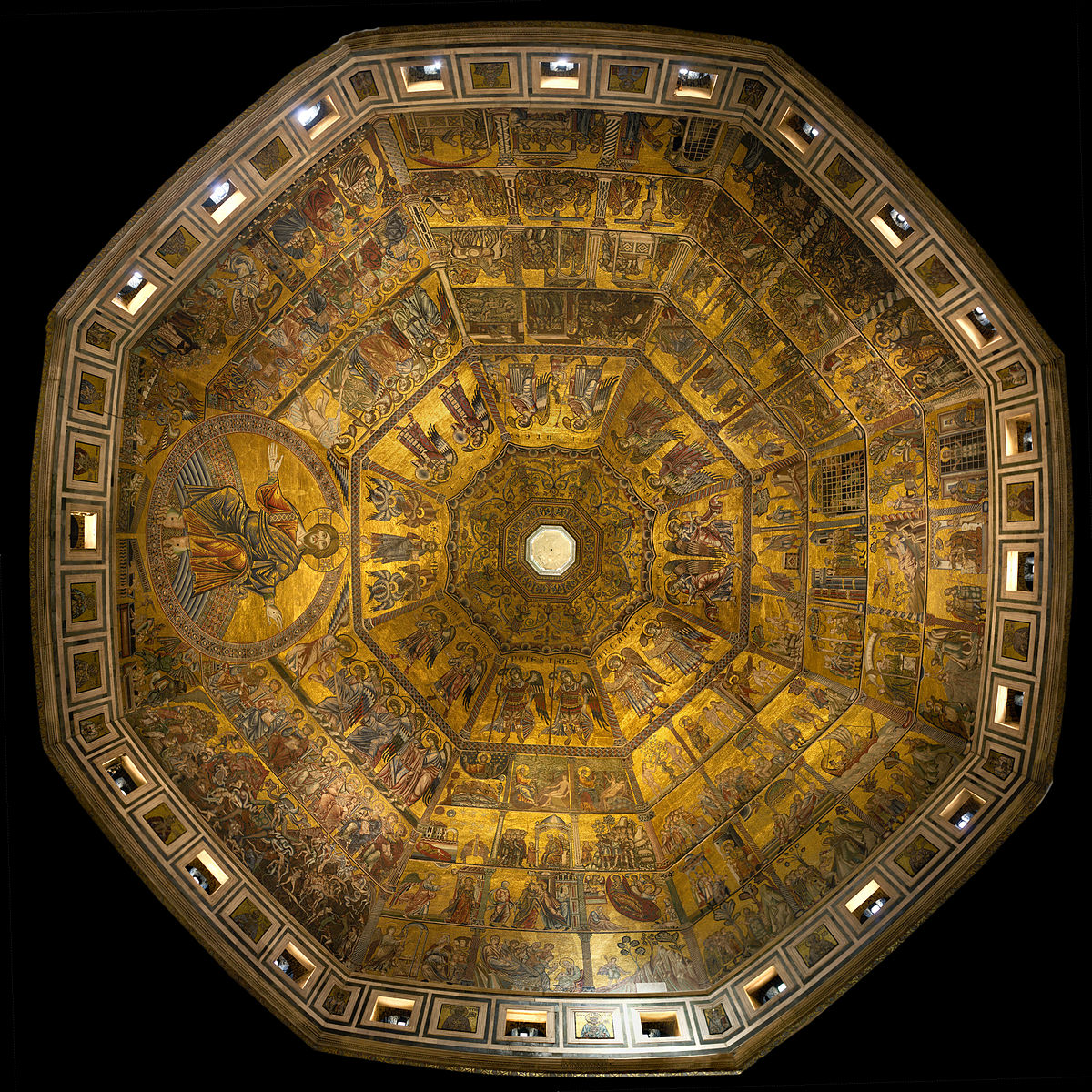
Chain of Being
Definition
The Great Chain of Being is the organizing ontological structure of the pre-modern Western world: a continuous, hierarchical ordering of all existence from the highest — the divine One, God, the infinite source — down through successive grades of diminishing being to the lowest — bare matter, the formless substrate. The chain is not a metaphor but a claim about the nature of reality: everything that exists occupies a specific position in an ordered hierarchy of being, goodness, and beauty, and these three, being, goodness, beauty, are coextensive. The higher a thing is in the chain, the more being it possesses, the better it is, and the more beautiful. Conversely, the descent from the divine source toward matter is a descent in being, goodness, and beauty simultaneously.
Arthur O. Lovejoy's The Great Chain of Being (1936) is the modern study that gave the concept its most precise historical analysis. Lovejoy identified three principles that jointly generate the chain: plenitude (the principle that a perfect Creator would generate all possible forms of being, leaving no possibility unrealized), continuity (the chain has no gaps — every grade is occupied, and adjacent grades shade into each other without abrupt leaps), and gradation (the chain is ordered hierarchically, not all levels are equal). These three principles working together produce a cosmos that is simultaneously maximally full, seamlessly ordered, and vertically differentiated.
The sources of the chain are primarily Platonic. Plato's metaphysics of the Forms — with the Form of the Good at the summit, the lower Forms arranged in a hierarchy of dependence beneath it — is the conceptual prototype. Plotinus (Enneads V) gives the most systematic Neoplatonic account: the One, utterly transcendent and beyond all predication, overflows (hyperokhē) into Intellect (nous), which contemplates the One and generates the Forms. Intellect overflows into Soul (psyche), which generates time and the sensible cosmos. Soul's lower nature, turned away from Intellect, produces matter — the absolute limit of being, the privation that bounds the chain below. This overflow (prohodos) and return (epistrophe) is not a temporal sequence but an eternal metaphysical structure: the chain is not a history but the permanent form of being.
Medieval Christian thought absorbed this structure through multiple channels: the pseudo-Dionysian celestial hierarchy (nine orders of angels between God and the human), the Islamic Aristotelian tradition (Avicenna's emanationist cosmology), and the direct study of Plato and Plotinus in the later Middle Ages. The chain was domesticated within Christian theology — with God as Creator rather than the Neoplatonic One, and with the essential difference that creation is free rather than necessary — but the hierarchical structure of being remained operative across scholastic philosophy. Dante's Commedia is the chain of being expressed in narrative form: Hell descends through graduated circles of ontological privation, Purgatory ascends through graduated purification, and Paradise rises through the celestial spheres to the Empyrean — a journey through the full extent of the chain from its lowest to its highest term.
Tradition by Tradition
Neoplatonic (Plotinus, Proclus)
Plotinus's account of emanation is the philosophical core of the chain of being in its most rigorous form. The key insight is that the chain does not involve a transfer of being from higher to lower — the One does not diminish by producing Intellect; Intellect does not diminish by producing Soul. The chain is a hierarchy of participation: each level participates in the level above it, and the higher level remains self-identical in its giving. Proclus systematized this into the most elaborate triadic emanationism: for every principle, there is a remaining in itself, a proceeding out of itself, and a returning to itself — mone, prohodos, epistrophe. These three movements are eternal and simultaneous, not sequential. The chain is not dynamic in a temporal sense but self-sustaining in an eternal ontological present.
Medieval Islamic (Avicenna)
Avicenna (Ibn Sina, 980–1037) transmitted Neoplatonic emanationism into the Islamic world through his concept of the "ten intellects" — a hierarchy of divine intelligences mediating between the First Cause and the sublunary world. The Active Intellect (the tenth intelligence) is the principle that illuminates the human intellect with the forms of knowledge, playing the role that Plotinus assigned to the soul's connection to Intellect. Avicenna's emanationism generated substantial controversy within Islamic theology (from al-Ghazali's critique onward) because it appeared to make the universe a necessary emanation from God rather than a free creation — a compromise of divine omnipotence.
Medieval Christian (Pseudo-Dionysius, Aquinas, Dante)
Pseudo-Dionysius the Areopagite's Celestial Hierarchy (c. 500 CE) gave the chain its most influential Christian form: nine angelic orders arranged in three triads, each participating in divine illumination and passing it downward. Thomas Aquinas synthesized this hierarchical ontology with Aristotelian physics and Christian theology, retaining the chain's structure while insisting on the contingency of creation against the Neoplatonic claim of necessary emanation. Dante's Commedia dramatizes the chain across its full vertical extent, making it emotionally and imaginatively accessible in a way that no philosophical text achieved.
Hermetic and Renaissance
In the Hermetic tradition, the chain of being grounds the theory of correspondence: because the cosmos is a continuous hierarchy with the same patterns recurring at every level, the celestial and the terrestrial mirror each other through the medium of the World Soul. The Hermetic practitioner who understands the chain can trace the correspondences between planets, metals, plants, animals, and human characters. Renaissance magical theory (Agrippa, Ficino, Bruno) is largely the practical application of chain-of-being metaphysics: magic works because the chain is real, and the trained practitioner can work the connections it provides.
Project Role
The chain of being is the metaphysical structure whose collapse is what the project calls the Hardening. The 17th-century scientific revolution did not simply correct errors in natural philosophy; it dismantled the hierarchical ontology within which the mystery traditions made sense. When Descartes divided reality into res cogitans (thinking substance) and res extensa (extended substance), he eliminated the middle portions of the chain — the world soul, the subtle bodies, the celestial intelligences, the graduated levels of being between pure matter and pure intellect. What remained was a binary: mind and matter, with no intermediary. The mystery traditions operated in the intermediary regions that were eliminated.
Understanding the chain of being is therefore prerequisite to understanding what the project means by the loss of the mystery traditions. It is not that the rituals were suppressed (though they were); it is that the metaphysical world within which those rituals were coherent practices was dismantled. The project's argument is not a call to restore the chain literally but an invitation to understand what the chain preserved about the structure of reality that the binary ontology lost.
Distinctions
Chain of being vs. Evolutionary hierarchy: The chain of being is not an evolutionary schema — it does not describe a sequence of development through time but a permanent ontological structure. The confusion of the Great Chain with 19th-century progressivist evolutionism (which used its vocabulary while inverting its logic from timeless to temporal) distorted both concepts.
Chain of being vs. Feudal hierarchy: The chain of being is sometimes lazily identified with the social hierarchies of medieval feudalism — as if it were simply a divine justification for social inequality. While it was certainly used to naturalize social structures, the metaphysical claim is independent: the chain describes the structure of being itself, not of any particular society.
Plotinian emanation vs. Christian creation: The Neoplatonic chain is produced by necessary emanation — the One cannot not overflow. The Christian chain is produced by free creation — God creates voluntarily. This distinction has consequences: in the Neoplatonic chain, the soul's return to the One is a natural metaphysical movement; in the Christian chain, the soul's return to God requires divine grace. Both versions are operative in the mystery traditions the project examines.
Primary Sources
- Plotinus, Enneads I-V (c. 250–270 CE): The foundational philosophical account of the chain of being as an emanationist hierarchy, with the One, Intellect, and Soul as the three primary levels.
- Pseudo-Dionysius the Areopagite, Celestial Hierarchy (c. 500 CE): The Christian angelological elaboration of the chain, the most influential account of the middle levels between God and humanity.
- Dante Alighieri, Divine Comedy (1308–1320): The greatest literary expression of the chain of being, tracing the full vertical extent from the lowest circle of Hell to the Empyrean.
- Arthur O. Lovejoy, The Great Chain of Being (1936): The indispensable modern scholarly study, tracing the three principles (plenitude, continuity, gradation) through the history of Western philosophy from Plato to the 18th century.
- E.M.W. Tillyard, The Elizabethan World Picture (1943): A complementary study of how the chain of being organized Elizabethan cultural consciousness, useful for understanding how pervasive the concept was as a lived world-picture rather than a technical philosophical doctrine.
Agent Research Notes
[AGENT: perplexity | DATE: 2026-03-22] Lovejoy's study has been criticized for projecting excessive unity onto what are actually diverse and often conflicting uses of the chain concept — a point worth acknowledging. Stephen Jay Gould's essay "The Chain of Being" in Ever Since Darwin offers an important scientific perspective on the chain's post-evolutionary transformation. The project should note that the chain of being was not simply replaced by modern science but transformed: the 19th century's progressivist evolutionism retained the chain's vocabulary (higher/lower organisms) while converting it from a static ontological hierarchy into a temporal developmental sequence — a transformation that, in the project's terms, is itself a symptom of the Hardening.