Sacred Geography
Definition
Sacred geography is the theoretical and practical understanding that physical space is not ontologically uniform. Against the Cartesian premise that all extension is equivalent — that any point in space is identical in nature to any other point and distinguished only by coordinate position — sacred geography holds that certain locations carry irreducible qualitative significance. These places participate differently in the divine order; they are thinner membranes between the human and the sacred, points where heaven and earth meet, axes around which cosmological reality organizes itself.
The theoretical foundation of sacred geography in modern scholarship is Mircea Eliade's concept of the axis mundi (world axis) and the templum (the oriented, bounded sacred space). In The Sacred and the Profane (1957), Eliade argues that for archaic and traditional peoples, the cosmos is must be constituted through the ritual act of orientation. The sacred site, a mountain, a spring, a cave, a temple, is the point where this orientation is established: the center around which the world becomes a world rather than undifferentiated chaos. The axis mundi is the cosmic pillar connecting the underworld, the earth's surface, and the heavens; it is not a myth but an experiential reality that makes the world habitable and navigable.
The templum — from the Latin root related to "to cut" or "to delineate" — was originally the oriented space cut out of the sky by the augur's staff: a bounded region of the heavens from which omens could be read. This image captures the structure of sacred geography precisely: sacred space is not found passively but constituted actively through ritual orientation that aligns a human-made space with a cosmic pattern. The temple, understood in this light, is not a building with religious decorations but a cosmogram — a physical embodiment of cosmic structure that allows those within it to inhabit cosmic order rather than mere physical location.
Eliade's framework has been criticized (by Jonathan Z. Smith and others) for its tendency to construct an idealized "archaic" consciousness and project universal patterns where specific historical variation is more accurate. These critiques are important, but they do not dissolve the underlying phenomenon: the cross-cultural persistence of practices for orienting built space cosmologically, identifying certain natural sites as charged with sacred significance, and organizing pilgrimage around spatial approaches to divine presence.
Tradition by Tradition
Ancient Greek / Eleusinian
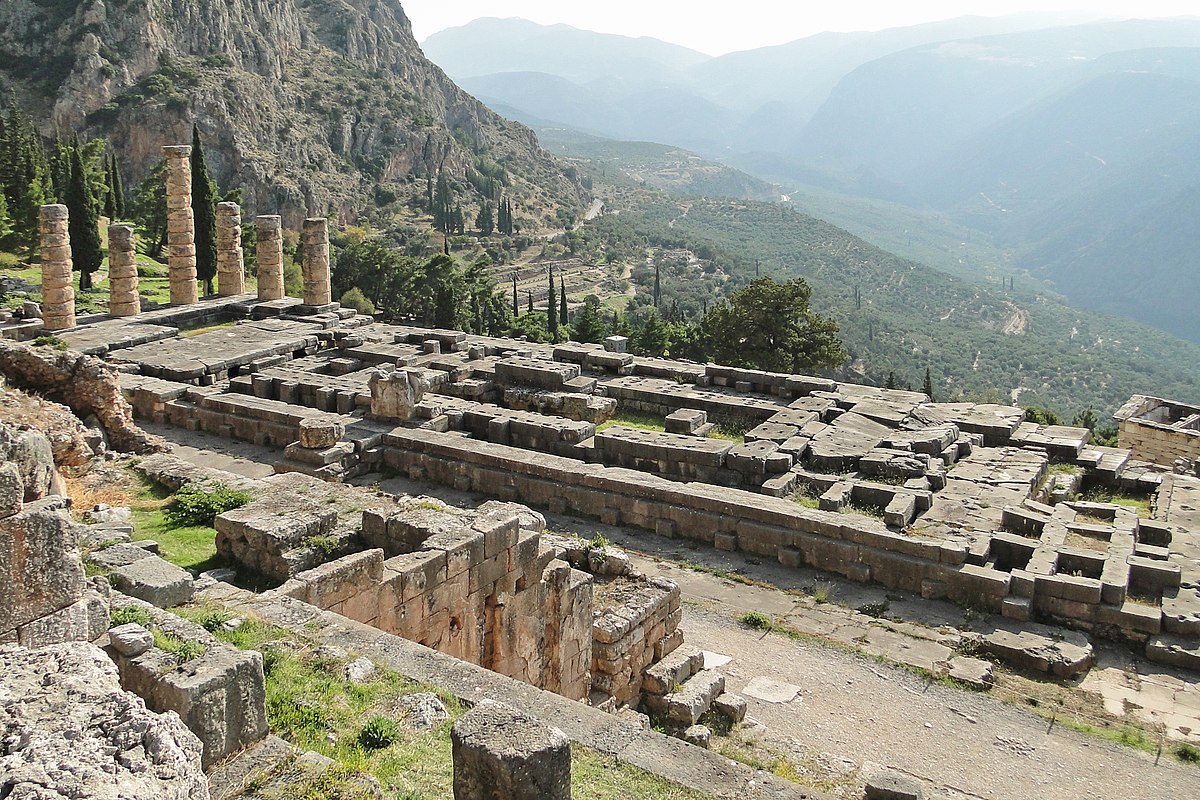
The choice of Eleusis as the site of the Mysteries was not arbitrary. The location — a bay on the route from Athens to the Peloponnese, backed by a cleft in the hills from which Persephone's descent might be enacted — embedded the ritual in a specific geography. The procession from Athens to Eleusis along the Sacred Way (the Hiera Hodos) was itself an initiatic act: the movement through space was a movement toward the center. Delphi, similarly, was understood as the omphalos — the navel of the world, the axis point where divine intelligence (the Pythia's oracular voice) erupted into human affairs. The oracle operated at a specific geographical location, and that location's significance was not separable from the quality of its revelations.
Vedic / Hindu
In the Vedic tradition, the concept of tirtha (sacred ford or crossing-point) structures the entire system of pilgrimage. A tirtha is a place where the boundary between the human and divine is thin — literally a "ford" that can be crossed. The four sacred cities (Char Dham), the sacred rivers (the Ganges above all), and the twelve jyotirlinga shrines of Shiva constitute a sacred geography that maps the subcontinent according to spiritual intensity rather than political or economic significance. The Kumbh Mela, which occurs when planetary alignments concentrate sacred energy at specific river confluences, shows sacred geography extending into sacred astronomy — the cosmos is temporally organized around recurring nodes of heightened divine presence.
Celtic and Germanic
The druids understood the land as alive with spiritual significance, and their sacred sites, groves (nemeton), springs, hilltops, were not chosen for convenience but for inherent sacred quality. The alignment of megalithic monuments (Stonehenge, Carnac, Newgrange) with solar and lunar cycles makes explicit the spatial-astronomical dimension: sacred geography is also sacred astronomy, the sky and earth being dimensions of a single oriented cosmos. The later Christian practice of building churches on pre-Christian sacred sites reflects an understanding that sanctity attaches to locations, not only to doctrines — the new religion honored the old geography even while displacing its theology.
Islamic / Sufi (Dugin's Eurasian dimension)
The Qibla: the direction of Mecca that every Muslim faces in prayer — converts the entire world into a geographically oriented sacred space. No matter where one stands, the direction toward the Ka'ba (itself understood as the navel of the world, the point where heaven and earth first converged) structures prayer spatially. Aleksandr Dugin's "geopolitical sacred geography" — his argument in The Foundations of Geopolitics (1997) and related works — represents a contemporary extension of this principle into explicitly political territory, arguing that the Eurasian heartland carries cosmological significance that manifests as geopolitical destiny. The project must engage this dimension critically: Dugin's sacred geography is an application of Eliade-derived concepts in the service of specific political claims that are contested on both empirical and ethical grounds.
Traditionalism
René Guénon's treatment of sacred geography appears most explicitly in The King of the World (1927) and Symbols of Sacred Science (1962). For Guénon, the axis mundi is not a myth but a metaphysical reality — there exist actual points in the physical world where vertical (spiritual) and horizontal (material) axes intersect, and these points have been recognized and marked across traditions. His concept of the "polar" symbolism of sacred sites connects to his broader cosmological scheme in which sacred geography maps the gradations of being onto physical space.
Project Role
Sacred geography provides the spatial dimension of the Mystery Schools project's core argument. The Mysteries were not ideas that could be transmitted anywhere and at any time; they were events that happened at specific places, Eleusis, Delphi, the Thebaid, Dodona, and the places were constitutive of what happened there. This means that the modern project of reviving or understanding the Mysteries cannot simply extract their doctrines and transplant them; it must grapple with the relationship between sacred knowledge and sacred location.
The concept also connects directly to the project's treatment of the Hardening (CON-0011). When Descartes' res extensa replaced the living, ensouled, hierarchically organized world with undifferentiated extension, the specific epistemic resource of sacred geography was extinguished. Places became real-estate coordinates. The restoration of sacred geography as a concept is not nostalgia but an intellectual demand: what does it mean to exist in space if space carries no inherent orientation?
Distinctions
Sacred geography vs. Religious tourism: Not every visit to a historically significant site involves sacred geography. Sacred geography requires that the location be understood as ontologically significant — not merely historically interesting. The distinction is between a place that witnessed events and a place that participates in an ongoing cosmic order.
Sacred geography vs. Geomancy: Geomancy (feng shui, ley lines) is a practical discipline for reading and working with the sacred significance of locations. Sacred geography is the broader theoretical framework within which geomancy operates. Not all sacred geography involves geomantic technique, and not all geomantic technique is embedded in a coherent sacred geography.
Eliade's sacred geography vs. Dugin's: Eliade's concept is descriptive and phenomenological — he is mapping how traditional peoples organize space. Dugin's is prescriptive and political — he is making specific claims about which geographic configurations have world-historical destiny. The project must use the descriptive tool without importing the prescriptive politics.
Primary Sources
- Mircea Eliade, The Sacred and the Profane (1957): The foundational theoretical statement of axis mundi, templum, and sacred orientation as universal structures of archaic religious experience.
- Mircea Eliade, Patterns in Comparative Religion (1958): Chapter 10 ("Sacred Places") provides the cross-cultural survey of sacred geography across traditions, with detailed analysis of sacred mountains, springs, and cities.
- Jonathan Z. Smith, To Take Place (1987): The most important scholarly critique of Eliade's sacred geography, arguing that sacred space is not discovered but produced through ritual performance — a qualification that the project needs to absorb.
- René Guénon, The King of the World (1927): Guénon's metaphysical treatment of the polar symbolism of sacred geography and its relationship to the spiritual center of traditional civilizations.
- Wendy Doniger, The Implied Spider (1998): Analyzes how comparative method in religion (including sacred geography) can honor both universal structures and specific cultural variations.
Agent Research Notes
[AGENT: perplexity | DATE: 2026-03-22] The Eliade-Smith debate on sacred space is central here. Smith's argument — that Eliade projects a universal pattern that actually varies significantly across traditions — is a necessary corrective, but Smith's own constructivist position has its own limits (if sacred space is entirely a social construction, why do practitioners across traditions independently choose similar types of locations?). The project should hold both positions in productive tension rather than resolving to either. Dugin's use of sacred geography requires separate treatment: his application of Eliade's concepts serves a specific geopolitical agenda (Eurasian nationalism) and must not be treated as neutral scholarship.