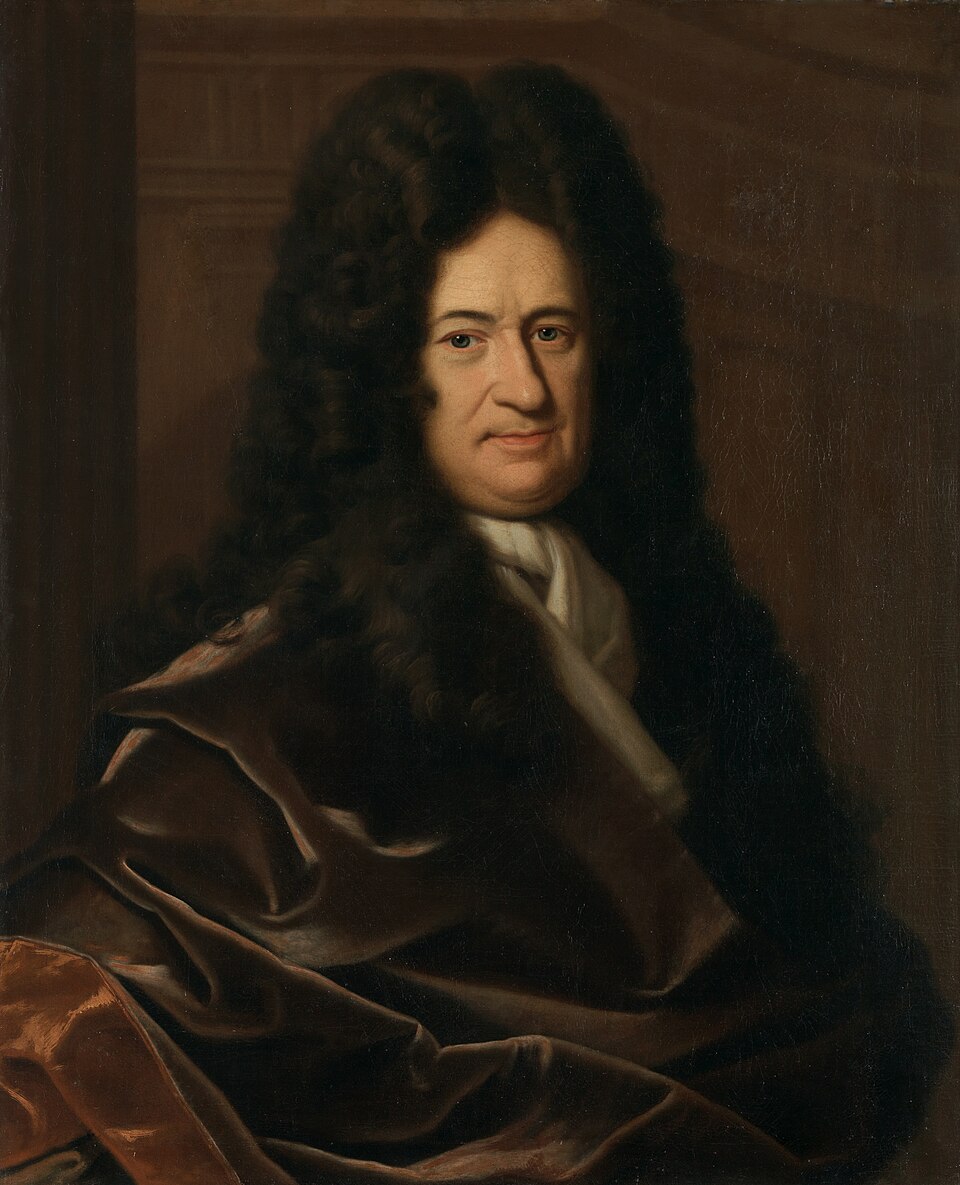
Gottfried Wilhelm Leibniz
Dates: 1646–1716 Domain: Philosophy, Mathematics, Theology, Diplomacy
Biography
Gottfried Wilhelm Leibniz was born in Leipzig in 1646, the son of a professor of moral philosophy. He was, by any measure, one of the most extraordinary minds of the seventeenth century: philosopher, mathematician (independent co-inventor of the calculus, along with Newton, and originator of the notation that we still use), logician, diplomat, physicist, historian, and theologian. He served as librarian and court philosopher to the House of Brunswick-Lüneburg (later Hanover) for most of his adult life — a position that gave him intellectual freedom and intellectual frustration in roughly equal measure. He died in Hanover in 1716, largely neglected by the court he had served, engaged in the bitter priority dispute with Newton over the calculus, and still working on the great philosophical projects he had never completed. He left no school, no disciples, no institution. His enormous manuscript archive, some fifty thousand pages, was not fully processed for over a century.
His philosophy is organized around two distinct but related visions that the project treats as the convergence point of the entire Western esoteric tradition's aspirations. The first is the characteristica universalis: the dream of a universal symbolic language in which every concept would be assigned a symbol and every argument would be expressible as a calculation. Once such a language existed, philosophical disputes could be resolved by computation: two philosophers who disagreed could sit down, take up their pencils, and calculate. The characteristica was explicitly descended from Llull's Ars Magna, which Leibniz had studied carefully; it was also connected to his development of binary arithmetic, in which all numbers are expressed as combinations of 0 and 1.
The binary arithmetic is the second and, for the contemporary moment, the more consequential element. Leibniz discovered (or rediscovered — Chinese mathematicians had long worked with binary-like systems) that all numbers could be expressed as sequences of two symbols. He then made an explicit connection to the I Ching: when the Jesuit missionary Joachim Bouvet sent Leibniz the complete sequence of I Ching hexagrams, Leibniz recognized in the sequence of broken and unbroken lines a representation of his binary notation. He wrote to Bouvet that the ancient Chinese sage Fu Xi had discovered the same mathematical truth he had independently found — evidence for the prisca theologia, the ancient wisdom that Ficino had placed at the origin of the Western tradition. The Chinese hexagram and the German binary 0-and-1 were, Leibniz believed, the same discovery.
The monadology — developed in the Monadology (1714) and the Discourse on Metaphysics (1686) — is Leibniz's answer to the Cartesian problem of the relationship between mind and matter. The world, for Leibniz, is composed entirely of monads: soul-like substances that are simple (without parts), inextended (not in space), and windowless (they have no causal connection with each other). Each monad mirrors the entire universe from its own unique point of view — it contains, in some sense, a representation of everything that is and ever will be, though most of this representation is confused (unconscious). The supreme monad is God, who perceives all things with perfect clarity; the monads of ordinary minds perceive them with various degrees of confusion. The pre-established harmony — God's arrangement of all monads so that their internal states correspond to each other without any direct causal interaction — is Leibniz's solution to the mind-body problem and simultaneously a metaphysical vision of a universe in which every part mirrors the whole.
The connection to the Hermetic tradition — and specifically to the Emerald Tablet's "as above, so below" — is structural: every monad mirrors every other monad and mirrors the whole. This is the metaphysical encoding of the principle of correspondence, derived not from Hermes Trismegistus but from the logic of Leibniz's own metaphysical system. That the same principle should emerge from a rigorous mathematical-metaphysical argument and from the ancient esoteric axiom is, significant.
Key Works (in library)
| Work | Year | Relevance |
|---|---|---|
| Monadology | 1714 | The metaphysical system: windowless monads, each mirroring the whole, arranged in pre-established harmony |
| Discourse on Metaphysics | 1686 | The foundational statement of Leibniz's philosophy |
| Theodicy | 1710 | The justification of God in the face of evil; the optimistic metaphysics |
| Correspondence with Bouvet | 1697–1702 | The I Ching-binary connection; the prisca theologia argument |
Role in the Project
Leibniz is the project's terminal figure for a specific reason: in him, the Mysteries' aspiration to a universal wisdom that can hold all truth simultaneously meets the computational dream of a universal calculus that can generate all truth mechanically — and the gap between these two visions is the gap the project is examining. The characteristica universalis is the Ars Magna realized: the system for mechanically generating all truths. But Leibniz himself was not a mechanist in the modern sense; his universe was alive with soul-like monads, each mirroring the divine. The mechanical notation was for him a vehicle for a metaphysical vision of total unity, not a replacement for it. What happens when later generations take the notation and discard the metaphysics — when binary becomes the language of digital computation without the monadological vision that gave it meaning for Leibniz — is the story the project is tracing from the other end.
Key Ideas
- Characteristica Universalis: The dream of a universal symbolic language in which all concepts can be expressed and all arguments can be calculated; the Lullian Ars Magna developed into a formal logical system.
- Binary Arithmetic: All numbers as sequences of 0 and 1; the notation that underlies all contemporary digital computation; explicitly connected by Leibniz to the I Ching's hexagram system.
- Monadology: The world composed of soul-like substances (monads), each windowless and self-contained but mirroring the entire universe from its unique perspective; the metaphysical vision that the notation was meant to serve.
- Pre-Established Harmony: God's arrangement of all monads so that their internal states correspond without direct causal interaction — the solution to the mind-body problem and the metaphysical foundation of the principle of correspondence.
- Prisca Theologia Extended: Leibniz's connection of his binary arithmetic to the I Ching as evidence for an ancient universal wisdom that preceded and transcended the divisions between cultures and traditions.
Connections
- Influenced by: FIG-0059 Llull (acknowledged; the Ars Magna as the prototype of the characteristica), Descartes (the problem he was solving), Spinoza (both agreed and disagreed with fundamentally), the Neoplatonic tradition, the I Ching (via Bouvet)
- Influenced: FIG-0058 Yuk Hui (the binary-I Ching connection is central to Yuk Hui's cosmotechnics analysis), the history of formal logic (Frege, Russell, Whitehead), digital computation (all computers run on binary)
- In tension with: Newton (the calculus priority dispute), Locke (empiricist epistemology), the purely mechanistic worldview that inherited the binary notation while discarding the metaphysics
Agent Research Notes
[AGENT: perplexity | DATE: 2026-03-22] Leibniz's dates are confirmed 1646–1716. His binary arithmetic paper "Explication de l'Arithmétique Binaire" was published in Mémoires de l'Académie Royale des Sciences (1703). His correspondence with Bouvet is in the Gottfried Wilhelm Leibniz Bibliothek in Hanover; key letters are from 1697–1703. The standard modern edition of his philosophical works is the Philosophische Schriften (ed. Gerhardt, 1875–1890). Nicholas Rescher's Leibniz: An Introduction to His Philosophy (1979) is a good modern introduction. For the I Ching connection specifically, see Franklin Perkins's Leibniz and China (2004). Yuk Hui's analysis of the Leibniz-I Ching connection is in The Question Concerning Technology in China, Chapter 2.