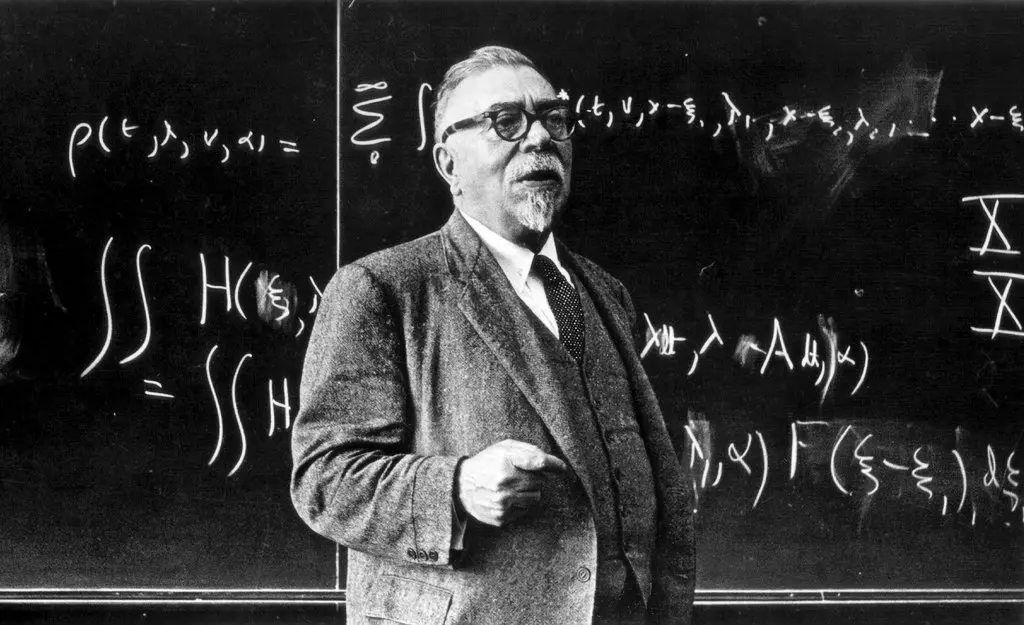
Norbert Wiener
Dates: 1894–1964 Domain: Mathematics, Cybernetics
Biography
Norbert Wiener was a child prodigy who entered Tufts University at eleven, earned his PhD from Harvard at eighteen, and spent nearly his entire career at MIT, where he became one of the twentieth century's most consequential mathematicians. His work during World War II on anti-aircraft fire control (the problem of predicting the future position of a moving target) led him to a general theory of feedback, prediction, and self-correcting systems that he named cybernetics (from the Greek kybernetes, "steersman").
Cybernetics: Or Control and Communication in the Animal and the Machine (1948) argued that the same mathematical principles govern self-regulation in mechanical systems (thermostats, servomechanisms), biological systems (the nervous system, homeostasis), and communication systems (language, signal processing). The core concept: negative feedback. A system that receives information about the effects of its own actions and adjusts accordingly is a cybernetic system. The thermostat is the simplest example. The human being reaching for a glass of water, correcting hand position based on visual feedback, is a more complex one.
The Macy Conferences on Cybernetics (1946–1953), which Wiener co-organized with Warren McCulloch, brought together mathematicians, neuroscientists, anthropologists (Bateson, Mead), psychiatrists, and engineers to build a unified science of self-regulating systems. The conferences were the institutional origin of several fields: artificial intelligence, cognitive science, information theory, and systems theory. The room where cybernetics was formalized is also the room where the intellectual conditions for AI were created.
The Human Use of Human Beings (1950) translated the cybernetic framework into social and ethical terms. Wiener saw automation coming. He warned that machines capable of learning from feedback would displace human labor, that the political question of the twentieth century would be the ownership and control of information, and that a society that treated human beings as interchangeable components of a production system had adopted, without knowing it, a cybernetic model of the human being. These warnings, largely ignored during the postwar boom, now read as precise predictions.
God and Golem, Inc. (1964), published the year of his death, addressed the theological implications of machines that learn. The title references the Golem of Prague, the animated clay figure of Jewish legend, and asks what it means for a creature to create a creature that can, in turn, create. Wiener treated this as a genuinely theological question, not a metaphor.
Key Ideas
- Cybernetics: The science of control and communication. All self-regulating systems, whether mechanical, biological, or social, operate through feedback loops. The word derives from the Greek for steersman: the helmsman who corrects course based on the relationship between heading and destination.
- Negative feedback: The mechanism by which a system compares its current state to a desired state and adjusts. The foundation of all self-regulation, from thermostats to nervous systems to economies.
- Information as fundamental: Wiener's philosophical commitment: information is neither matter nor energy but a third category, and it is the most fundamental. "Information is information, not matter or energy." This commitment is what AI inherited.
- The human use of human beings: The ethical principle that human beings must not be treated as interchangeable, predictable components of a system. The reduction of the human to the cybernetic model is a moral and political catastrophe, even as cybernetics correctly describes some dimensions of human behavior.
Role in the Project
Wiener created the intellectual framework within which AI became conceivable. Cybernetics made two moves worth tracing forward: first, it proposed that the logic of self-regulation is universal (applying equally to machines and organisms); second, it proposed that information, not substance, is the fundamental category. Both moves have ancient antecedents. The Stoic concept of pneuma as a universal medium of cosmic sympathy, the Hermetic principle of correspondence. Wiener was not a mystic. But the system he built is downstream of questions the Hermeticists were asking.
His ethical writings are equally important. Wiener saw that the cybernetic reduction, treating all systems as feedback systems, would, if applied to human beings without restraint, produce the Gestell (CON-0038): a world in which everything, including human attention and human relationship, is rendered as standing reserve for optimization. He warned against the outcome his own system enabled.
Primary Sources
- Norbert Wiener, Cybernetics (1948): The foundational text.
- Norbert Wiener, The Human Use of Human Beings (1950): The social and ethical translation.
- Norbert Wiener, God and Golem, Inc. (1964): The theological questions machines raise.