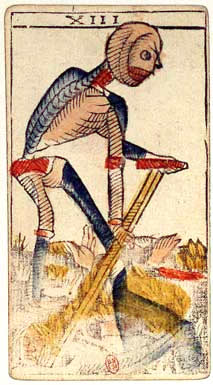
Arcanum XIII — (unnamed) (Death)
Definition
The thirteenth Arcanum bears no name. In the Tarot de Marseille (CON-0098) tradition, card-makers left it untitled — a silence that says more than any label could. The image speaks plainly enough: a skeleton wields a scythe in a field strewn with severed heads, hands, and feet, while green shoots push up through the soil. Death and new growth occupy the same frame because they are the same event seen from two directions.
As a philosophical-spiritual concept, the unnamed Arcanum addresses the principle of transformation through dissolution. Not physical death, though the image does not flinch from that either, but the death that precedes every genuine change in consciousness — the initiatory death (CON-0001) that every mystery tradition places at the center of its practice. The Eleusinian mystai died to their ordinary identity before they could receive the vision. The alchemists called it nigredo, putrefactio, the blackening that precedes all color. Tomberg (LIB-0084) and Mebes (LIB-0053) both treat this Arcanum as the hinge on which the entire sequence turns: without the death that XIII enacts, the higher Arcana remain inaccessible.
The card's namelessness is itself instructive. What it depicts cannot be captured by a concept because it is the undoing of conceptual frameworks. To name it would domesticate it. The tradition chose silence.
Tomberg's Reading (Letter XIII)
Tomberg's Letter XIII — written with the same meditative deliberation as all his Letters, but darker here, more willing to sit with discomfort, a man thinking his way through an image that resists consolation — treats the unnamed Arcanum as the gateway to understanding transformation at every level. Biological, psychological, spiritual. His central argument: genuine transformation is not modification but death-and-rebirth. A caterpillar does not improve into a butterfly. The caterpillar dissolves. What emerges from the chrysalis shares genetic material with what entered, but the form, the mode of being, the relationship to the world are discontinuous. Tomberg insists the same discontinuity operates in spiritual development.
The skeleton's scythe harvests what has ripened. Tomberg reads this with care: the scythe does not destroy arbitrarily. It cuts what has completed its growth cycle. The severed heads and limbs are not victims of violence but organs of a former life that has run its course. The fermentation pattern (CON-0087) operates here — living material must break down before it can reconstitute at a higher level. Grain crushed into bread. Grapes pressed into wine. Consciousness follows the same law.
Tomberg develops the initiatory dimension explicitly. The death depicted here is the death the mystes undergoes in the mystery temple — ego-dissolution, terrifying and liberating in equal measure. He links this to Christ's descent into hell between crucifixion and resurrection: katabasis (CON-0002) enacted at the cosmic scale. The unnamed Arcanum marks the threshold between ordinary experience and the world that opens only after the old self has been laid down.
Mebes' Reading (Arcanum XIII)
Mebes assigns Arcanum XIII to transformation, death-and-rebirth, and the dissolution that precedes new form. His treatment in the Course (LIB-0053) is characteristically schematic — no atmosphere, no pathos, just the principle stated and its correspondences catalogued with the clinical precision of an anatomist labeling bones. Every transition between levels of being requires the destruction of the form appropriate to the lower level. A seed must cease to be a seed before it becomes a plant. A student must cease to identify with received opinions before original thought becomes possible.
Within his ternary structure, Arcanum XIII occupies the position of transition — the passage from one complete triad to the next. Death of one order so that another may begin. The principle operates impersonally, like natural law. The scythe does not choose. It harvests what is ready. The practitioner's task: not resistance but cooperation — offering up what has completed its usefulness rather than clinging to forms that have become husks.
Symbolic Elements
The Marseille card depicts a skeleton — stripped of flesh, identity, individual characteristics — striding across a dark field. The scythe curves through the space with an arc suggesting ongoing motion, not a single strike. Scattered across the ground: severed heads (one crowned), hands, feet. Among the remnants, green grass and small flowers push upward. That juxtaposition is the card's entire argument. Decomposition feeds growth.
The skeleton's lack of identity matters. Death is not a person, not an agent with intentions. A process — impersonal, impartial, and (the green shoots insist) generative. The crowned head among the severed remains signals that no station exempts anyone. King and commoner alike feed the soil.
Tomberg reads the new growth as the card's hidden message: what looks like pure destruction from one vantage point is preparation for life from another. Mebes emphasizes the skeletal figure as the reduction to structure — what remains when all that is contingent, temporary, and personal has been stripped away. The bones are the essential framework, the forma that persists through transformation.
Project Role
The unnamed Arcanum sits at the center of the project's argument about what the mystery traditions actually claimed to do. Not improvement. Transformation. And transformation, as every tradition insists, passes through death. The mystai at Eleusis enacted a symbolic death before receiving the vision (CON-0003). The alchemists described nigredo as the indispensable first stage. The Christian mystics spoke of the dark night of the soul.
The project takes this claim seriously without claiming to verify it from the outside. If the traditions are right that consciousness can undergo a genuine death-and-rebirth — not metaphorically but as a restructuring as radical as the caterpillar's dissolution — then the modern reduction of these practices to "self-help" or "personal growth" misses the point entirely. Growth modifies what exists. Death-and-rebirth replaces it. The unnamed card marks the threshold between these two understandings, and the project stands at that threshold, pointing in both directions.
Primary Sources
- Tomberg, Meditations on the Tarot, Letter XIII (LIB-0084)
- Mebes, The Course of the Encyclopaedia of Occultism, Arcanum XIII (LIB-0053)
Agent Research Notes
[AGENT: cursor | DATE: 2026-03-25] Scaffolded as part of Tarot Major Arcana KB expansion. Body population pending via prompt relay to Claude Code.