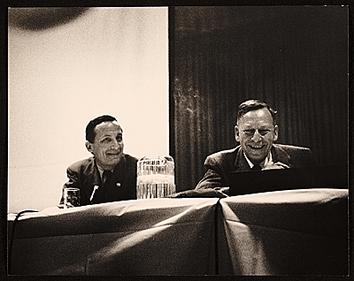
Gregory Bateson
Dates: 1904–1980 Domain: Anthropology, Cybernetics, Systems Theory
Biography
Gregory Bateson was born in 1904 in Grantchester, England, the son of the geneticist William Bateson (who coined the word "genetics"). He trained in anthropology at Cambridge, conducted fieldwork in New Guinea and Bali (the latter with Margaret Mead, his second wife), and then underwent a conversion of intellectual framework during World War II that would define his subsequent career: he encountered cybernetics.
The Macy Conferences on Cybernetics (1946–1953) were the crucible. Bateson sat in the same room as Norbert Wiener, John von Neumann, Warren McCulloch, Margaret Mead, and Lawrence Kubie. The conferences attempted to build a unified science of feedback, self-regulation, and information. Bateson absorbed the core insight, that circular causality (A affects B affects A) is fundamentally different from linear causality (A causes B), and spent the next thirty years applying it to domains the engineers never intended: schizophrenia, alcoholism, learning, ecology, aesthetics, and the sacred.
His most consequential intellectual move was the theory of logical types applied to communication. Working at the Veterans Administration Hospital in Palo Alto in the 1950s, Bateson and his team developed the "double bind" hypothesis of schizophrenia: the claim that certain pathological communication patterns, in which a person receives contradictory messages at different logical levels with no possibility of metacommentary, can produce psychotic symptoms. The hypothesis has been contested as an etiology of schizophrenia, but its significance lies elsewhere. Bateson demonstrated that confusion about logical levels, about the relationship between a message and a message about the message, is a constitutive feature of human communication, not an aberration.
Steps to an Ecology of Mind (1972), a collection of essays spanning three decades, is the key text. It contains the double-bind theory, the schismogenesis analysis from Naven, the cybernetic epistemology, and the late essays on ecology and aesthetics that constitute Bateson's mature position: that mind is immanent in the total system of organism-plus-environment, that the unit of survival is not the organism but the organism-in-its-environment, and that the ecological crisis is a crisis of epistemology, a consequence of thinking in terms of isolated entities rather than relational patterns.
His final years at Esalen Institute and the University of California, Santa Cruz, produced Mind and Nature (1979) and the posthumous Angels Fear (completed by his daughter Mary Catherine Bateson), which explicitly approached the question of the sacred from within a cybernetic framework: what would a science look like that did not murder the thing it studied?
Key Ideas
- The pattern which connects: Bateson's late formulation. A meta-pattern connects the crab to the lobster, the orchid to the primrose, the human being to the horse, and all four to the person studying them. Not a shared substance but a shared formal organization. The cybernetic restatement of the Hermetic "as above, so below."
- Double bind: A communication structure in which contradictory injunctions are delivered at different logical levels, with no possibility of escape or metacommentary. Applied to schizophrenia, but applicable to any system in which messages about messages are suppressed.
- Schismogenesis: The process by which interacting groups progressively differentiate in either complementary (dominant/submissive) or symmetrical (competitive escalation) patterns. From Naven, his study of Iatmul ceremonial life.
- Ecology of mind: Mind is not a thing in the head. It is the larger circuit, the total feedback system of organism, environment, and the information that flows between them. Cutting the circuit at the skin is an epistemological error with ecological consequences.
- Epistemological error: The Western habit of thinking in terms of isolated substances rather than relational patterns. Bateson held that this error, not greed or technology or capitalism per se, is the root of the ecological crisis.
Role in the Project
Bateson occupies a specific position in the AI Esoteric Genealogy track: he is the thinker who brought the cybernetic worldview into contact with the living world and discovered, in the process, that the cybernetic vocabulary describes something the esoteric traditions had been describing all along. His "pattern which connects" is Plotinus's sympatheia in scientific language. His "ecology of mind" is Barfield's participation articulated through feedback-loop theory. His question about the sacred ("what would a science look like that did not murder the thing it studied?") is the question theurgy answers: a science that includes the observer in the act of knowing.
The Macy Conferences, where Bateson first encountered cybernetics, are also the institutional ancestor of AI. The line from Wiener's feedback theory through McCulloch's neural networks to contemporary machine learning runs directly through the room Bateson sat in. His subsequent career can be read as a sustained attempt to prevent the cybernetic insight from being reduced to the mechanical: to show that feedback, self-organization, and information are properties of living systems, not of machines that simulate them.
Primary Sources
- Gregory Bateson, Steps to an Ecology of Mind (1972): The essential collection. Contains the double-bind theory, the cybernetic epistemology, the ecology essays.
- Gregory Bateson, Mind and Nature: A Necessary Unity (1979): The mature synthesis. The pattern which connects, the ecology of mind as formal proposition.
- Gregory Bateson and Mary Catherine Bateson, Angels Fear: Towards an Epistemology of the Sacred (1987): The posthumous work on science, aesthetics, and the sacred.